Aegopodium podagraria

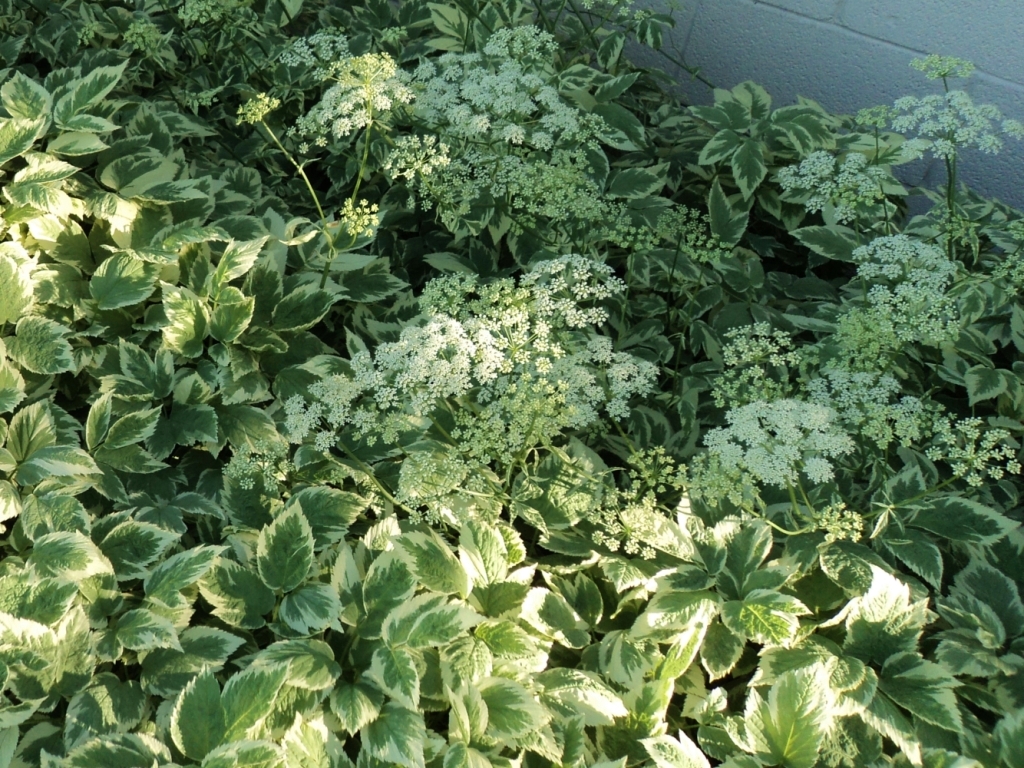
Variegated Bishop’s Goutwort – Aegopodium podagraria ‘variegata’. Penticton, B.C., June 2014. Image: HFN

Perennial. Zone 1. Apiaceae, formerly Umbelliferae.  Europe, Northeast Asia. Aka HANSEL-AND-GRETEL, JACK-JUMP-ABOUT, BISHOPSWEED, SNOW-ON-THE-MOUNTAIN, GROUND ELDER. 12 to 16  inches tall; spread infinite. Any soil, average moisture, sun to shade.

Aegopodium is derived from the Greek aix or aigos (a goat) and pous or podos (a foot), from the fancied resemblance in the shape of the leaves to a goat’s foot. Podagraria comes from the Latin word for gout, podagra, because this plant was highly valued as a treatment for that ailment in medieval times.

Goutwort is an attractively variegated pale green and ivory foliage plant, though it does produce umbels of tiny, creamy white flowers in summer.  It is an insidiously invasive but very valuable groundcover for difficult sites. A solid edging or path will generally contain it.

Avoid planting in a mixed border, as it will gobble up less rambunctious neighbours. I have had success growing it with other hold-your-own plants, namely with Lily-of-the-Valley (Convallaria majalis), Ribbon Grass (Phalaris arundinaceae ‘picta’), and Joe-Pye Weed (Eupatorium purpureum), but I do believe it is generally best alone, in a place where it can flourish to its (and the gardener’s) heart’s delight.
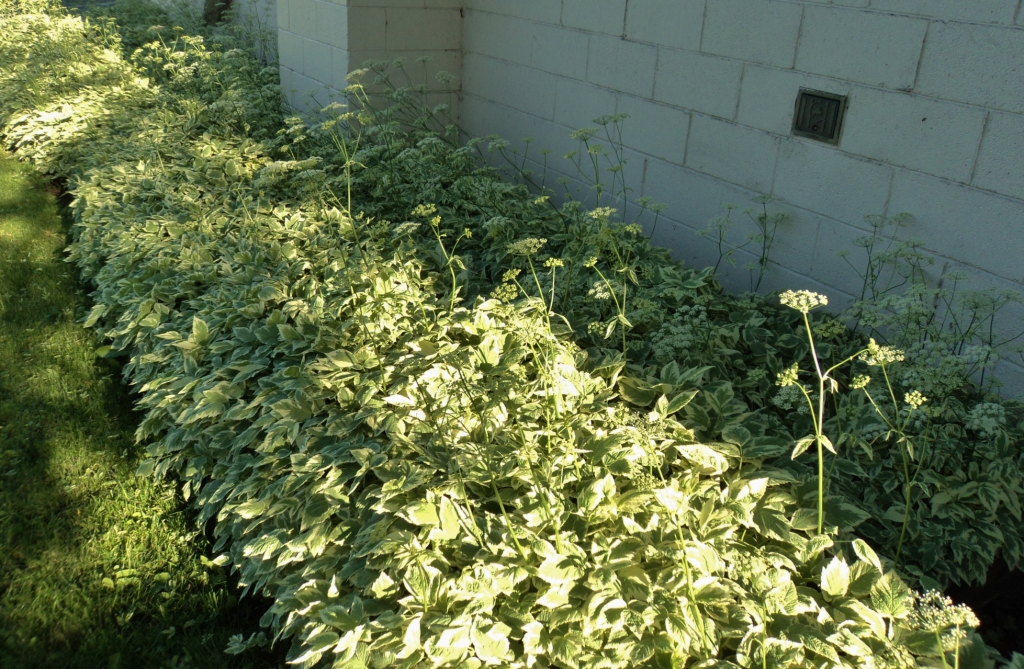
An excellent example of perfect placement of this exceediningly successful groundcover. Aegopodium podagraria grown in a shady border between a structure and a mown lawn in Penticton, B.C.  June 2014

An excellent example of perfect placement of this exceediningly successful groundcover. Aegopodium podagraria grown in a shady border between a structure and a mown lawn in Penticton, B.C., June 2014. Image: HFN

Bishop’s Goutwort is an old-time, pre-Medieval garden plant, once used in medicine and cookery. From Maude Grieve’s 1930 Modern Herbal:

 It has a creeping root-stock and by this means it spreads rapidly and soon establishes itself, smothering all vegetation less rampant than its own. It is a common pest of orchards, shrubberies and ill-kept gardens, and is found on the outskirts of almost every village or town, being indeed rarely absent from a building of some description. It is possible that Buckwheat might drive it out if planted where Goutweed has gained a hold.

It was called Bishopsweed and Bishopswort, because so frequently found near old ecclesiastical ruins. It is said to have been introduced by the monks of the Middle Ages, who cultivated it as a herb of healing. It was called Herb Gerard, because it was dedicated to St. Gerard, who was formerly invoked to cure the gout, against which the herb was chiefly employed.

The white root-stock is pungent and aromatic, but the flavour of the leaves is strong and disagreeable. (However) Linnaeus recommends the young leaves boiled and eaten as a green vegetable, as in Sweden and Switzerland, and it used also to be eaten as a spring salad.

A poultice made from the boiled leaves and roots was used with reportedly good effect as a treatment for all sorts of joint pains.
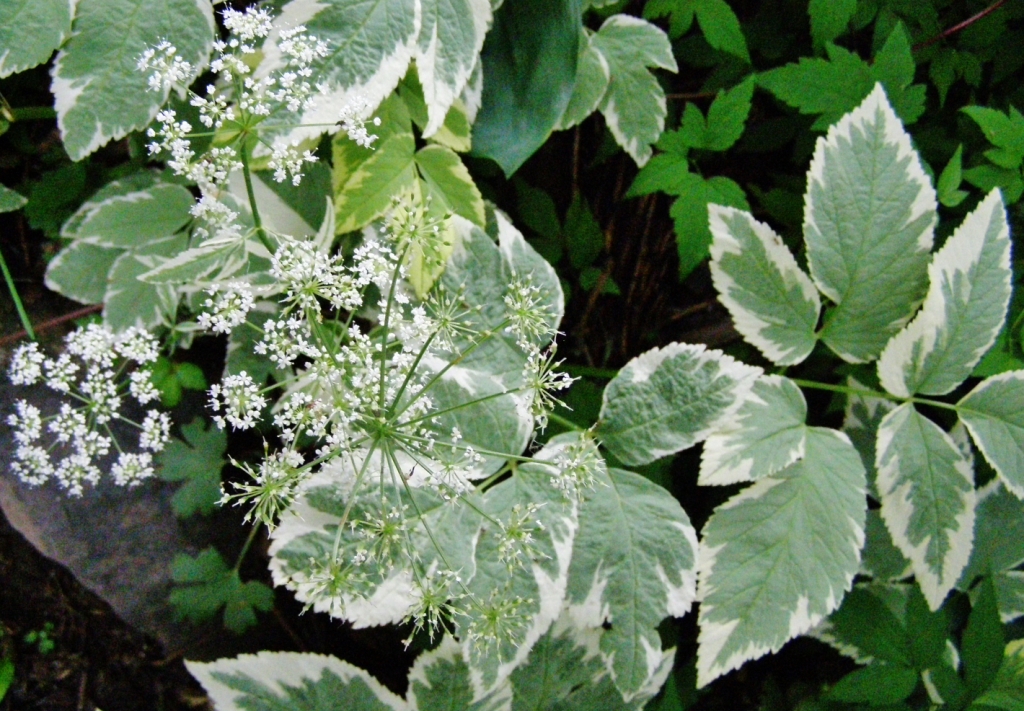
Aegopodium podagraria 'variegata'- Hill Farm, July 2011.

Aegopodium podagraria ‘variegata’– Hill Farm, July 2011. Image: HFN

Nowadays this plant is grown strictly as an ornamental, and it is a very good plant for difficult sites, as long as its land-grabbing habits are taken into consideration. Propagation of the variegated form is by division; it seldom sets viable seed. There original species is solid green, even more vigorous than its creamy-leaved sport, and a profuse self-seeder. Luckily it is not at all common in our country – the variegated version is sufficiently successful in our gardens.

Bishop’s Goutwort is frequently seen in old gardens and around abandoned homesteads. A particularly nice Cariboo planting is behind the Theatre Royal in the restored 1860s’ Gold Rush town of Barkerville, B.C., where it thrives in a lush colony hemmed in by Mountain Bluet (Centaurea montana) and Lady’s Mantle (Alchemilla species), both vigorous survivor-type plants in their own right.
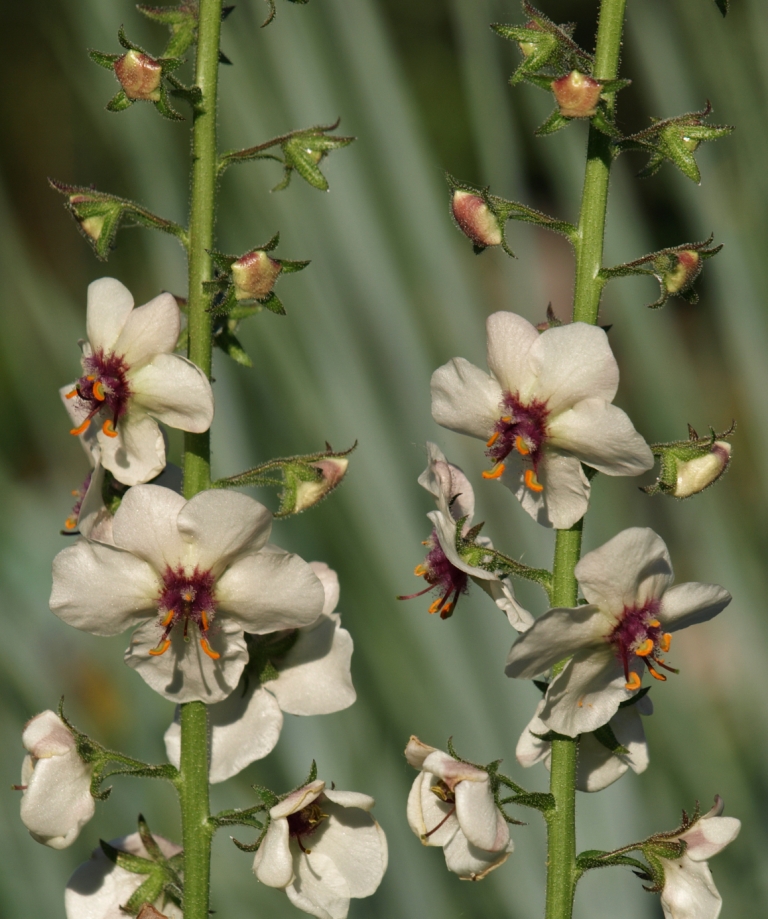
White Moth Mullein - Verbascum blattaria albiflorum. Hill Farm, July 14, 2014.

White Moth Mullein – Verbascum blattaria albiflorum. Hill Farm, July 14, 2014. Image: HFN

Biennial. Zone 3. Scrophulariaceae. Europe, northern Africa. Verbascum is from the Latin barbascum, bearded. Blattaria comes from the Latin blatta, cockroach, in homage to the plant’s history as an insect repellant. Thrives in full sun to part shade. Happy in a wide variety of soils. Quite drought tolerant.

A dainty and lovely biennial.

In its first year, smooth, deep green leaf rosettes form and lie close to the ground, giving no hint of next year’s tall and graceful flower stalks.

The rosettes overwinter and start to show signs of further development in the spring of the second year, when slender, multi-branched stems emerge and elongate, reaching an ultimate height of 4 feet or so for the white form, and up to 6 feet for the yellow. Though tall, Moth Mullein’s general effect is airy enough for the front of the border.

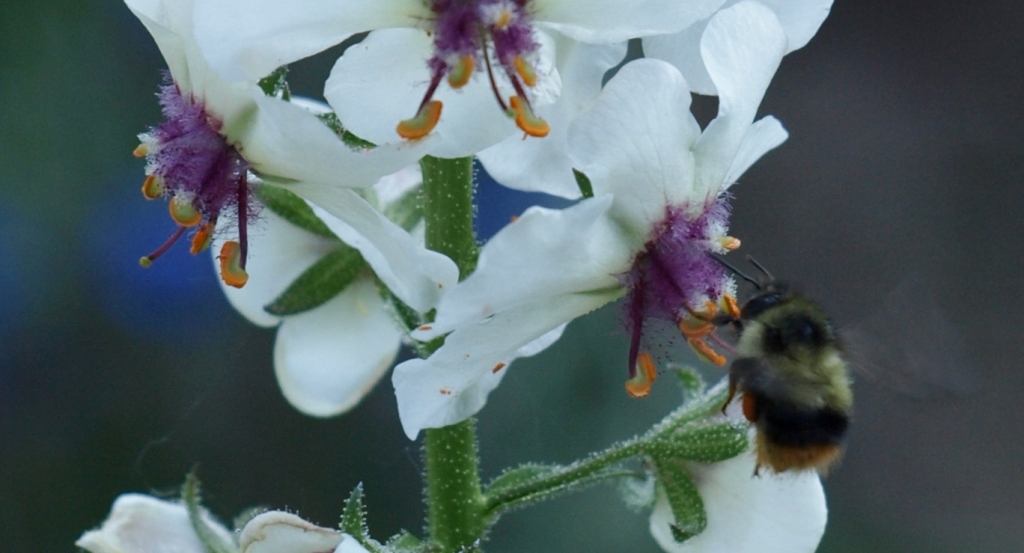
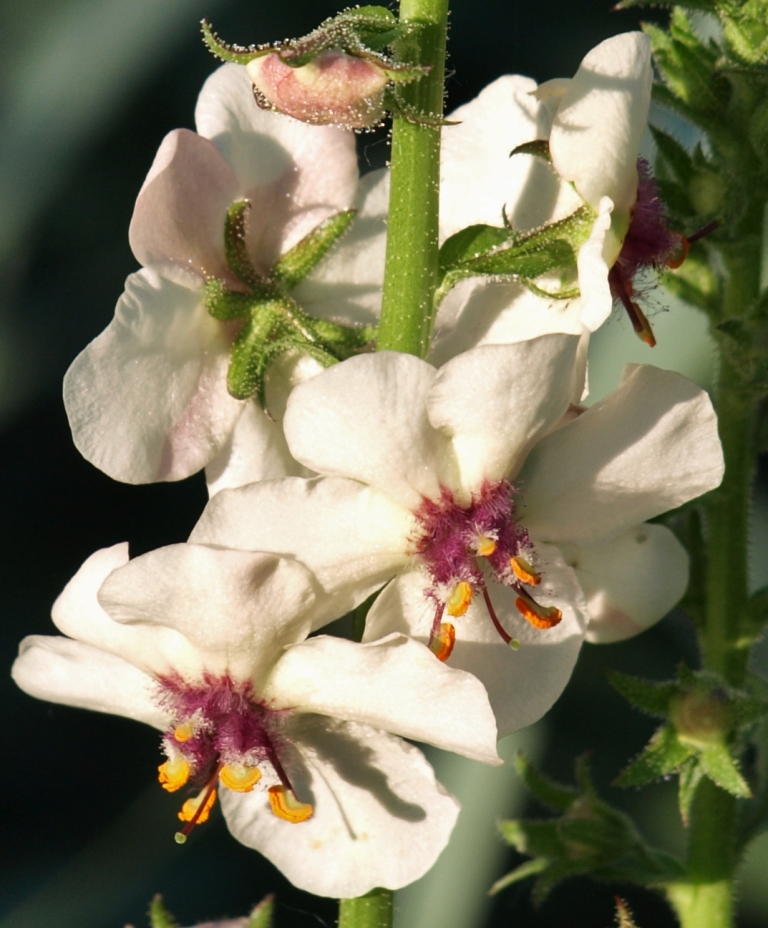
Neatly folded, angular buds on short pedicels pop open into large, gleaming white flowers blushed on the petal backs with purple, echoing the bright purple, intricately furred stamens tipped with brilliant orange pollen. Blooms unfold in late June or early July, and continue through summer, ending at last in September.

Bloom detail, Verbascum blattaria albiflorum. Hill Farm, July 2014.

Bloom detail, Verbascum blattaria albiflorum. Hill Farm, July 2014. Image: HFN

The common name of Moth Mullein is thought to come from the resemblance of the stamens to the intricately haired antennae of moths. The flowers are also attractive to all sorts of insects, including nocturnal moths and early-foraging bees. Blooms unfold in earliest morning, and subside by noon, to reopen the following day.

An early-foraging bee visits Moth Mullein just before sunrise. Hill Farm, July 14, 2014. (All of the Verbascum family are veritable bee magnets.)

An early-foraging wild bee visits Moth Mullein just before sunrise. Hill Farm, July 14, 2014. (All of the Verbascum family are veritable bee magnets.) Image: HFN

Neatly dropped flowers are followed by hard, round seed pods, each containing hundreds of small, black seeds. Seeds of this species remain viable in soil for a long time; in one well-documented experiment  initiated by Michigan State University Professor William James Beal in 1879, Moth Mullein seeds sprouted over 120 years after their storage outdoors in an upside-down bottle buried in dry sand.

Arriving with early European colonists, Moth Mullein has been known to grow in North America since at least the early 1800s. It has become naturalized to various degrees across the United States and into southern Canada, being particularly successful at establishing itself on freshly disturbed ground.

Moth Mullein was traditionally used to safeguard fabrics against moths and other insects; American colonial gardens grew Moth Mullein for this purpose and also for use as a dye plant. With appropriate mordants Moth Mullein yields green and yellow dyes.

Verbascum blattaria has been investigated for various medicinal properties, and in 1974 was the subject of a study on its insecticidal properties, showing some intriguing possibilities as its application killed over half of the mosquito larvae in the study.


Yellowtuft Alyssum - Alyssum murale - Agriculture Canada Research Station, Summerland, B.C., June 7, 2014.

Yellowtuft Alyssum – Alyssum murale – Agriculture Canada Research Station, Summerland, B.C., June 7, 2014. Image: HFN

Perennial. Zone 5, and probably colder. Brassicacea. Syn. Alyssum argenteum, A. chalcidicum. A.k.a. Rock Alyssum, Wall Alyssum. Native to the Mediterranean and Eurasia, where it is locally abundant on mineral-rich serpentine soils.  Introduced populations found in British Columbia, Washington, Oregon and California, where the plant has escaped cultivation from its experimental use as a heavy metal hyperaccumulator species being tested for use in mine reclamation.

On a recent trip to the Okanagan we stopped to explore the Summerland Ornamental Gardens located at the Agriculture Canada Research Station in Summerland, just outside of Penticton.

Established almost a century ago, in 1916, the gardens served as a testing ground for the local suitability of ornamental trees, shrubs and herbaceous plants. When the ornamental horticulture programs of the Station were phased out in the 1980s, the gardens seriously deteriorated through lack of maintenance. Luckily a community organization was formed to rescue the gardens from complete dissolution, and the result of thousands of hours of mostly volunteer labour is visible in the well maintained and updated plantings, in particular an ambitious and beautifully landscaped hillside xeriscape garden.

Lovely as the cultivated area of the Gardens are, though, we found some of the most interesting areas to be those on the outskirts of the manmade plantings, where the wild and the tame meet, with rather telling results. Domestic roses, clumps of iris, peonies and other old garden stalwarts flourish unpruned and gloriously untidy amidst the native grasses, and the steep sides of the Trout Creek ravine are starred with fragrant dianthus flowers obviously self-seeded from cultivars grown in the garden above.

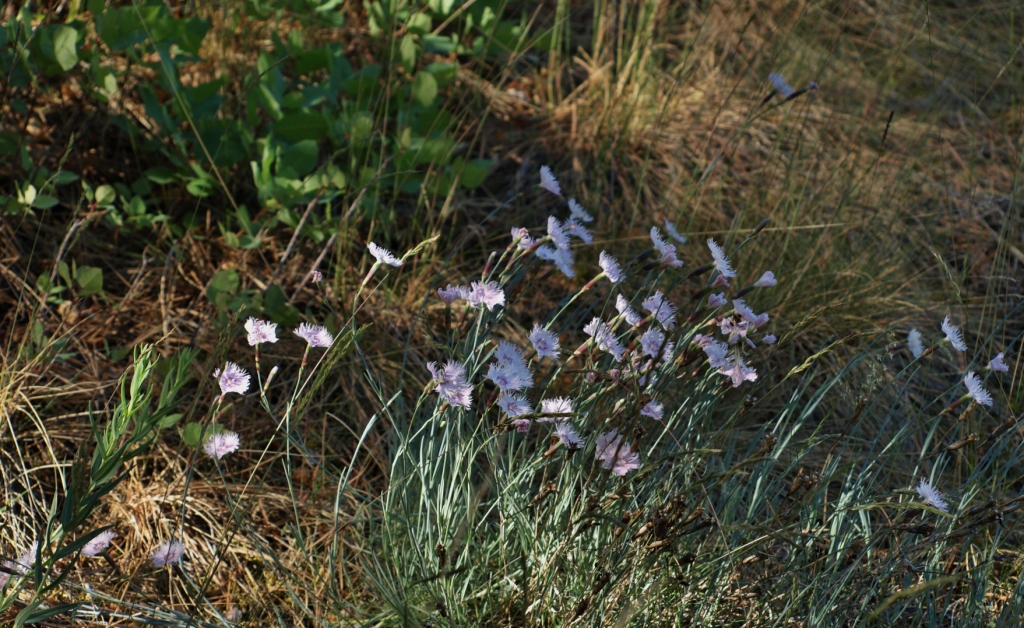
Naturalized dianthus sp., just under the Kettle Valley Railway trestle over the Trout Creek ravine, Summerland Ornamental Gardens. We were visiting early in he morning, and the sun was just warming the ground, and the spicy fragrance of the dianthus flowers was astonishing in its clarity and reach.

Naturalized Dianthus species, just under the Kettle Valley Railway trestle over the Trout Creek ravine, Summerland Ornamental Gardens. We were visiting early in the morning, and the sun was just reaching the hillside, and the spicy fragrance of the dianthus flowers was astonishing in its clarity and reach. Image: HFN

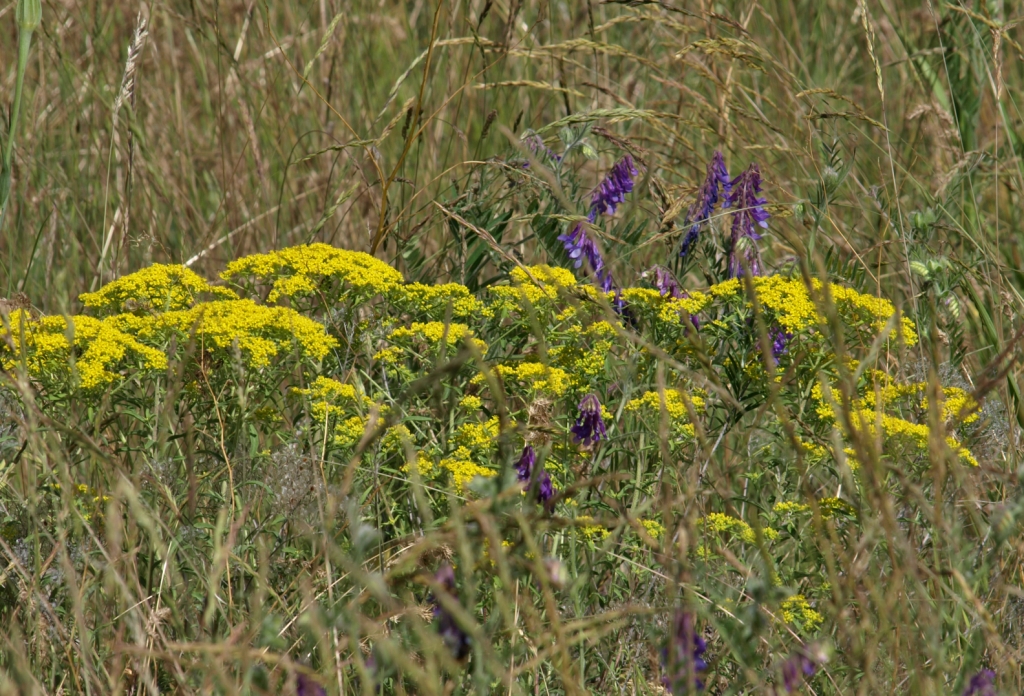
And there was this unusual plant, which I didn’t recognize, at first thinking it might be some sort of Galium (Bedstraw) species, but on closer examination realizing that it did not fit into that family after all, for though the flowers were small and four-petalled and the leaf arrangement generally whorled, the bloomhead was more of an umbel than a spike, and the aged seedpods were round and silver. What could it be?

The mystery plant, showing cloudy yellow blooms, silver seedpods and a sturdy, tufting habit. Obviously a survivor, as it was happily growing among grasses and on the steep and eroding hillside. Wildflower, or another garden escapee?

The mystery plant, early morning under the shade of the Ponderosa pines at Summerland, B.C., June 8, 2014, showing cloudy yellow blooms, silver seedpods and a sturdy, tufting habit. Obviously a survivor, as it was happily growing among grasses and on the steep and eroding hillside. Wildflower, or another garden escapee? Image: HFN

One of the first things I did upon my return home was to search out the plant in my wildflower books. This was unsuccessful, so I turned to the internet, where I soon made a positive identification. The mystery plant is an exotic escapee, and a rather worrisome one at that, being classified as a noxious weed in several U.S. states due to its rapid spread in biologically sensitive ecosystems and its potential toxicity to livestock.

Alyssum murale, Yellowtuft Alyssum, is a native of Mediterranean regions, through central and southeastern Europe, being particularly common in Romania and Albania. It has been grown as an ornamental in North America for at least a century, being a prized rockery plant grown for its attractive habit and long bloom period.

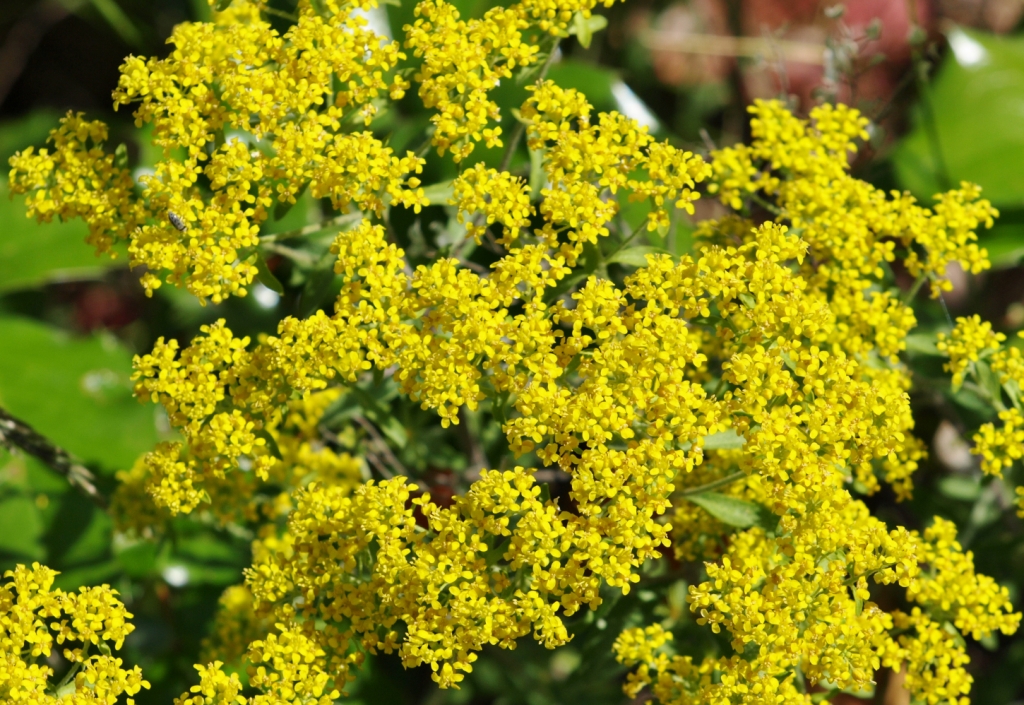
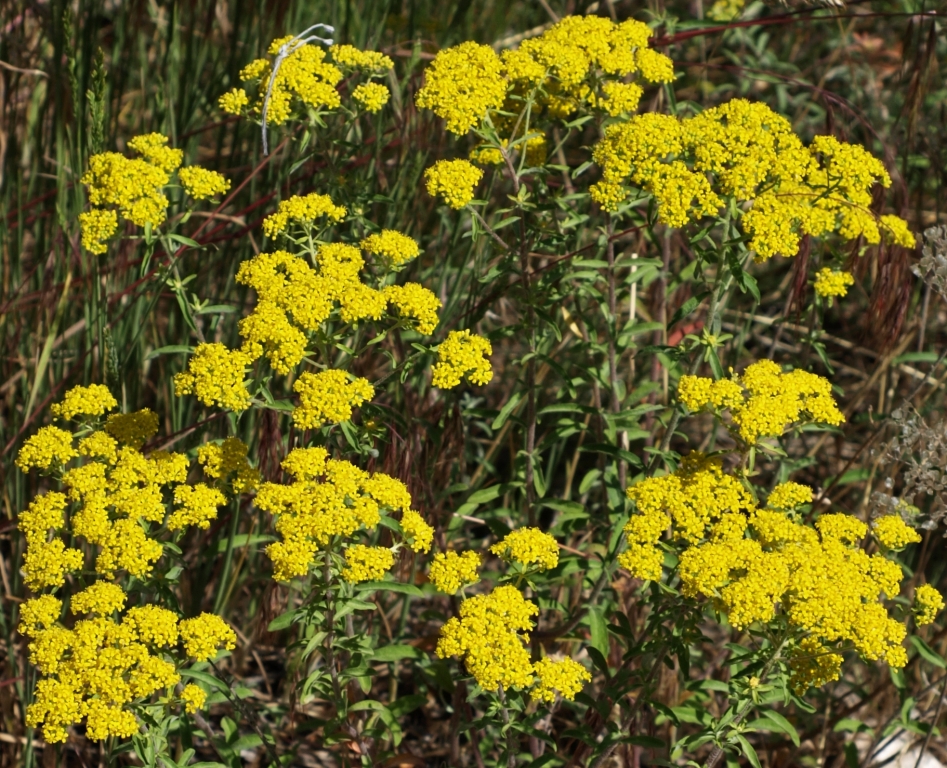
Alyssum murale showing clump-forming habit and umbel arrangement of the flowers. Summerland, June 7, 2014.

Alyssum murale showing clump-forming habit and umbel arrangement of the flowers. Summerland, June 7, 2014. Image: HFN

The plant is clump-forming, with multiple stems reaching from one to three feet tall. (The Summerland plants were about a foot tall; the three-foot height might be attained under cultivation with supplementary water and fertilization.) Yellow flowers in generous umbels appear in late May, and bloom for several months. Stems are covered by fine white hairs, and show a variable red coloration on the older portions. Seeds are produced in clusters of round or oval flattened fruits, with an ornamental, silver-grey, papery silicle persisting after the outer sheaths and the large, flat black seed is dropped.

Undoubted visual appeal aside, Alyssum murale has some other qualities which make it both potentially valuable as a commercial crop and dangerous as an invasive.

The species is unique in that it has an extremely high tolerance to heavy metals in the soil, in particular copper, chromium and nickel, and it actually functions as a hyperaccumlator of these metals, uptaking them during the growth period and concentrating them in intense quantities in its stems, shoots and foliage.

In certain parts of Europe the plant is deliberately cultivated in a process referred to as phytomining, where the plants are cultivated on mineral-rich soils, and then harvested and burned, with the ashes being further refined to yield the desirable metals. Within the last decade, the plant has received serious study in North America as a potentially useful species for mine reclamation work, being planted on tailings areas to take up excess potentially toxic heavy metals; the plants are then removed and burned, yielding a small but significant amount of usable metals. The process is repeated until the site shows a marked reduction in the minerals-of-concern.

This unique adaptation of Alyssum murale becomes a drawback when the plant is consumed by wildlife or livestock, as it then becomes a highly toxic meal.

Alyssum murale is a generous seed producer and is highly drought tolerant and very adaptable to native soils, and has escaped from cultivation in areas where it is or was being tested and used in the mining industry, to become a vigorous invasive weed in some sensitive ecosystems in the western U.S. states.

I wonder where the Summerland Alyssum murale population originated? Is it an escapee from the research station, or from the ornamental plantings of the garden?

It is a rather pretty thing, and I can definitely see its appeal as a garden flower. It has apparently been grown as a desirable and problem-free ornamental throughout North America, Europe and Great Britain since its first collection and distribution by botanists in the late 1700s, but its new reputation as an invasive escapee from industrial applications does give serious pause when contemplating acquiring it for one’s own garden…


Alyssum murale naturalized among native grasses and cow vetch (Vicia cracca), fringes of the Summerland Ornamental Gardens, June 7, 2014.

Alyssum murale naturalized among native grasses and cow vetch (Vicia cracca), growing on the fringes of the Summerland Ornamental Gardens, June 7, 2014. Image: HFN


Corallorhiza striata - Striped Coral-Root. Near Tyee Lake, B.C., June 12, 2014.

Corallorhiza striata – Striped Coral-Root. Near Tyee Lake, B.C., June 12, 2014.

Perennial. Zone 1/2. Orchidaceae. From the southern Peace River district and through B.C. and the Pacific Northwest into California. Found in most Canadian provinces and in many American states, and into Mexico and Central America.

This unusual and rather rare orchid is occasionally found in the moist forests of the Cariboo-Chilcotin, most often in conjunction with rotting wood, as it is a saprophyte, a plant which feeds entirely off of decaying organic matter in the soil. As it has no need of chlorophyll, the leaves are merely small bracts on the stem, and there is no green coloration to any part of the plant.

I was very pleased to come upon this thriving clump yesterday, on the edge of a wet meadow next to a fallen poplar tree. It may be found in bloom from May into mid-summer, and is often an unexpected find, having no foliage clump to mark its presence in the times before and after blooming, though the dried flower stems will give the sharp-eyed botanist a clue.

The bloom stems arise from rhizomes – elongated underground stems – and vary from a single spike to a generous grouping. Stems are pale brownish-purple, and typical hooded orchid flowers are vividly striped with darker purple over a whitish background.

Up to 20 intricate flowers are produced on each 12-inch (or taller) stem, and are pollinated by a variety of insects, including mosquitoes and tiny parasitic wasps. There is no detectable (to a human) fragrance. Seed capsules form after pollination, and mature many tiny seeds which are dispersed by wind or by disturbance of the dried flower spike.

Lewis J. Clark, Wild Flowers of British Columbia, 1973:

Like most members of the Orchid family, the Coral-roots are becoming increasingly rare as cultivation progressively destroys their habitats. The plant-lover should not attempt to transplant Corallorhiza species to the garden, because the odd, clubbed rhizomes are associated, for their work of extracting nourishment from decayed organic materials, with a complex group of fungi found only in natural sites.

A plea, then, to enjoy in the wild, and to leave undisturbed in the hope that this unusual flower may continue to thrive as part of an intricately balanced natural forest community.

Corallorhiza striata - June 12, 2014

Corallorhiza striata – June 12, 2014


Petasites sagittatus (syn. frigidus var. sagittatus) - Arrow-Leaf Coltsfoot, in roadside swamp, Gibraltar Mine Road, McLeese Lake, B.C. - June 9, 2014.

Petasites sagittatus (syn. P. frigidus var. sagittatus) – Arrow-Leaved Coltsfoot, in roadside swamp, Gibraltar Mine Road, McLeese Lake, B.C. – June 9, 2014. In full seedhead development, which is the plant’s most conspicuous stage. The pure white “fluffs”, on foot-high (or taller) stems, are extremely eye-catching. These quickly disperse, leaving only the broad leaves as evidence of the plant’s presence. Image: HFN

Perennial. Zone 2. Asteraceae. (Syn. Compositae.) Widespread through Northern North America, Alaska to Labrador. Found in wet seepages, swampy lake margins, and boggy meadows.

“I’ve seen a plant that I think you should look at,” reported Edwin the other day. “It’s got pure white flowers on tall stems, and it’s growing in the swamp on the Gibraltar Mine hill, just where the great blue heron hangs out.”

Well, that was like catnip to a cat, and off we went, camera at the ready. “What could it be?” I pondered, with dreams of finding something exotic. But as soon as we got close, the identification was immediate. It was the rather spectacular seed stage of yet another Coltsfoot.

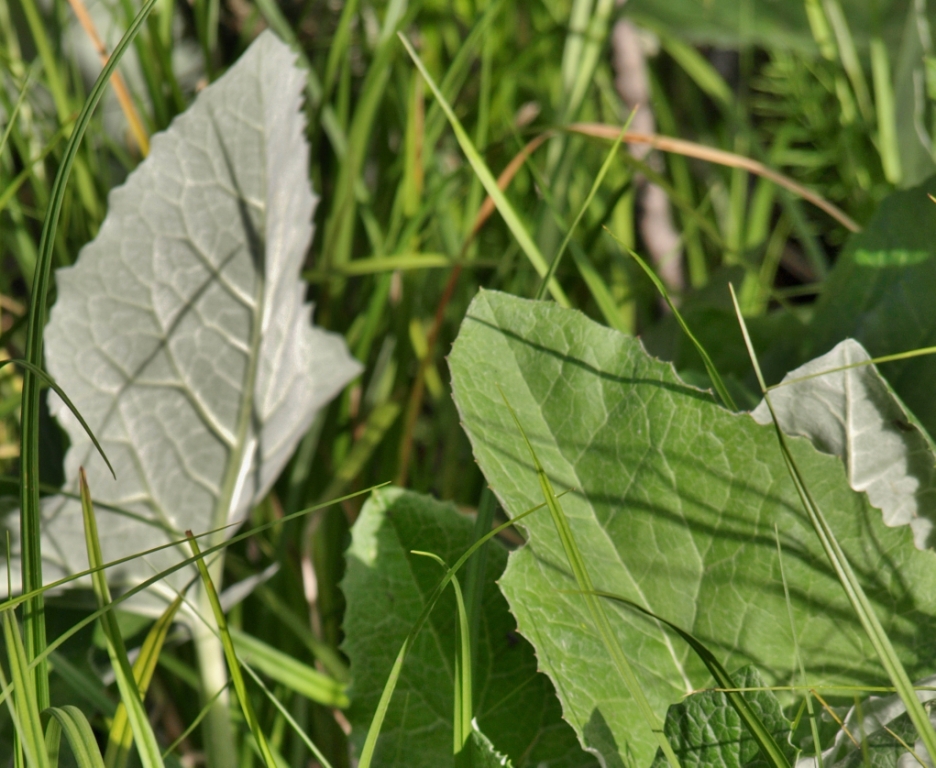
This is decidedly the most noticeable Coltsfoot – Petasites –  in the Cariboo-Chilcotin, with its large (up to a foot long) arrowhead shaped leaves, green on the surface, and felted white underneath.

Leaves are large, thickly textured, and entire, with sharply toothed margins. The leaf surfaces are quite smooth, but the undersides are thickly coated with tiny, silky white hairs, making for an interesting contrast.

Leaves are large, thickly textured, and entire, with sharply toothed margins. The leaf surfaces are quite smooth, but the undersides are thickly coated with tiny, silky white hairs, making for an interesting contrast. Near McLeese Lake, June 9, 2014. Image: HFN

Petasites sagittatus has a creeping rootstalk, with flower stalks rising from it some distance away from the leaves. The flower stalks emerge in early spring, well before the leaves, and are thick, conspicuously bracted, and topped by clusters of typically Composite Family flowers, consisting of many disc flowers and surrounding ray flowers. Flowers range in shade from a slightly greyish white to faintly pink.

The seedheads are tall, up to 18 inches, and display cotton-ball white clusters of long-haired achenes, which soon disperse on the wind.

June 9, 2014 - Almost ready to fly away...

June 9, 2014 – Almost ready to fly away… Image: HFN

...and there they go.

…and there they go. Image: HFN

This species will sometimes overlap with the other regional Petasites, P. frigidus var. nivalis and P. frigidus var. palmatus, and hybrids showing a mixture of traits may result, but in general this is the easiest of the Coltsfoots to positively identify.

This plant will happily naturalize in a cultivated bog garden, though its vigorous nature and substantial size should be taken into consideration before introducing it.

First Nations’ uses of all of the Coltsfoots included use as an early spring green (cooked), and as a salt substitute (the leaves were burned, leaving a salty residue), and medicinally for chest and stomach ailments. These uses duly noted, it is not recommended that one experiment with consuming or self-medicating with any of the Petasites, as they all contain potentially harmful, liver-damaging alkaloids.

A handsome and unique genus.

One last look - June 9, 2014.

One last look – June 9, 2014. Image: HFN

Showy Jacob's Ladder, Polemonium pulcherrimum. NOt terribly common in our region, but there is a colony on Bull Mountain north of Williams Lake, where these photos were taken on June 10, 2014.

Showy Jacob’s Ladder, Polemonium pulcherrimum. Not terribly common in our region, but there is a colony on Bull Mountain north of Williams Lake, where these photos were taken on June 10, 2014. I have also seen it growing in various rocky places throughout the higher elevation areas of the province, and on the Chilcotin Plateau. Image: HFN

Perennial. Zone 1/2. Polemoniaceae. Western North American, California to Alaska, higher elevations from sub-alpine forest to past the timberline.

Lewis J. Clark explains the origin of the genus name – with a touch of opinionism! –  in the Polemoniaceae (Phlox Family) section of Wild Flowers of British Columbia (1973):

The family derives its name from the Greek polemos, war. Pliny (Roman soldier, statesman, and naturalist) states that “polemonia” was given this name from having caused a war between two kings, each of whom claimed the honour of first having discovered its medicinal virtues. The causes of some recent wars make no better sense. Incidentally, no member of the family is now used for any medicinal purpose.

The species name, pulcherrimum, also comes from the Greek, for handsome or beautiful. English botanist William Jackson Hooker named this plant after seeing a specimen collected by Thomas Drummond during an exploration of the Canadian Rockies in 1825-27.

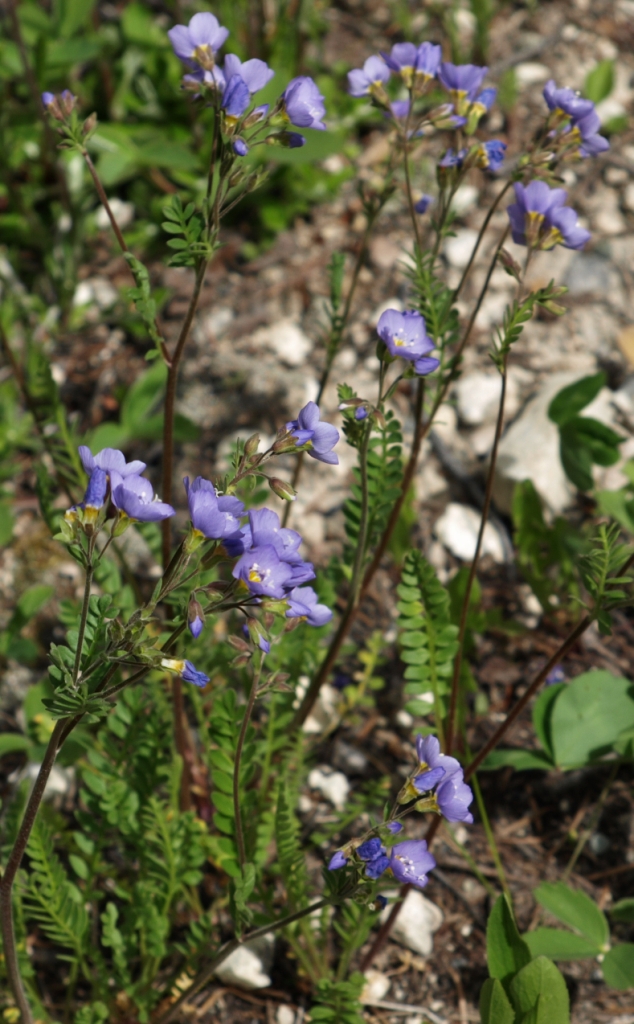
Foliage, Polemonium pulcherrimum. Egg-shaped leaflets are arranged in pairs on a central stem. The fancied resemblance of the foliage arrangement to a ladder is the origin of the common name, from the Biblical Jacob, who dreamed of a ladder reaching to heaven, with angels climbing to and fro. In this case, the blue of the flowers might be seen as to represent the sky, wherein Heaven is traditionally thought to be located...

Foliage, Polemonium pulcherrimum. Rather egg-shaped leaflets are arranged in pairs on a central stem. The fancied resemblance of the foliage arrangement to a ladder is the origin of the common name, from the Biblical Jacob, who dreamed of a ladder reaching to heaven, with angels climbing to and fro. In this case, the blue of the flowers might be seen as to represent the sky, wherein Heaven is traditionally thought to be located…  Image: HFN

This very pretty small plant moves happily into the garden, though its preference for excellent drainage makes it best suited for a slope or rockery position. Plants are quite variable in height and spread, ranging from 6 to 18 inches in eight. Flower stems arise from a basal cluster of the leaves, and bloom through late May well into June.

Small, pale blue-lavender flowers have vivid yellow eyes and contrasting white stamens, and are diligently visited by various species of pollinating bees.

Very cold hardy, and self sows modestly where happy. Easy to start from seed, which is the most eco-friendly way to bring the plant into cultivation. Look for the distinctive leaves, which will support the aging flower stems topped by clusters of pointed seed capsules full of ripe seed in mid-summer.

Best in full sun, or very light shade. Though a tough little wildflower, it is not particularly drought tolerant, preferring a steady supply of summer moisture to perform its best.

Bull Mountain, June 10, 2014. Polemonium pulcherrimum and pussytoes (Antennaria sp.) 0 to give an idea of the scale of this delicate flower.

Bull Mountain, June 10, 2014. Polemonium pulcherrimum and pussytoes (Antennaria sp.) t0 to give an idea of the scale of this delicate flower. Image: HFN

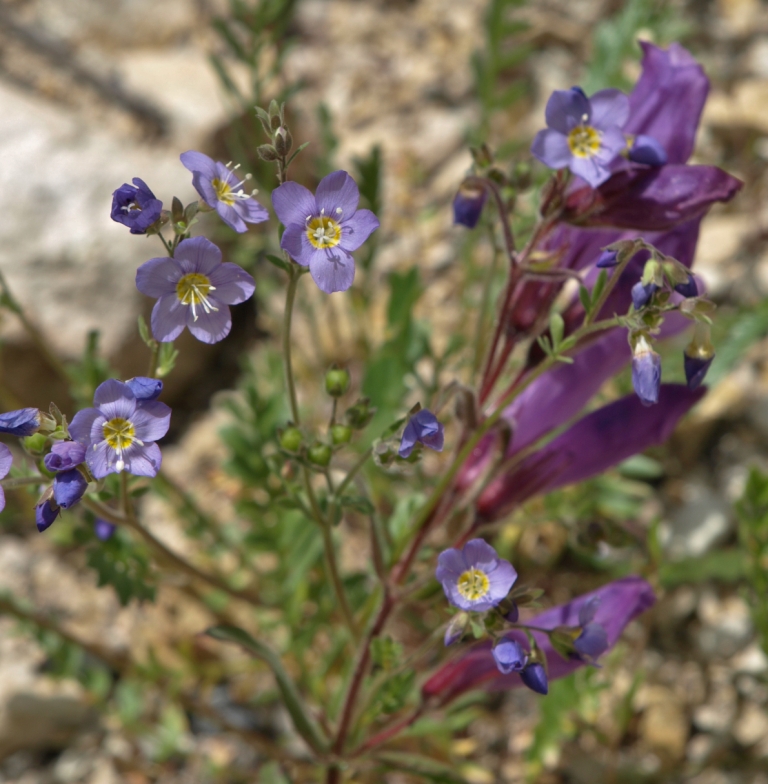
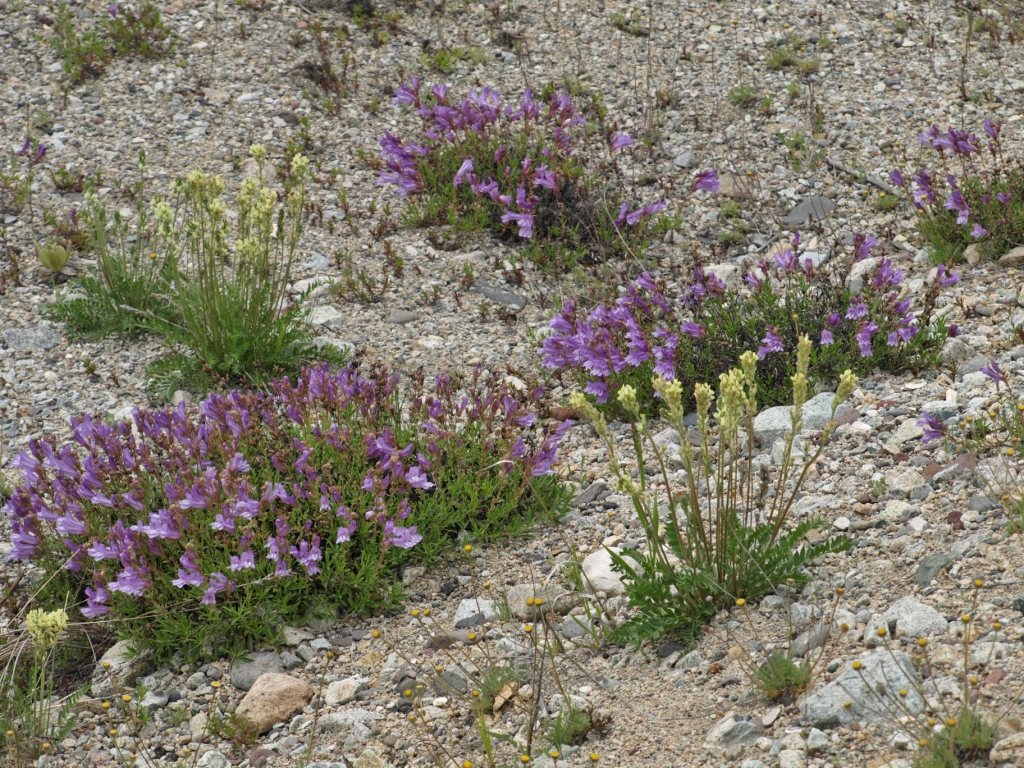
Beautiful companions - we found this Jacob's Ladder blooming alongside Shrubby Penstemon (Penstemon fruticosus var. scouleri) on Bull Mountain, June 10, 2014.

Beautiful companions – we found Showy Jacob’s Ladder blooming alongside Shrubby Penstemon (Penstemon fruticosus var. scouleri) on Bull Mountain, June 10, 2014. Image: HFN

Plant habit when growing on shale on the edge of Douglas fir/lodgepole pine forest. Companion plants in this area include Penstemon fruticosus var. scouleri, Pussytoes (Antennaria sp.), Anemone multifida, Kinnickinick (Arctostaphylos uva-ursi), and Indian Paintbrush (Castilleja sp.)

Plant habit when growing in fractured shale on the edge of Douglas fir/lodgepole pine forest. Companion plants in this area include Penstemon fruticosus var. scouleri, Pussytoes (Antennaria sp.), Anemone multifida, Kinnickinick (Arctostaphylos uva-ursi), and Indian Paintbrush (Castilleja sp.)  Image: HFN


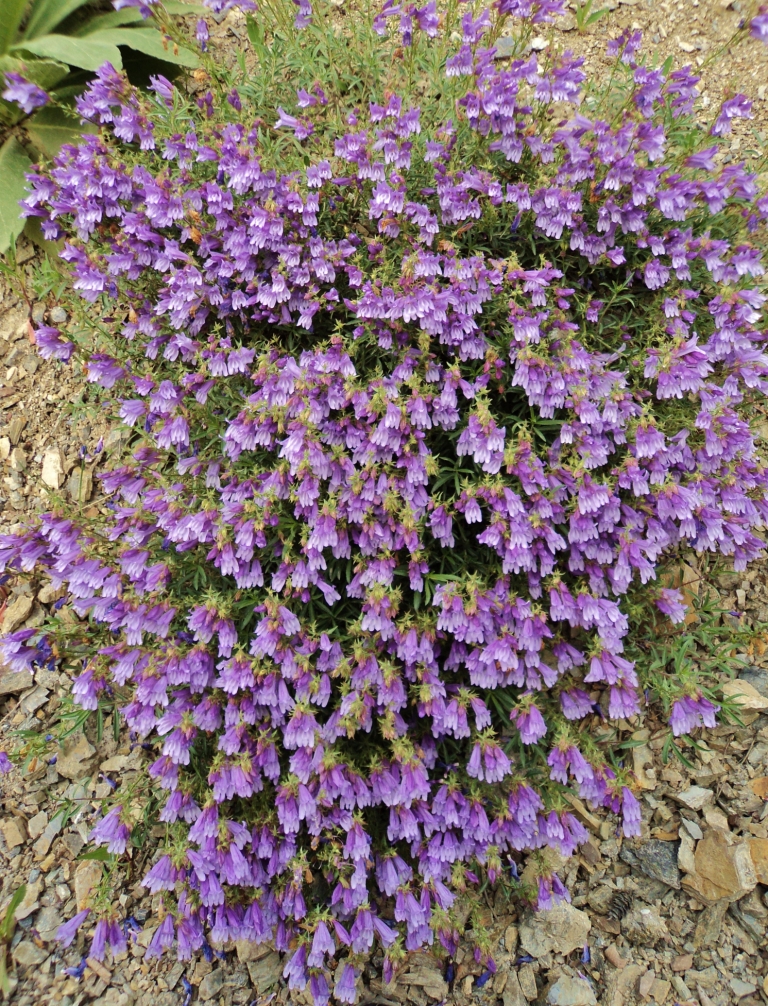
Shrubby Penstemon - Penstemon fruticosus var. scouleri - low clumps of large, light purple blooms are locally abundant throughout the Cariboo-Chilcotin on rocky cliffs and steep, gravelly, roadside cutbanks in mid-spring. This photo was taken near Soda Creek, B.C., May 23, 2010.

Shrubby Penstemon – Penstemon fruticosus var. scouleri – low, woody, fine-leaved foliage clumps covered with large, tubular, light purple blooms are locally abundant throughout the Cariboo-Chilcotin on rocky cliffs and steep, gravelly, roadside cutbanks in mid-spring. This photo was taken near Soda Creek, B.C., May 23, 2010. Image: HFN

Perennial. Zone 1/2. Scrophulariacea. North America; in Canada throughout the southern third of B.C. east of the Cascades and west to the Rockies, and in the United States common in Washington, Oregon, Idaho, Montana and Wyoming. A.k.a. Shrubby Beardtongue, Scouler’s Penstemon.

In bloom from May until July, depending on elevation, this floriferous sub-shrub is unmistakeable when seen on the roadside. It favours steep rock bluffs, gravel pits and roadsides, flourishing best in well-drained, rocky/sandy soil. Its pale purple blooms range in shade of warm violet to cool mauve, with occasional (very rare) white sports.

Here is what Lewis J. Clark had to say in his 1972 Wild Flowers of British Columbia:

This subshrubby species is described by its name, fruticosus meaning shrub-like. It is a variable species, but in all its forms is very beautiful. Choice forms are easily obtained for the garden by taking short cuttings, which root very readily in sand…To keep the plants attractively compact and floriferous, they should be given gritty soil with very little food.

The plants are semi-evergreen, a proportion of the leaves usually turning reddish in the fall, and later dropping. Commonly the compact framework of branches is 6-12 inches tall. Leaves are generally without hairs, up to 2 inches long, but usually shorter…narrow, almost elliptic and obscurely toothed. Flowers are relatively large (up to 2 inches long), generally blue-lavender, but so highly variable that the gardener should always be on the alert for exceptionally good colour forms. White, and beautiful pink specimens are seen occasionally…


This close-up of Penstemon fruticosus var. scouleri found growing in generous abundance on the gravel roadsides opposite the huge open-pit Highland Valley Copper Mine east of Ashcroft, B.C. shows the reason for the common name of this genus - 'Beardtongue'. Lewis J. Clark: "The lower luip of the corolla is ornamented with two deep folds and with long white hairs. When the corolla is slit lengthwise, the anthers (and also the filament of the half-length infertile stamen) are seen to be densely white haired."

This close-up of one of the  Penstemon fruticosus var. scouleri clumps found growing in generous abundance on the gravel roadsides opposite the huge open-pit Highland Valley Copper Mine east of Ashcroft, B.C. shows the reason for the common name of this genus – ‘Beardtongue’. Lewis J. Clark: “The lower lip of the corolla is ornamented with two deep folds and with long white hairs. When the corolla is slit lengthwise, the anthers (and also the filament of the half-length infertile stamen) are seen to be densely white haired.” (Click on the image to open an enlargement, which will show the afore-mentioned long white hairs on the lip folds.) Image: HFN

According to Plants of Southern Interior British Columbia (Parish, Coupé, Lloyd – Lone Pine Publishing – 1996), traditional First Nations’ uses of this plant included the production of a dye to colour basket-making materials, in pit cooking to flavour root vegetables, and medicinally as a purgative, and to bathe sore eyes and sooth ulcers, wounds, and arthritic joints.

Though in general removing plants from the wild to the garden is frowned upon, in the case of this penstemon all of my guidebooks mention how easy it is to establish from stem cuttings rooted in grit or sand, and as this technique will not harm the parent plant, one may in good conscience give it a try. Seeds are abundantly produced in pointed capsules, but are difficult to germinate, so might not be the best way to obtain this lovely species.

This is definitely a plant for a specialized location, requiring full sun and extremely well-drained soil to thrive, as evidenced by its flourishing in pure gravel in the wild. It would be wonderful in a rockery where it could cascade over a border or down a slope. Bloom time is relatively short, a few weeks in late May and early June, but the plants stay reasonably attractive throughout the rest of the growing season. A good xeriscape plant.

Shrubby Penstemon and its many fellow species are much favoured by bees and hummingbirds, another point in favour of stopping to observe this plant in the wild, and of incorporating it in the garden if one has a favourable spot.

Growing in a roadside gravel pit, Highland Valley Copper Mine, Ashcroft, B.C. - June 8, 2014. A few miles west, the roadside display was even more spectacular - a veritable carpet of purple under the pine trees on both sides of the road.

Growing in a roadside gravel pit, Highland Valley Copper Mine, Ashcroft, B.C. – June 8, 2014. A few miles west, the roadside display was even more spectacular – a veritable carpet of purple under the pine trees on both sides of the road. Image: HFN

Plant habit is that of a tidy round mound. Closer investigation shows that the shrubby stems radiate from a central point, with a main taproot providing the anchoring point. Highland Valley Copper Mine, June 8, 2014.

Plant habit is that of a tidy round mound. Closer investigation shows that the shrubby stems radiate from a central point, with a main taproot providing the anchoring point. Highland Valley Copper Mine, June 8, 2014. Image: HFN

A brighter violet individual. The bloom time of Shrubby Penstemon coincides with that of the showy cream-coloured locoweed (Oxytropis sp.).

A brighter violet individual. The bloom time of Shrubby Penstemon coincides with that of the showy cream-coloured locoweed (Oxytropis sp.), making for an attractive colour combination which could be easily replicated in the rock garden. Image: HFN

One of the nicest displays of Penstemon fruticosus var. scouleri that I've ever seen is on a steep roadside cutbank above Dunlevy Ranch in Soda Creek, B.C., a few miles south of Hill Farm. May 23, 2010.

One of the nicest displays of Penstemon fruticosus var. scouleri that I’ve ever seen is on a steep roadside cutbank above Dunlevy Ranch in Soda Creek, B.C., a few miles south of Hill Farm. This photo was taken May 23, 2010. Image: HFN


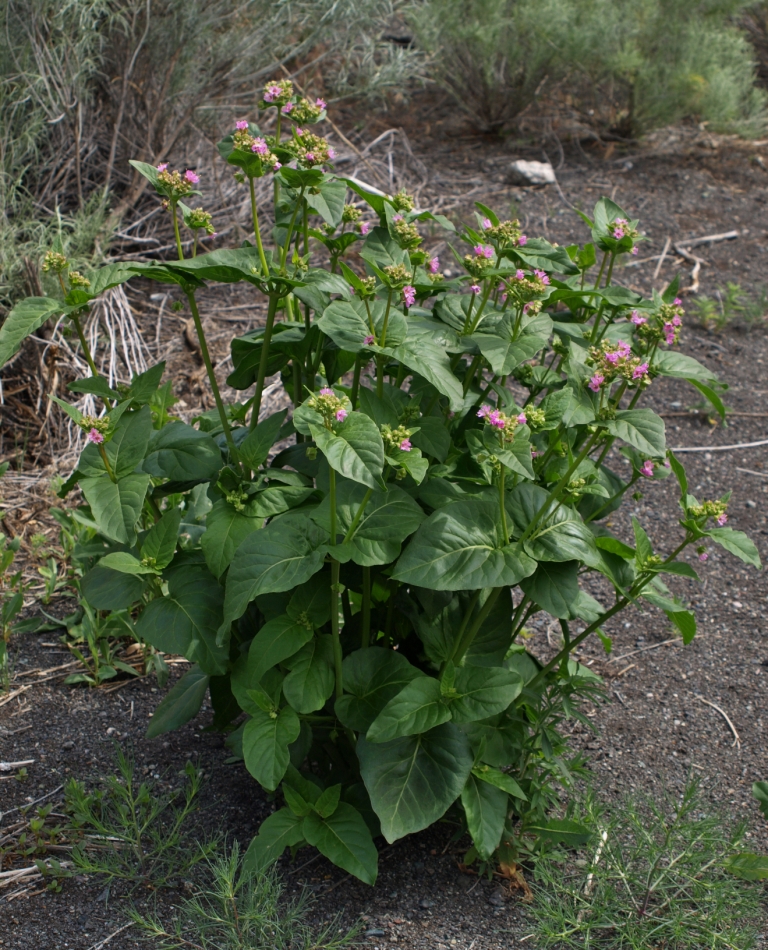
Wild Four-O-Clocks - Mirabilis nyctaginea. Spences Bridge, B.C. May 30, 2014.

Wild Four-O-Clocks – Mirabilis nyctaginea. Spences Bridge, B.C. May 30, 2014. Image: HFN

Perennial. Zone 6, possibly colder. Nyctaginaceae. A.k.a. Heart-Leaved Four-O’Clock, Umbrellawort. Native to the Great Plains of the United States, as well as southern regions of Manitoba, Saskatchewan and Ontario. Isolated introduced populations found throughout B.C., Alberta and Quebec.

On a recent road trip, heading through the arid rangelands and rolling hills south of Cache Creek and following the Thompson River’s deeply carved valley as it heads towards its spectacular rendezvous with the Fraser at Lytton, my attention was caught by several tall clumps of lush, dark green foliage, showing clusters of small but vivid magenta-pink blooms. Pulling over in a wide spot on the road, I looped back to take a closer look.

An initial examination of the flower structure and foliage gave me an “Aha!” moment. Could this possibly be wild four-o’clocks? It wasn’t in any of the wildflower field guides I had along, nor, when back home, in my trusty and comprehensive Lewis J. Clark’s Wild Flowers of British Columbia, but an internet search yielded an immediate confirmation.

Plant habit is eye-catching, in this case because of its unexpectedly lush greenness set against a background of silver-green sagebrush and bunchgrass-tufted hills.

Near Spences Bridge, May 30, 2014. Plant habit is eye-catching, in this case because of its unexpectedly lush greenness set against a background of silver-green sagebrush and bunchgrass-tufted hills. Image: HFN

My online research yielded these details.

The plants grow in vigorous clumps from 1 to 3 feet tall (these were about 2 feet tall), with broad, heart-shaped, opposite leaves clasping the angle-sided stems. Flower clusters show green bracts at the bases of the tubular flowers, which are of a bright magenta pink. Stamens are also magenta, tipped with yellow pollen. After flowering, the bracts enlarge into a papery “umbrella” centered by a cluster of large, rather hairy nutlet-type seed. These bracts then act as parachutes during the seed dispersion stage.

The plant forms a large, tuberous tap-root, which extends a foot or more into the soil, allowing the plant to thrive in arid conditions. This root is what has led this plant to be classified as a weed-of-concern in some regions, as it is very hard to eradicate once established, being highly herbicide resistant, and able to resprout from root fragments left in the soil after pulling. (And of course the wind-dispersed seeds would also be a major factor in its ability to spread, especially in areas of disturbed soil.)

The sweet-tasting roots of this plant were used by indigenous peoples as a poultice for skin ailments and burns, and as a medicinal tea to expel worms, and to treat fevers and bladder complaints. Though pigs apparently dig up and eat the roots with great relish – they are recommended for eradication in agricultural infestations – there is some speculation that Mirabilis nyctaginea may contain some mildly toxic alkaloids, so experimentation with herbal use is not advised.

I suspect that this plant would not be winter hardy in the Cariboo-Chilcotin, but it might well succeed as an annual, as its domestic relative, the lovely and fragrant Mirabilis jalapa (the commonly grown garden flower Four-O’Clocks, or Marvel-of-Peru) blooms generously as a summer-flowering annual, and forms a similar fleshy root which does not withstand freezing soil.

While decidedly pretty in a low-key way, Mirabilis nyctaginea is not particularly showy, and reports of its “weedy” tendencies would make me cautious to recommend this plant, though it might be an interesting addition to a wildflower planting if one is feeling adventurous, and is prepared to remove seedheads before they can disperse. Seed is often available for this plant through botanical seed exchanges, and commercially through some specialist native plant seed houses.

Near Spences Bridge, B.C. May 30, 2014.

Near Spences Bridge, B.C. May 30, 2014. Image: HFN


Convallaria majalis - Lily-of-the-Valley - Williams Lake, B.C. - May 23, 2014

Convallaria majalis – Lily-of-the-Valley – Williams Lake, B.C. – May 23, 2014. Image: HFN

Perennial. Zone 1. Asparagaceae, formerly Liliaceae. Woodland flower of Northern Europe, from England east and south to the Caucasus, into northern Turkey. Also found in Japan, and the North American Appalachians, though there is some speculation that the American population originated from introduced plants.

Lily-of-the-Valley has been grown in gardens since at least 1000 B.C. It is well documented in many herbals and plant lists, and was an important medicinal herb as well as a highly-regarded ornamental. Today most of its uses are decorative, though the species’ chemical constituents are being studied for various medicinal applications, and it is used in homeopathy as a remedy for various heart conditions.

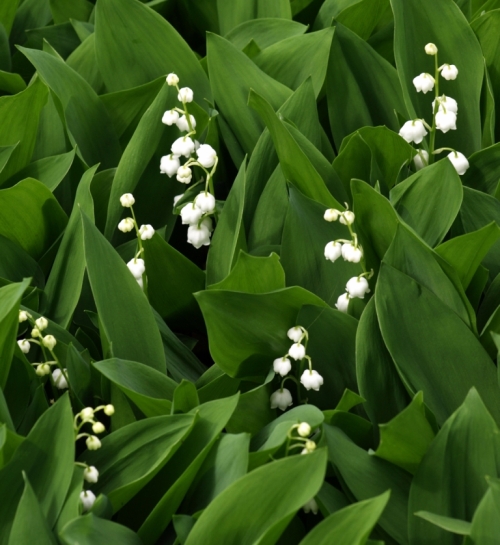
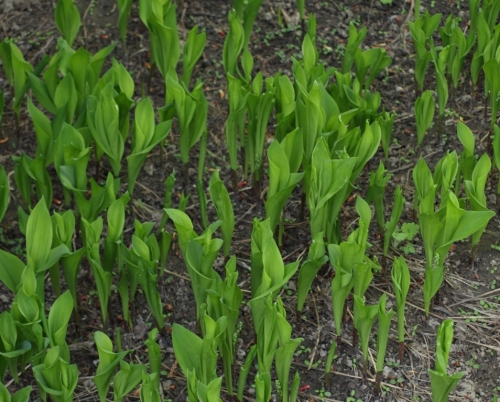
By mid to late April in Cariboo-Chilcotin garden, the tightly furled spikes of Lily-of-the-Valley start to emerge, soon unfolding into dark green, mule-ear shaped leaves, with the bloom clusters visible at the base of each foliage cluster.

A thriving colony of Convallaria majalis in early May - Hill Farm, 2014. If you look closely you will see the emerging flower buds at the base of the leaf clusters.

A thriving colony of Convallaria majalis in early May – Hill Farm, 2014. If you look closely you will see the emerging flower buds at the bases of the leaf clusters. Image: HFN

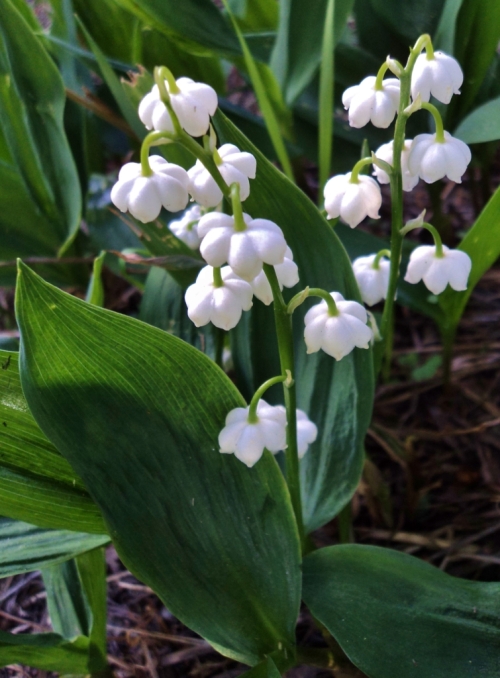
As May progresses the leaves expand to form a solid carpet of green, and the bloom stems lengthen, until one long-anticipated day one becomes aware, by catching a waft of the unmistakable fragrance, that the first flowers have opened.

Early June, Hill Farm, 2010.

Early June, Hill Farm, 2010. Image: HFN

The blooms are pristinely perfect: tiny pure white bells with pale yellow stamens, arranged in gently arching sprays. Thickly textured and long lasting, these are marvelous cut flowers, being free of their fragrance even after several days in a vase. Lilies-of-the-Valley are classic wedding bouquet flowers, and are commercially grown for the specialty florist market, though brides in months other than when the plants naturally flower should be prepared to pay a premium price for the artificially-forced greenhouse-grown blooms, which will also not be as fragrant as their garden-grown counterparts.

In the Victorian “Language of Flowers”, Lily-of-the-Valley signified “return to happiness” and “expectation of love”, which, along with the delicate virginal beauty of the blooms, no doubt accounts for its many bridal associations.

The fragrance of the flowers is outstanding, and perfumers have tried for centuries to mimic it in their concoctions, for though it is freely produced, it is not able to be captured in any sort of usable way. Reasonable imitations have been produced chemically, but there is truly nothing like the real thing, from a cluster of the dew-wet blooms picked on a fresh May morning.

To grow your own plot of Convallaria, you should first prepare a patch of shady ground by removing all surface tree and shrub roots and potentially competing grasses and other plants, and then digging in some well-rotted compost or manure. Plant the shallow-rooted pips just as they come out of their pots, with the rhizomes extending at right angles from the leaf clusters. Keep well watered and weeded the first season, and after that the plants should settle in to form an ever-expanding, maintenance-free colony. 

Lily-of-the-Valley does very well under trees and high-pruned shrubs, thriving on the filtered sunlight coming through leaves. Though very shade tolerant, plants do need some natural light if they are to bloom, so avoid dense shade such as that on the north side of buildings. Also avoid planting these in the mixed border, as they are happier where they can form a single-species colony. Very vigorous larger plants will crowd them out, and they in turn will gobble up more delicate things; the ongoing struggle will not be a happy thing, so it’s best to dedicate an area to your plantation right from the start.

Many people inquire as to the poisonous aspects of this plant, as it does appear on many “toxic garden flower” lists. Though all parts of the plant contain cardiac-affecting glycosides and digestive system-affecting saponins, though there are very few confirmed cases of actual poisonings, and no confirmed fatalities. It is theorized that, though potentially dangerous, the chemical constituents in the fresh plant matter are poorly absorbed by the digestive tract, so though accidental consumption might make you feel quite sick, it probably won’t kill you. (And I can’t imagine why one would accidentally consume this plant, as it is quite distinctive and not likely to be mistaken for anything else during any stages of its growth.)  The plants frequently produce red berries in the summer and autumn and this may be of some concern to those with very young children; be aware and garden with this in mind.

Convallaria majalis ‘striata’ – Hill Farm – May 26, 2014. Image: HFN

There are a number of interesting variations of this venerable garden plant occasionally available at specialty nurseries. We are in the process of propagating our own small colony of the striped-leaved variety, Convallaria majalis ‘striata’, and hope to be able to share these in a few more years. There is also a rosy-pink variation, Convallaria majalis ‘rosea’, and a double type, Convallaria majalis ‘prolificans’, though these last two are much less vigorous than their ancestors.


Viola elatior - Tall Woodland Violet - Hill Farm, Macalister, B.C. - May 23, 2014. One-year-old seed-grown plants.

Viola elatior – Tall Woodland Violet – Hill Farm, Macalister, B.C. – May 23, 2014. One-year-old seed-grown plants. Image: HFN

Perennial. Zone 4. Violaceae. Syn. Viola erecta; V. montana. Central and Eastern Europe, from Northern Italy and France east to Siberia and Northwest China. Natural habitat is sunny marsh meadows, moist woodland, and rocky water edges.

This charming Old World woodland flower has taken to garden life with great success, and is a popular item in the various specialty garden society seed exchanges, which may ultimately save this species from extinction. Tall Woodland Violet is becoming very rare now in much of its native habitat, due to agriculture and urban development pressures.

The plant habit is an upright clump of very elongated, bright green, thinly-heart-shaped foliage. The effect is rather shrubby in well-established plants. It may reach 18 inches in height where conditions are just right; even if shorter the plant habit is very upright versus spreading. Plants are completely herbaceous, and die to the ground in winter.

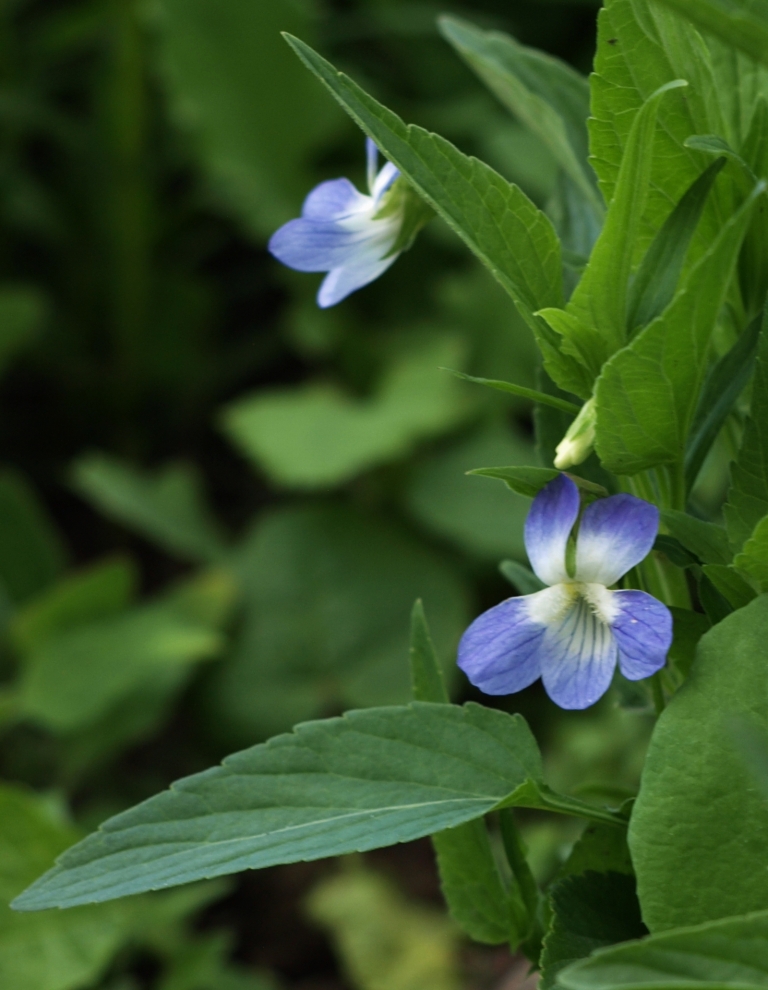
The centres of these violets are a pristine white, giving a two-tone effect which is accentuated as the bloom edges darken with age.

The centres of these violets are a pristine white, giving a two-tone effect which is accentuated as the bloom edges darken with age. Image: HFN

In May and June generous numbers of pale purple, 1-inch violets with white central shading and beards and dark purple whiskers are produced. Some references mention mild fragrance; others declare Viola elatior scentless. I checked mine, and couldn’t detect any aroma, so will assume that noticeable scent is not a general characteristic of this species.

The overall effect of this pretty violet is that of quiet elegance. Just the thing for a not-too-dry corner of the rockery, to set off lower-growing plants such as the miniature campanulas or Oenothera minima, or to follow small spring bulbs.

Sun to part shade; appreciates humus-rich soils. Best with a steady supply of moisture, though it will handle dryer conditions if grown in shade.