Archive for the ‘Plant Portraits’ Category

Viola elatior - Tall Woodland Violet - Hill Farm, Macalister, B.C. - May 23, 2014. One-year-old seed-grown plants.

Viola elatior – Tall Woodland Violet – Hill Farm, Macalister, B.C. – May 23, 2014. One-year-old seed-grown plants. Image: HFN

Perennial. Zone 4. Violaceae. Syn. Viola erecta; V. montana. Central and Eastern Europe, from Northern Italy and France east to Siberia and Northwest China. Natural habitat is sunny marsh meadows, moist woodland, and rocky water edges.

This charming Old World woodland flower has taken to garden life with great success, and is a popular item in the various specialty garden society seed exchanges, which may ultimately save this species from extinction. Tall Woodland Violet is becoming very rare now in much of its native habitat, due to agriculture and urban development pressures.

The plant habit is an upright clump of very elongated, bright green, thinly-heart-shaped foliage. The effect is rather shrubby in well-established plants. It may reach 18 inches in height where conditions are just right; even if shorter the plant habit is very upright versus spreading. Plants are completely herbaceous, and die to the ground in winter.

The centres of these violets are a pristine white, giving a two-tone effect which is accentuated as the bloom edges darken with age.

The centres of these violets are a pristine white, giving a two-tone effect which is accentuated as the bloom edges darken with age. Image: HFN

In May and June generous numbers of pale purple, 1-inch violets with white central shading and beards and dark purple whiskers are produced. Some references mention mild fragrance; others declare Viola elatior scentless. I checked mine, and couldn’t detect any aroma, so will assume that noticeable scent is not a general characteristic of this species.

The overall effect of this pretty violet is that of quiet elegance. Just the thing for a not-too-dry corner of the rockery, to set off lower-growing plants such as the miniature campanulas or Oenothera minima, or to follow small spring bulbs.

Sun to part shade; appreciates humus-rich soils. Best with a steady supply of moisture, though it will handle dryer conditions if grown in shade.


Read Full Post »


Mukdenia rossii syn. Aceriphyllum rossii - Hill Farm, Macalister, B.C. - May 21, 2014

Mukdenia rossii syn. Aceriphyllum rossii – Hill Farm, Macalister, B.C. – May 21, 2014 Image: HFN

Perennial. Zone 4. Saxifragaceae. Native to Korea, Northern China and Manchuria, where it grows in cool deciduous forest and on rocky slopes and subalpine ravines. The name Mukdenia comes from the Chinese province of Shenyang, then called Mukden, while the specific name, rossii, is after a Scottish missionary John Ross* (1842-1915) who established one of the first Christian churches in the region.

Quietly beautiful in all stages of growth. I fell for this the first time I saw it in autumn-leaf mode, long after flowering, in a coastal garden. The silk-sheened foliage was flushed with crimson, but that was merely what initially caught my eye; on closer examination I saw that the structure and habit of the plant made it a perfectly self-contained woodland garden sort of clump former. A bit of research and a description of the starry white spring blooms merely confirmed my first impression that this was a Very Good Thing, and so I set off on my quest to obtain it for myself.

This proved much more challenging than I had anticipated. Though various coastal nurseries occasionally showed the deluxe cultivar ‘Crimson Fans’ on their stock lists, there never seemed to be one available on my infrequent visits. I did find one rather bedraggled specimen on an end-of-season sale table for a breathtaking $40, but couldn’t bring myself to buy it for that sum, not knowing if it would prove hardy for me. (All plant people are by nature gamblers of sorts, but, like most of us, I do have my limits!)

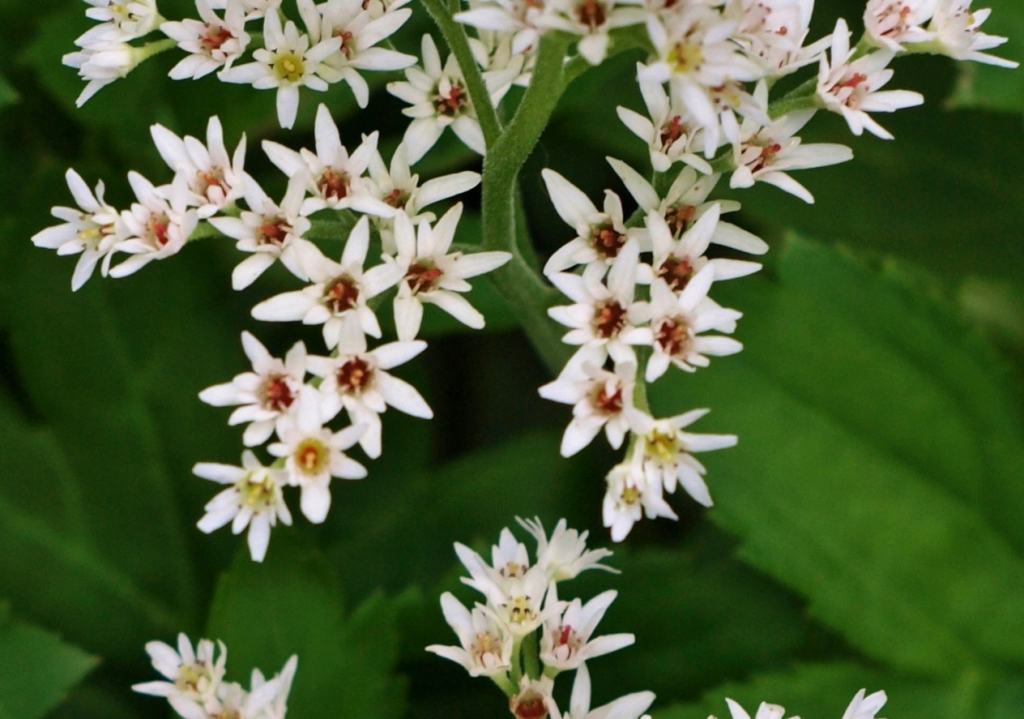
Then, ten years or so ago, I found Mukdenia rossii listed on Kristl Walek’s most excellent Gardens North perennial seed list. A half dozen tiny seedlings survived the rigors of the germination and growing out stage, and I was set. I mulled over a suitable placement for them, and settled on the front of the border on the west side of the house, an area shaded by trees in the afternoon, and well protected by snow from the house roof in winter. The plants approved, and settled in happily, to expand their clump modestly each season and to give me more and more spikes of their tiny white starflowers with every succeeding spring. There they are at the top of the post, and here they are in close-up mode.

Hill Farm - May 21, 2014. A closer look at the starry blooms will show this plant's membership in the venerable Saxifrage family.

Hill Farm – May 21, 2014. A closer look at the starry blooms will show this plant’s membership in the venerable Saxifrage family. Image: HFN

I occasionally consider stealing some divisions from my cherished little colony, but so far I have resisted that temptation. It is modestly thriving but is in no way outgrowing its allocated space; I think I will leave it well enough alone. Seed remains hard to come by, and I haven’t seen it on Kristl’s list recently. I have managed to germinate a few seedlings from my own plants, but as they are delicate things in the early stages I sadly lost them all before they reached transplanting stage – damping off, too hot a greenhouse, and a day’s missed watering during the busiest time of the nursery year spelled their various dooms. I shall try again, though, because this is something I would love to share with my fellow Cariboo gardeners.

So, on to the nitty gritty.

Mukdenia rossii forms a compact clump which expands by slowly creeping rhizomatous roots. Rosy-blushed, crowded bud spikes emerge in earliest spring a little before the foliage, and the budding stems and leaves grow a little day by day, until at last, in late April or early May, the first white stars appear. These add to the number day by day, until at last the branched panicles are drooping from their combined weight; the show lasts for weeks, well into June if we don’t have a heat wave. The flowers slowly fade to brown, and the aging seed heads may be left in place or clipped off if you are of the exceedingly tidy sort.

Foliage is broad, fan-shaped with serrated edges, and of a most attractive silken texture, with a lovely light-catching sheen. The leaves are well flushed with dark red upon emergence, and though this fades to a uniform green for the majority of the growing season, autumn again brings out the red tints, until the plants disappear under the snow.

Mukdenia appreciates humus-rich soil and a fair bit of moisture in the heat of summer, though it never droops. Afternoon shade is definitely appreciated; this can be grown under tree cover in a woodland setting.

Once established, bloom stems will reach a foot or so in height, with clumps expanding to 1 or 2 feet. Perhaps nicest in a colony, with several planted together, as it is grown in the University of British Columbia Botanical Garden, and, in a more modest way, my own shady border.

A gorgeous colony of Mukdenia rossii in full bloom, UBC Botanical Garden, Vancouver, B.C. - April 8, 2014.

A gorgeous colony of Mukdenia rossii in full bloom, UBC Botanical Garden, Vancouver, B.C. – April 8, 2014. Image: HFN

UBC - April 8, 2014

UBC Botanical Garden – April 8, 2014 Image: HFN

I did eventually acquire a small start of ‘Crimson Fans’, but sadly it inadvertently spent a recent winter with the crown crushed under a brick which had tipped sideways – it (the brick) was meant to protect a promising hellebore seedling – and it (the mukdenia) was not looking at all well, so is now residing in a pot, being nursed back to health.

This is the one you will likely find if you are yourself scanning the more southerly nurseries. It is also sold under the original Japanese name, ‘Karasuba’. Ignore whatever the zone rating on the tag says – it might be a conservative Zone 6 or 7 – and give it a try. I would be confident to recommend it to at least Zone 4, or even Zone 3 if it can be guaranteed good snow cover. The red colour does fade by mid spring, after which it looks pretty much like the species type, but it is very pretty while it lasts.

Nice plant. Worth a try.

*I wondered if John Ross was also involved with botany in some way, but I found no mention of it in the few places I checked. There is this short biography, however, from the Biographical Dictionary of Chinese Christianity:

Born in northern Scotland, Ross served several Gaelic-speaking churches before leaving for China under the United Presbyterian Church in 1872. His ministry deeply touched two areas, Manchuria and Korea. By 1873 he had preached his first sermon in Chinese and had pioneered Manchurian work through wide itineration from his post in Shenyang (Mukden).

Known for his generous spirit toward Confucianism and Chinese ancestral rites, he supported the idea of a Chinese church that would not be a Western replica. In 1873, living on the northern border of a Korea still closed to outsiders, he met traders from the “hermit kingdom.” His growing interests produced the first Korean primer (1877) and grammar (1882) in English, the first history of Korea in any Western language (1879), and, under his direction, the first Korean translation of the New Testament (1887). Its unheralded distribution in Korea produced an authentic church there before Protestant missionary itineration began widely within the country. He retired to Scotland because of ill health in 1910 but continued to write and lecture.


Read Full Post »
 

??????????????????????

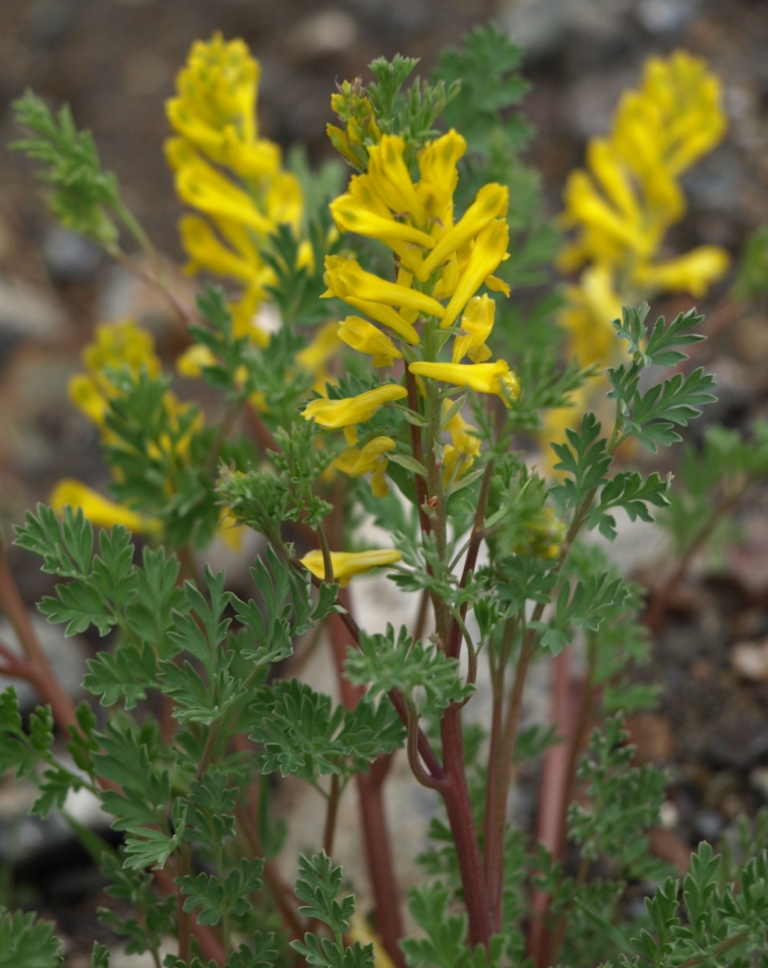
Corydalis aurea – McLeese Lake, B.C. – May 17, 2014.  Image: HFN

Annual/Biennial. Zone 2. Fumariaceae. North America. Widespread throughout North America, in particular in areas disturbed by development, logging and forest fires. Common in the Cariboo-Chilcotin on recently disturbed ground – on graded roadsides, in gravel pits, and in newly logged areas.

This interesting and largely ephemeral early spring bloomer is occasionally abundant and always something of a surprise to see, appearing in the most unexpected places. Once it blooms in earliest spring, it quickly fades away after casting out its seeds, which can remain dormant for decades until germination conditions are again to its liking.

Technically a winter annual, Yellow Corydalis sprouts in the summer, makes an inconspicuous foliage clump which overwinters in semi-evergreen state, and then advances quickly into flowering stage in early spring. By July its life cycle is nearing its end; the beautiful, lacy, grey-green foliage is turning yellow and the plant is fading fast. No sign of it will be left by autumn.

Corydalis aurea - growing in a gravel pit near McLeese Lake, B.C. - May 17, 2014

Corydalis aurea – growing in a gravel pit near McLeese Lake, B.C. – May 17, 2014. Image: HFN

Plants expand quickly from their over-wintered rosettes, reaching 6 to 12 inches in height and spread. Roots are tap-rooted and fleshy, with spreading side roots. Foliage is rather “carrot-like” in appearance, being much divided, slightly succulent, and softly blue-green.

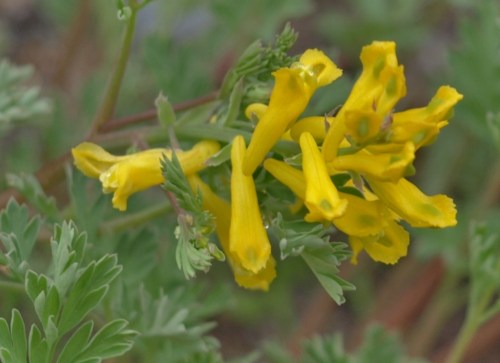
Tubular blooms are bright yellow blushed with green and are produced in great abundance during the few weeks of flowering time. Early-foraging wild bees are attracted to the nectar-rich blooms, and sometimes bore into the tubes to avoid having to negotiate their way past the stamens at the opening of the flowers.

??????????????????????

Corydalis aurea – detail of flower cluster. Image: HFN

Seeds produced by Corydalis aurea are small, black and shiny, and form encased in slender, cylindrical pods. They are very attractive to ants, who aid in their dispersal by caching the seeds in underground storage chambers; it is theorized that when these nests are disrupted the seeds are brought back to the surface where they then germinate in great abundance.

This plant may be introduced into the rock garden as it is very showy in early spring, but as its ongoing garden presence depends upon random germination of the seeds and the plants themselves disappear after blooming, it should be sited with this in mind, and not depended on as a feature plant.

??????????????????????

The tiny, slender, legume-like seed pods may be seen at the base of the central floral cluster. Image: HFN

Corydalis aurea is reportedly very toxic to sheep, and less so to cattle and horses, though I am unaware of any poisoning incidents in our region. Because of the plant’s early emergence, and its palatability – sheep paradoxically find it quite delicious – stock owners might be advised to keep an eye out for this plant when investigating their spring pastures before turnout.

Read Full Post »

Palmate Coltsfoot - Petasites frigidus var. palmatus - Van Dusen Garden, Vancouver, B.C. - April 8, 2014.

Palmate Coltsfoot – Petasites frigidus var. palmatus – Van Dusen Garden, Vancouver, B.C. – April 8, 2014. Image: HFN


Perennial. Zone 2. Asteraceae. (Syn. Compositae.) Widespread through Western North America. Common to wet coniferous forest and subalpine regions of B.C. A.k.a. Arctic Sweet Coltsfoot.

Lewis J. Clark, in Wild Flowers of British Columbia, 1973:

Petasites derives from the Greek petasos, a broad-rimmed hat, which describes the wide basal leaves. Palmatus (is) from the large hand-shaped leaves…

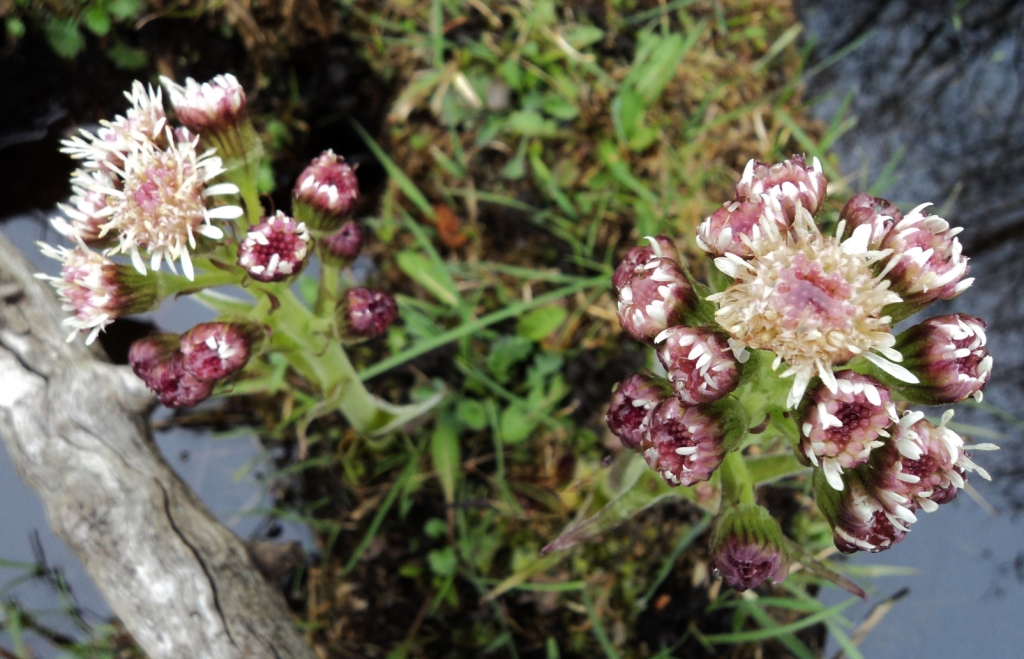
Most Composites bloom late in the year, but the Colt’s Foot pushes its thick stem through the ground at the beginning of March, sometimes while snow still lingers. Soon the rapidly lengthening shoot displays a heavy, flattened cluster of purplish (sometimes white, rarely yellow) flower-heads. These are of two kinds, the staminate soon withering. The pistillate-heads usually have a few short ray-florets. By early summer they are succeeded by clusters of achenes whose radiating pappus recall a very large, but flattened, Dandelion “puff”.

??????????????????????

Petasites frigidus var. palmatus – close-up of pistillate heads. Image: HFN

??????????????????????

Palmate Coltsfoot – Van Dusen Garden – April 8, 2014. Image: HFN

This species is very similar to Sweet Coltsfoot, Petasites frigidus var. nivalis, and as the ranges overlap, hybridization often occurs, making positive identification something of a challenge.

No matter what the details of nomenclature, the native Petasites found throughout the Cariboo are quietly spectacular in a low-growing, botanically interesting sort of way, being among the earliest bloomers and a sign of the start of the brief but intense growing season proper.

These plants happily grow in the garden, being most suited to moist wild gardens and boggy areas. They do spread vigorously where happy via underground rhizomes, so that is something to keep in mind when siting.

Coltsfoot is reported to be attractive to early foraging bees and other pollinating insects.

Ethnobotanical uses of Palmate Coltsfoot (and its relations) include flowering stalks and young leaves being used as an early “potherb”, no doubt highly welcome after a long winter of no fresh greens. According to the field guide Plants of Northern British Columbia (MacKinnon, Pojar and Coupé, 1992), Petasites leaves were used to cover berries in steam-cooking pits. Medicinal uses were widespread, with decoctions used to treat chest and respiratory ailments, as well as externally applied to treat rheumatism.

An interesting use which I have seen referred to in several places is the value of the plant as a salt substitute, either as an addition to stews, or from the ashes of the burned leaves.

As with any medicinal or culinary use of plants, it is best to be cautious about consuming or applying anything one is not familiar with; the above uses are provided merely as historical notes and not recommendations or suggestions. Petasites species contain alkaloids which may cause liver damage when ingested.

Palmate Coltsfoot at UBC Botanical Garden, April 8, 2014. This population shows the rosy colour variation.

Palmate Coltsfoot at UBC Botanical Garden, April 8, 2014. This population shows the rosy colour variation. Image: HFN

Newly emerging foliage in the background - notice the "palmate" form of the "hand-like" leaves. UBC Botanical Garden, April 8, 2014.

Newly emerging foliage in the background – notice the “palmate” form of the “hand-like” leaves. UBC Botanical Garden, April 8, 2014. Image: HFN

Close-up of flower cluster. UBC Botanical Garden, April 8, 2014.

Close-up of flower cluster. UBC Botanical Garden, April 8, 2014. Image: HFN

Read Full Post »

Sweet Coltsfoot - Petasites frigidus var. nivalis - near Tyee Lake, B.C., May 9, 2014.

Sweet Coltsfoot – Petasites frigidus var. nivalis – near Tyee Lake, B.C., May 9, 2014. Image: HFN

Perennial. Zone 2. Asteraceae. (Syn. Compositae.) Widespread through Western North America. Common to wet coniferous forest and subalpine regions of B.C. A.k.a. Alpine Coltsfoot, Arctic Butterbur.

With the departure of the last of the sodden winter snow and the first faint flush of green as plants awake from their long dormancy, the sudden appearance of the exotic-looking coltsfoot bloom stems is a welcome surprise to the keen native plant gardener or roving botanist.

Thick, fleshy stems appear, lined with bract-like leaves and topped by clusters of densely packed disc flowers. Plants are either male, with all disk flowers, or female, with ray as well as disk flowers, as in the photo above. This plant’s membership in the Composite Family (think sunflowers, Helianthus annuus, as the poster child of the composites with well-differentiated ray and disk flowers in a single head) is very obvious once one takes a close look at the flower structure, and especially when the feathery, dandelion-like seeds start to mature.

???????????????????????????????

Image: HFN

Blooms are most frequently white, but can be shades of pink, and occasionally a deep ivory-yellow.

Leaves appear a few weeks after the bloom stems, and as they often arise at some distance from the flowers due to the plant’s extended underground rhizomatous root system they are often  not associated with the flowers. Many of the Petasites have massive foliage – the leaves of the vigorous Japanese Butterbur, Petasites japonicus, easily reaching 2 feet across, and those of another common British Columbia species, P. palmatus, often reaching a foot wide – but P. frigidus var. nivalis is a more modest creature, with glossy, deeply wrinkled, raggedly toothed, grape-like leaves only 6 to 8 inches across.

The common name “coltsfoot” arise, according to Lewis J. Clark, from the appearance of the leaves, rather than the flowers:

Soon after the appearance of the flowering stems, stout leaf-shoots emerge. They are folded in an extraordinary manner, with the hairy lobes reflexed, at an early stage evoking the metaphor of the little foot of a colt.

Sweet Coltsfoot is often found in wet locations, thriving in boggy areas and on stream and lake edges. It is something of a spreader, forming thriving colonies where happy, and is occasionally seen as a happily domesticated “tamed wildflower” in bog and woodland gardens.

Typical habitat of Petasites frigidus var. nivalis, along a boggy lakeshore.

Typical habitat of Petasites frigidus var. nivalis, along a boggy lakeshore. Image: HFN

Read Full Post »

Eryngium planum 'Blue Cap" - thriving in less than ideal conditions at the 108 Heritage Site, Lac La Hache. We planted the raised perennial beds at the rest stop over 10 years ago with "tough, no-maintainence" plants, and it is quite interesting to see what has survived and, in some cases, thrived. This sea holly and Achillea filipendulina, Salvia nemerosa, Lychnis coronaria and Silene maritime, a goodly number of columbines, Erigeron 'Pink Jewel' and various sedums are hanging right in there. Exposed site, no supplementary water or fertilizer, and lots of traffic back and forth - we're pretty happy with how this planting has held up.

Eryngium planum ‘Blue Cap” – thriving in less than ideal conditions at the 108 Roadhouse Heritage Site, Lac La Hache. We planted the raised perennial beds at the rest stop there over 10 years ago with “tough, no-maintainence” plants, and it is quite interesting to see what has survived and, in most cases, thrived. This sea holly and Achillea filipendulina, Salvia nemerosa, Lychnis coronaria and Silene maritima, a goodly number of columbines, Erigeron ‘Pink Jewel’ and various sedums are hanging right in there. Exposed site, no supplementary water or fertilizer, and lots of traffic back and forth – we’re pretty happy with how this planting has held up. Photo taken in the late evening while stopping by for a quick break to stretch our road-trip weary legs, mid-August, 2012. Image: HFN

Perennial. Zone 2. Apiaceae. Central Europe, from Germany and Austria eastward to Russia; throughout the Caucasus Mountain region and into central Asia, where it grows happily in grassy meadows and on rocky, sun-baked hillsides.

I’ve been a die-hard fan of the sea hollies in general and this species in particular ever since my mother planted one out on her difficult-ground shale hillside north of Williams Lake over four decades ago. It self seeded about, and made a thriving colony, and provided untold hundreds of sturdy bloom stems which ended up being dried and made into everlasting wreaths and arrangements which Mom then gave to friends and sold at various arts-and-crafts sales.

It really is as blue as it looks, and the stems carry that cobalt blush as well, almost as if the whole thing were dusted with spray paint by someone seeking to enhance things.

Leathery, silvery-green, rounded leaves in basal rosettes send up 18-24” tall multi-branched stems topped by loose clusters of bristly, bracted, cone-shaped flower heads summer through fall.  Stems and flowers are flushed a deep electric blue. A very long season of bloom through summer into autumn.

An excellent cutflower and everlasting. A popular bee and butterfly flower, always alive with insect activity.

‘Blue Cap’ – translated from ‘Blaukappe’ – is a premium German selection of the species, and is even more compact and floriferous (and darker blue) than its attractive ancestor. A number of other E. planum cultivars have appeared in recent years, such as the very dwarf ‘Blue Hobbit’, and white forms such as ‘Silver Salentino’ and ‘White Glitter’.

A variegated form, ‘Jade Frost’, with pink-blushed, white-edged foliage, has been appearing in garden centres for a few years; I have a small planting of this cultivar and am at this point not terribly impressed, as one of the original trio mysteriously withered and died, and the other two are less vigorous than I had hoped for from this generally reliable species.

Sun; any soil; drought tolerant. Fantastic xeriscape plant. A generous self-seeder, but not a “runner” – individual plants stay put, and are tap rooted and very long lived. Oh – and it is reasonably deer resistant, too!

???????????????????????????????

Definitely approved by bees! A late evening forager on ‘Blue Cap’ Sea Holly at the 108 Roadhouse Heritage Site at Lac La Hache, B.C., mid-August, 2012. Image: HFN

Read Full Post »

UBC Botanical Garden, Vancouver, B.C. April 8, 2014

Trachystemon orientalis – UBC Botanical Garden, Vancouver, B.C. April 8, 2014. Image: HFN

Perennial. Zone 4/5. Boraginaceae. Syn. Borago orientalis. Bulgaria, Turkey, northern Asia.

Something of a bio plant (“botanical interest only”) but one which I am intrigued by, having long had a strong affection for the members of the Boraginaceae as a whole.

Deep green, crisply wrinkled, rather bristly leaves arise in early spring, along with many 6-inch stems topped by loose spikes of many small, star-shaped blue blooms with curiously reflexed petals and prominent stamen clusters. A rich nectar source, the flowers are a favourite of foraging bees. Once the flowers subside in May, the foliage expands to form a dense colony of 18-inch long, bright green leaves, reminiscent of a colony of furry-leaved hostas.

Most literature dismisses Trachystemon orientalis as hardy only to Zone 6, but properly sited, in humus-rich soil in areas with reliable snow cover, this one is worth a try in our region’s Zone 4-ish woodland gardens.

From UBC Botanical Garden horticulturist Jackie Chambers, April 2, 2008:

A fine example of Trachystemon orientalis can be found in the David C. Lam Asian Garden here at UBC. The coarse-textured, heart-shaped leaves are bright green and reach 25-30cm long. However, it is the dainty blue flowers, currently in bloom, that are the most striking feature of this perennial groundcover.

The flowers are held on hairy, purple flower stalks of 15-30cm in height. Flower stalks emerge in early spring (March-April) before the leaves have reached full size. Individual flowers are about 1cm in diameter, and are hermaphroditic – meaning they have both staminate (pollen producing) and carpellate (ovule producing) structures. Stiff hairs and blue flowers are typical features of members of Boraginaceae.

Trachystemon is derived from the Greek trachys, meaning rough, and stemon, a stamen. The species name orientalis means eastern or from the orient, and is a reference to the native distribution of this species. Trachystemon orientalis is endemic to southeastern Europe and western Asia.

In Turkey, the plant is eaten as a vegetable, and has the common name aci hodan. The flowers, stems, young leaves and rhizome may all be cooked and eaten.

English common names include Abraham-Isaac-Jacob, and Eastern or Oriental borage.

From a horticulturist perspective, this plant is an extremely useful groundcover; while it prefers partly shaded woodland locations, it can tolerate full sun to shade, and a range of soil conditions. It even performs well in dry shade which is always a challenge for gardeners.

Trachystemon orientalis grows in forested and subalpine areas of its native lands, where it is collected in early spring as a much-loved delicacy. It is sold in the local farmers’ markets and prepared rather like spinach, though I would fervently hope that the overall bristly texture is subdued by cooking.

A gardener from Ankara, Turkey, shared this comment on an online garden forum I occasionally visit:

This plant is highly edible and grows in the Black Sea mountains in Turkey. Much like spinach it needs a very good soak and rinsing several times because of the bristles. It is a lovely food, stem and flowers included, when chopped and added to sautéed chopped onions then whisked eggs stirred in and allowed to cook through. Salt and pepper to taste.

It is a seasonal plant and not available except by foraging for it. (The common name in Turkey is) ‘Kaldirik’.

Grown as an ornamental in Great Britain since the 1860s, it was reportedly introduced to North American in the 1970s by renowned plantsman John Elsley, who has been instrumental in introducing many new-to-the-continent species and cultivars to the North American nursery trade.

Still very rare in the nursery trade in Canada. Reported to be easy from seed, so a good place to start would be the various alpine garden club seed exchanges, or keep an eye out if visiting a coastal specialty nursery. Hill Farm Nursery hopes to be able to offer this plant in the future. A test planting is in the ground as of fall 2014.

Read Full Post »

Achillea sibirica var. camptshatica 'Love Parade' - Williams Lake, B.C., July 2014.

Achillea sibirica var. camtschatica ‘Love Parade’ – Williams Lake, B.C., July 2014. Image: HFN

Perennial. Zone 2. Compositae. The species is from Russia’s Kamchatka Peninsula. This improved selection is of garden origin.

Ten years or so ago, this glowing description in England’s iconic (and rather chatty) Chiltern Seeds catalogue caught my attention:

We forecast a great future for this fine new hardy perennial both for enhancing your border or for supplying attractive cut flowers to decorate your home. Developed from a newly introduced botanical variety from Kamchatka – that peninsula in the far, far north-east of Russia (so far it makes Vladivostok seem close!) with a somewhat unlovely climate – with highly ornamental and unique bright green, leathery foliage composed of narrow, lance-shaped, saw-edged, vaguely fern-like leaves (quite unlike any others in the genus), it bears from June to September flat-topped heads of clusters of numerous large and lovely soft pink flowers with pale yellow stamens…

I proceeded to acquire and grow this interesting Yarrow, and while it wasn’t anything close to being a traffic stopper, it did have a quiet charm that turned me into a sincere admirer. I have grown it ever since.

Clusters of large – for an Achillea – pastel pink, pale yellow-centered flowers top sturdy 18-24” stems during a long bloom time, from June to September. The blooms are darkest when they first open, fading to a paler pink and eventually white as the clusters age. Good cutflower.

It makes a rather loose clump, and expands itself by short underground runners, but it is not at all uncontrollable, being easily nipped back if required. The saw-toothed foliage is a glossy deep green, rather fleshy and brittle, and attractive throughout the growing season.

‘Love Parade’ seems to have settled down into being something of a standard variety, which is generally a good recommendation of garden merit.

Sun to part shade; average soil. Very easy from seed, and can be divided once plants reach a large enough size to take splitting.

Read Full Post »

UBC Botanical Garden, Vancouver, B.C. April 8, 2014

UBC Botanical Garden, Vancouver, B.C. April 8, 2014 Image: HFN

Perennial. Zone 3. Araceae.  Western North America; California north to Alaska; throughout British Columbia from coastal regions to lower elevations of mountain ranges. 

This spectacular native wildflower emerges from its winter hibernation before the snow is completely gone, appearing in wet and swampy areas in April and early May. Tight-packed green flower spikes are enclosed in a large, bright yellow bract. Pollinated by flies and beetles, which are attracted by the musky fragrance of the flowers. Club-shaped seed pods mature in late summer.

Foliage is strongly pungent when bruised, hence the common name. Massive, glossy, fleshy fleaves are 3 to 4 ft. tall.

Excellent for those with larger gardens, and adds early spring interest to the bog garden and pond edge. Prefers shade. A moisture lover, which demands wet feet to be happy. Fairly slow growing, but long-lived and maintenance free where happy.

Yellow Skunk Cabbage may be found in our in the wild in our area in wetter regions, generally where cedars thrive. Look for it in the bush around Likely and Horsefly, and in lower elevation wet areas in the Cariboo Mountains. Abundant in Wells Grey Park.

From Lewis J. Clark’s superb 1973 masterwork Wild Flowers of British Columbia:

The whole plant has a smell of spring, of surging growth, that would be objectionable in a closed room but is not unpleasant in its own habitat. For the record, it does not smell at all like the mephitic spray of the skunk. Bears consume the whole plant, including the short thick rootstock, while deer occasionally browse the leaves.

This huge plant is related to the taro, staple food of the Polynesians. Both plants produce a stinging sensation in the mouth, due to calcium oxalate. Ages ago, however, the natives in our area discovered, as did those of the South Seas, that roasting and drying the root drove off the substance responsible for the stinging, burning taste, after which it could be ground to an edible flour.

Fraser’s Thimble Farms on Saltspring Island is the only commercial source that I am aware of, but you may be able to acquire this by special order through local nurseries such as Richbar in Quesnel.

Lysichiton americanus has received the Royal Horticultural Society’s Award of Garden Merit.

UBC Botanical Garden, Vancouver, B.C. April 8, 2014.

UBC Botanical Garden, Vancouver, B.C. April 8, 2014. Image: HFN

UBC Botanical Garden, Vancouver, B.C. April 8, 2014

UBC Botanical Garden, Vancouver, B.C. April 8, 2014 Image:HFN

Mid-summer foliage. Wells Gray Park, north of Clearwater, B.C. July 20, 2011

Mid-summer foliage. Wells Gray Park, north of Clearwater, B.C. July 20, 2011 Image: HFN

Maturing seed pod. Wells Gray Park, north of Clearwater, B.C. July 20, 2011

Maturing seed pod. Wells Gray Park, north of Clearwater, B.C. July 20, 2011 Image: HFN

Read Full Post »
UBC Botanical Garden, Vancouver, B.C. April 8, 2014

UBC Botanical Garden, Vancouver, B.C. April 8, 2014 Image: HFN

Perennial. Zone 3. Araceae. Kamchatka Peninsula of northeastern Russia, Sakhalin and Kuril Islands, northern Japan.  Closely related to the native yellow-spathed Skunk Cabbage, Lysichiton americanus.

Very early blooming, emerging through the last of the snow and flowering from late April through May. Big white spathes with a central green spadix packed with tiny green flowers. Large, thick, shiny green leaves.

Pollinated by beetles and flies, which are attracted by the somewhat transient fragrance of the flowers. Foliage is musky-scented when bruised, hence the common name. Foliage clumps are 2 to 3 ft. tall.

A handsome species for the bog garden, edge of pond or stream, or wet woodland garden. Prefers shade. This one thrives in moist conditions, and will require some extra care to establish in Cariboo gardens, though it should prove fully hardy where happy, especially in areas where the native Skunk Cabbage already thrives. It is reported to hybridize with Lysichiton americanus; offspring will show cream coloured spathes which will be larger and more showy than both parents, according to botanical garden reports from England.

Of most interest in earliest spring into early summer, when the seed pods form and the foliage starts to get a bit tired. The “skunky” aroma is not particularly offensive, but it is noticeable when plants are disturbed.

Very rare in cultivation in our region; one for the serious collector. Fraser’s Thimble Farms on Saltspring Island is a good place to inquire if you are keen on giving this one a try. Slow growing, taking five years or so to reach full size, but long-lived and problem free once established.

Lysichiton camschatcensis has received the Royal Horticultural Society’s Award of Garden Merit.

Read Full Post »

« Newer Posts - Older Posts »