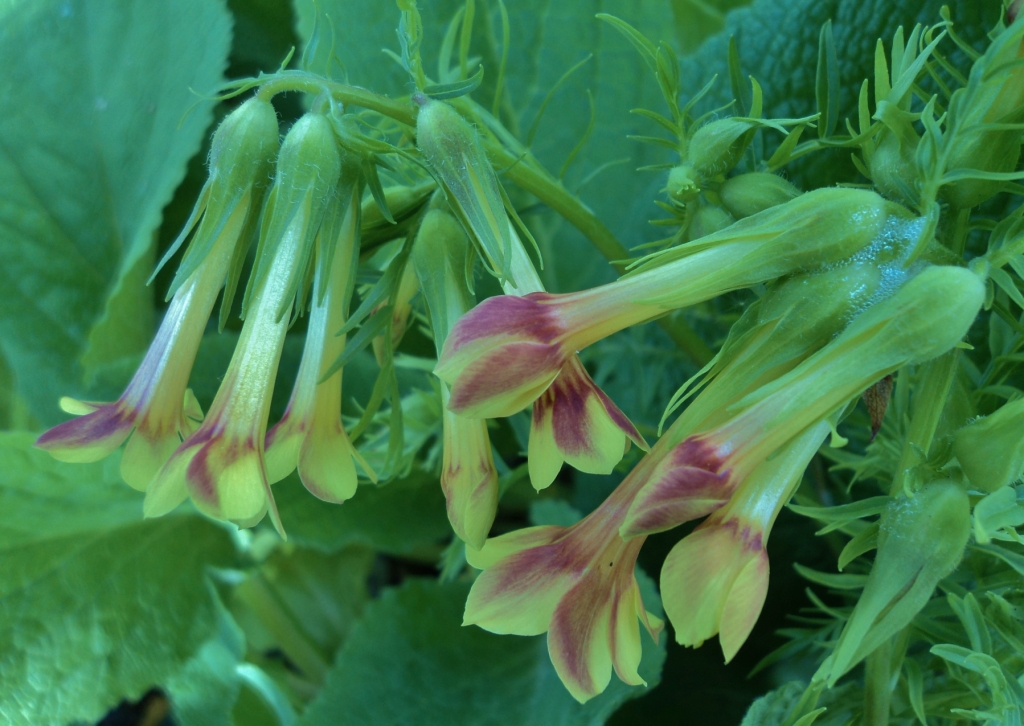
Polemonium pauciflorum - Yellow Jacob's Ladder - Hill Farm, June 2011. Image: HFN

Polemonium pauciflorum – Yellow Jacob’s Ladder – Hill Farm, June 2011. Image: HFN

Short-Lived Perennial. Zone 4. Polemoniaceae. Arizona, New Mexico, Texas.

This is a Jacob’s Ladder with a difference. Instead of the usual clusters of blue and lavender wide-open flowers, P. pauciflorum produces graceful downfacing sulphur yellow trumpets, blushed with dusky red.

The specific name, pauciflorum, translates as “few-flowered”, but this is a relative designation. There may be few in each cluster compared to the dense arrangements of many of its relatives, but there are many blooming stems produced. So many, in fact, that Yellow Jacob Ladder frequently “blooms itself to death”, fading away completely after its exertion.

Delicate, many-leafleted foliage in lush 12-inch wide clumps. The graceful flower clusters on slender, 12 to 18 inch stalks appear in spring and early summer.

A very nice little plant, rarely found commercially but popular in the “plant fanatic” seed exchange world, which is where I originally obtained mine, from a gardener in Wales. (A rather roundabout trip from its native home in southern North America!)

Polemonium pauciflorum frequently blooms profusely in its first season, so may be treated as an annual, though technically it is perennial. Allow it to set seed and self sow to ensure its continued presence in your garden. If collecting seed for sharing or growing out, be aware that it has a short viability period in dry, cool room temperature storage, of 6 months to a year at most in my experience.

Sun to light shade; average soil and moisture.

This plant's membership in the Phlox Family is very evident from the appearance of the tightly furled buds - something I hadn't really noticed regarding other species. Image: HFN

This plant’s membership in the Phlox Family is very evident from the appearance of the tightly furled buds – something I hadn’t really noticed regarding other species. Image: HFN

Biennial or short-lived perennial. Zone 2. Brassicaceae. Syn. Cheiranthus x marshallii. Despite the common name, Siberian Wallflower is most accurately described as originating in England. It was a deliberate cross made by John Marshall in 1846 between Erysimum perofskianum, originally native to the Middle East, in specific Persia, and E. decumbens, from northern Spain, the Pyrenees and the southwestern Alps.

The Brassica Family makes up for its generally utilitarian foliage – think of the humble cabbage, and kale, and all of the mustards, not to mention the inconspicuous foliage of our cottage garden stalwarts such as Dame’s Rocket (Hesperis) and Stocks (Matthiola) – by frequently having the sweetest scented of flowers. The Wallflowers surpass all of their relatives in this characteristic, being famously planted in combination with less-fragrant spring bulbs such as tulips, both for the contrasting beauty of their velvety flowers and for their outpouring of honey-rich, spicy fragrance.

Sadly, the “traditional” English wallflowers, Cheiranthus/Erysimum cheiri, with their large blooms in shades of antique red and rich brown, copper, cream and crimson are not reliably hardy in our Canadian climate, unless one happens to live in gentler-wintered regions such as B.C.’s lower mainland. The Siberian Wallflower happily steps in to fulfill the role of its more delicate cousin for us Northerners, and it does so in a most eye-catching and deliciously fragrant way.

Siberian Wallflower is technically a biennial, but I have had it flower profusely in its first year from early-sown seed. From fast-growing clumps of strap-shaped foliage sprouted in early March, an abundance of bud clusters appear in May, which quickly pop open in an endless succession of very fragrant, absolutely neon-bright orange blooms well into mid-summer.

The plants elongate and get a bit weedy looking as summer advances, but it is best to ignore this and leave at least a few plants to mature their seeds, because this pretty flower is quite happy to establish itself as a self-sowing permanent resident in the garden. It naturalizes quite nicely; we’ve seen it used among other wildflowers as a bank erosion planting, as well as in more traditional plantings.

Despite the self-sowing trait, it is considered non-invasive; seedlings are shallow rooted and very easy to eliminate, but are generally welcome wherever they appear, or you can clip the plants back after blooming.

Siberian Wallflower is a fairly modest thing, size-wise, growing about a foot or so tall. It is easy to tuck in here and there where its vibrant colour will accent other spring and early summer flowers, and it harmonizes particularly beautifully with its fellow biennial Forget-Me-Not (Myosotis), the warm orange and cool sky blue proving the artistic theory of contrasting colours to be a Very Good Thing in the garden as well as on the canvas.

Siberian Wallflower is occasionally offered in a bright yellow variation, ‘Citrona Yellow’, and in a number of other named strains in various degrees of yellow, gold and orange.

Full sun is preferred, and any sort of soil. Thrives with average fertility and watering care, and is quite drought tolerant once established.

Geum triflorum - Prairie Smoke, Nodding Avens - Alice Wolyzuk Botanical Garden, University of Northern British Columbia, Prince George, B.C. May 2014. Image: HFN

Geum triflorum – Prairie Smoke, Nodding Avens – Alice Wolczuk Alpine Garden, University of Northern British Columbia, Prince George, B.C., May 2014. Image: HFN

Perennial.  Zone 1. Rosaceae. A.k.a. PURPLE AVENS, THREE-FLOWERED AVENS, OLD MAN’S WHISKERS. Native to a large area of North America, from British Columbia through the prairie provinces, as far south as California, and eastward across the northern United States. Geum comes from the Latin name gaeum, “a plant with aromatic roots” which is derived from the Greek geno, “to yield an agreeable fragrance”. Triflorum = three-flowered, from the habit of the blooms to appear in clusters of three.

One of my favourite spring wildflowers, this pretty plant flourishes from the dry hillsides of the Cariboo to the prairie grasslands east of the Rockies. It happily adapts to the garden, and I always enjoy meeting it unexpectedly, flourishing in alpine and botanical gardens in its quiet way, as content to be treated with care in a plant collection as it is on the rocky slopes of the higher points of Hill Farm.

According to Plants of Northern British Columbia (1992: MacKinnon, Pojar, Coupé), Geum triflorum was used by the Thompson and Okanagan First Nations people to make a root tea for treating colds, flu and fever. The Blackfoot in Alberta were reported to use the crushed seed as a perfume.

Geum triflorum - flower details. Macalister, B.C., May 2010. Image: HFN

Geum triflorum – flower details. Macalister, B.C., May 2010. Image: HFN

Tidy clumps send up multiple 6 to 12 inch tall stems topped by triplets of dusky pink, nodding, bell shaped blooms. These never properly open, but are sought out regardless be tenacious early-foraging wild bees, which force their way into the downfacing bells. The insects’ great pollinating success is evident by the profuse seed heads which develop a little later.

These seed heads are Geum triflorum’s main attraction, and its showiest feature in June and July. Large, feathery, often spiralled, and very long lasting, they are prettily blushed with pink, which makes a delicate contrast to the soft green of the developing seeds at the centre of each cluster.

After pollination, the feathery seed heads start to expand. Prince George, May 2014. Image: HFN

After pollination, the feathery seed heads start to expand. Prince George, May 2014. Image: HFN

Foliage is softly downy, a gently sage green, and rather ferny in effect. It forms basal clusters, and stays attractive all season, eventually blushing rich red in autumn.

Nodding Avens has a rhizomatous root system, and gently spreads to form a generous colony where happy, but is never invasive or ill-behaved. Very nice for spring and early summer interest in the rockery or at the border front. Very good on slopes.

Best in sun but will tolerate light shade. Very adaptable to all sorts of soil. Very drought tolerant, but appreciates some extra moisture at the peak of summer.

Star-of-Persia - Allium christophii - June 6, 2014

Star-of-Persia – Allium christophii. Summerland, B.C., June 6, 2014. Image: HFN

Perennial. Zone 4. Liliaceae. Syn. Allium albopilosum Originally native to Iran, Turkey, and central Asia – general region of ancient Persia.  This lovely plant has been grown in western gardens since its first introduction to England in 1884.

I first grew this beautiful ornamental onion over 20 years ago, and I well remember how the reality of it exceeded my already high expectations. It is a wonderful thing.

This is a spectacular allium, gorgeous in all its stages, bud to bloom to seed head. Clumps of long (to 20 inches), grey-green, strap-shaped leaves appear in early spring, soon followed by 12 to 24 inch stalks topped by a quickly expanding sheathed bud, which explodes in late May into a huge bloom cluster – up to 12 inches in diameter – which consists of many pale lavender star flowers.

Allium christophii - unfolding star flowers - a beautifully fascinating process. Image: HFN

Allium christophii – unfolding star flowers – a beautifully fascinating process. Image: HFN

These continue to look good for weeks, gradually transfiguring into plump green seed pods, which can be left alone to eventually dry in place, giving a rather surreal accent to the border. (Or they can be harvested just as they start to turn yellow and hung to dry as unique everlastings.) The fresh and green seed stage blooms are wonderful as cutflowers, too.

The foliage quickly withers and is gone by midsummer, by which time other plants have filled in to hide the yellowing leaves. Where happy, on well-drained soil in full sun, these bulbs will slowly reproduce to form an increasingly large colony.

Bulbs may be lifted in midsummer to early fall, and (if they have formed a cluster) separated and replanted. Because of the size of the blooms, it is best to space them fairly generously, up to a foot apart, or a bit closer if you are going for a cluster effect.

Sun; average soil & moisture. Quite drought tolerant. Appreciates good drainage.

A flourishing colony of Star-of-Persia in the Summerland Ornamental Garden. June, 2014. Image: HFN

A flourishing colony of Star-of-Persia in the Summerland Ornamental Garden. June, 2014. Image: HFN

??????????????????????

Achillea filipendulina – ‘Cloth of Gold’ Fernleaf Yarrow. Hill Farm, July 2014. Image: HFN

Perennial. Zone 2. Compositae. Syn. Achillea eupatorium (obsolete). Eupatorium referred to the plant’s native presence around the city of Eupatoria (Yevpatoria) on the Crimean coast. The species is native to Europe’s Caucasus Mountains, Turkey, Iran, Central Asia, and Afghanistan. There are a number of improved cultivars which are widely grown in gardens. ‘Cloth of Gold’ is a well-known older variety, which received the Royal Horticultural Society’s Award of Garden Merit in 1999.

Poor Fernleaf Yarrow – it seems to be named mainly for its resemblance to other plants! The specific names filipendulina refers to its foliar similarity to Meadowsweet, Filipendula species. The common name “Fernleaf” needs no explanation.

Esteemed horticulturalist William Robinson, in his 1883 masterwork, The English Flower Garden, had this to say:

Achillea eupatorium (sometimes called A. filipendulina) is a tall-growing, vigorous, herbaceous plant, somewhat woody in its lower growth. Its flowering corymbes are flat, bright yellow in colour, and elevated on stout stems to a height of 3 ft. to 4 ft.; they retain their beauty and freshness for at least two months. This is admirably adapted for a shrubbery border, where its brilliant yellow flowers and its erect habit of growth show to wonderful advantage amongst the evergreen foliage. It is native to the shores of the Caspian Sea, and is one of the finest of perennials.

Shining yellow flowers in flattened domes top strong 24-inch or taller stems. In habit, Fernleaf Yarrow is a non-invasive clump-former. Foliage is light sage-green, and warmly aromatic.

This is a superb everlasting and cutflower – heads can reach 5 inches or more across. Some years ago, when I was growing everlastings and making wreaths and arrangements for sale, this was outstanding for its effect and attractive colour.

Close-up of the tightly packed flower head, with 6-legged visitors.

Close-up of the tightly packed flower head, with 6-legged visitors. Completely pest-free, though frequented by insects of all sorts seeking nectar and pollen. Hill Farm, July 2014. Image: HFN

Fernleaf Yarrow is one of those bombproof plants which just keep on looking good (or at the very least decent) even in challenging conditions. It has times of great beauty – new spring foliage is downy-soft, pleasingly aromatic, and elegantly fern-like, while the huge corymbes of tiny, bright yellow flowers remain gloriously untarnished for an astounding length of time – but even when the gold fades to brown and the leaves get a bit dusty-looking round about the beginning of autumn it remains upright and respectable.

This plant is a star of the xeriscape garden, thriving in sunny and dry locations, though it is appreciative of some supplemental moisture at summer’s peak. However, too rich a soil and too much moisture will cause Fernleaf Yarrow to produce lush foliage at the expense of flowers.

This plant is reputed to be very deer resistant, likely because of its downy foliage and high aromatic oil content.


Work in Progress:

  • aug 13 2011 018 (3)

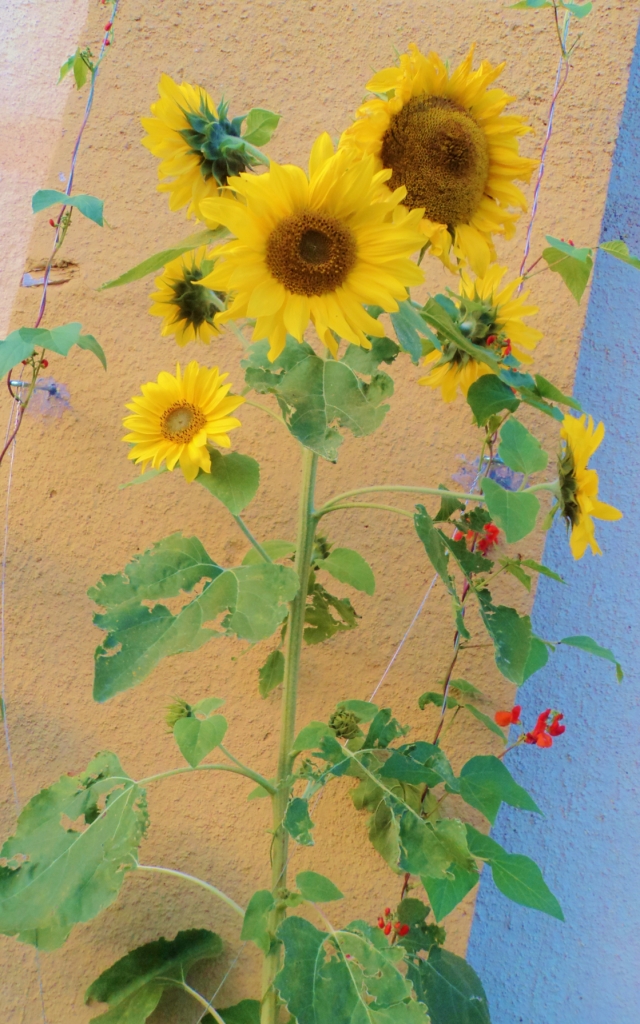
    Sunflowers and Scarlet Runner Beans – Revelstoke, B.C. – August 2011. Image: HFN

    This is a “sticky” post and remains permanently at the top of the page. To get to the plants, please scroll down.

  • We are continually adding posts to this page. It is indexed and searchable, and can be referenced year to year.
  • Plant Portraits appear in order of posting, but if you are looking for something in particular, you can click over to the PLANT INDEX page, which is an ongoing compilation of links, or use the SEARCH function which appears in the right hand sidebar.
  • This page is not a sales list – it’s a general interest discussion of plants we’ve encountered:  in our gardens, in other people’s gardens, and in the wild.
  • Double-clicking photos will usually enlarge them in a new window.

The Legal Stuff:

  • All herbal/medicinal information is provided for general interest only. Please do not use historical or anecdotal references as a recommendation and/or guarantee of safe use.
  • For commercial use of Hill Farm Nursery images or information, please contact us for permission. High resolution images are available for purchase as jpeg files; please inquire.
  • For general non-commercial reuse, a quick message to ask permission is also requested; we are very easy to deal with! A credit/link to our site is appreciated.
Slene dioica aurea - Ray's Golden Campion. Hill Farm, June 2012.

Silene dioica aurea – ‘Ray’s Golden Campion’. Hill Farm, June 2012. Image: HFN

Perennial. Zone 4. Caryophyllaceae. Syn. Melandrium rubrum; syn. Lychnis dioica. (Both names are now obsolete.)  The green-leaved Silene dioica, Rosy Campion, is a common European wildflower which has been grown in gardens for centuries. There are numerous cultivars, of which ‘Ray’s Golden’ is one of the most recent, and notable because of its ease of cultivation and trueness from seed.

This is one of those garden colour combinations which really shouldn’t work – shocking pink with chartreuse – but it does, and extremely well, too.

‘Ray’s Golden Campion’ is a recent introduction from English nurseryman Ray Brown at Plant World in Devon, who painstakingly stabilized this sport of the well-known Rosy Campion. When I received my packet of seed, I was warned to rogue out any green-leaved seedlings which appeared; this was tremendously easy to do, as the gold-foliaged seedlings were immediately conspicuous from the first unfolding of their cotyledons.

The first season the plants formed lush rosettes; the striking foliage colour remained true all summer. By late spring of the second year bloom stems appeared. I was very pleased to note that these were flushed with a contrasting red tint, as were the buds, which popped open into pretty, white-eyed, hot pink flowers in mid June. They bloomed and bloomed and bloomed, right through July, subsiding at last in mid August, when they started to mature seed in tiny, bottle-shaped capsules.

A few of the plants in my test row succumbed to their second winter, but most soldiered on. Self sown seedlings were mostly gold-leaved, and the population sustained itself quite nicely up in the “delphinium jungle” of my neglected growing-out garden. After the second year I did not bother rogueing out the green seedlings, and now, five years later, much of the stand has reverted to green foliage. Still very pretty – Rosy Campion is a nice cottage garden flower even in its “unimproved” state – but not nearly as eye-popping as the original planting.

This is a mid-sized sort of plant. Foliage rosettes are about a foot in diameter; bloom stalks are 12 inches or so tall when they first bloom, elongating to 18 inches by mid-summer. Nice in a foreground planting. These combine beautifully with delphiniums; the pink and gold of the Silene contrasting beautifully with any of the delphinium blues.

This plant appreciates full sun. It is not fussy as to soil, and, though it flourishes most lavishly with regular summer watering, it has proven itself quite drought tolerant, surviving and blooming for most of the summer among the grasses which have taken over the neglected sections of the nursery garden.


Blooming at the same time as delphiniums, Ray's Golden Campion is a eye-catching contrast plant and makes a grand foreground companion to the cobalts, azures, and sky blues of its garden neighbour. Hill Farm, July 2012.

Blooming at the same time as Delphinium, ‘Ray’s Golden Campion’ is a eye-catching contrast plant and makes a grand foreground companion to the cobalts, azures, and sky blues of its garden neighbour. Hill Farm, July 2012. Image: HFN


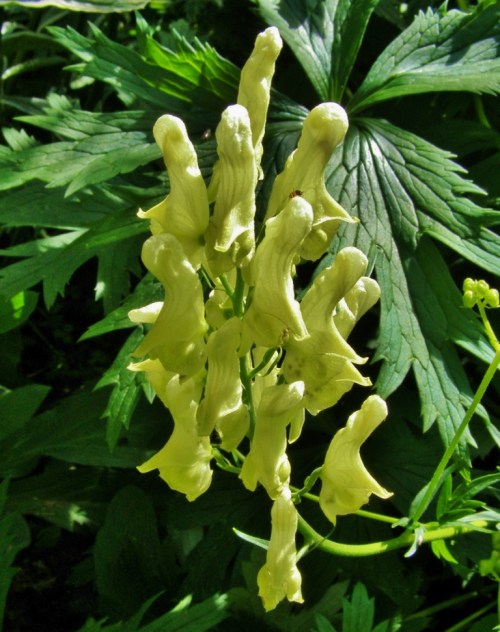
Aconitum lycoctonum ssp. vulparia; syn. Aconiyum lamarckii. Hill Farm, August 2011.

Aconitum lycoctonum ssp. vulparia; syn. Aconitum lamarckii. Hill Farm, August 2011. Image: HFN

Perennial. Zone 2. Ranunculaceae. A.k.a. NORTHERN WOLFSBANE, FOXBANE, YELLOW MONKSHOOD. The Aconitums are in general a rather complex genus, with much natural adaptation and inter-species hybridization, so this species (or slight variations thereof) may appear under various names. A. lycoctonum is frequently thought to be synonymous with A. lamarckii and/or A. pyrenaicum and/or A. ranunculifolium (obsolete); it may also appear under the name A. vulparia. This somewhat variable species is native to Southern Europe, being found in the wild in France, Spain, Morocco, Northern Greece, Bulgaria and Romania. It grows in high-shade forest, in meadows and by stream sides, and flowers in July and August.

The genus name Aconitum is thought to come from the ancient Greek village of Akonai, the site of which is now in Turkey. Nearby is a cave which was said to house the entrance to Hades, which was famously guarded by the three-headed dog Cerebus. The places where the froth from Cerebus’s maddened slavering fell to earth was thought to have been marked by these plants, which were notorious for their poisonous properties.

The species name lycoctonum originates from the Greek: lycos = wolf, and kteinein = kill, which is the origin of the common name wolfsbane, as the roots were used to formulate arrow poisons, and were added to meat left out to bait wolves and foxes.

The many members of the large Ranunculus (Buttercup) Family are in general excellent garden plants for colder regions such as the Cariboo-Chilcotin, and this unusual Monkshood is no exception, being hardy, attractive, and trouble free.

The foliage is lush, dark green, and raggedly cut. It forms clumps to 2 feet tall and wide, from which many slender stems arise in early summer. These produce clusters of intriguing greeny-yellow buds, which slowly expand into elongated, pale sulphur yellow, hooded blooms in mid and late summer. The bloom stalks tend to overbalance themselves when flowering is at its peak, so sturdy neighbours or a bit of modest staking is beneficial.

Buds and blooms are often tinted green. Hill Farm, August 2011.

Buds and blooms are often strongly tinted green. Hill Farm, August 2011. Image: HFN

Margery Fish, writing in 1964 in  A Flower for Every Day, has this to say:

Aconitum lycoctonum may not have enough colour for everybody, but some of us enjoy the greeny cream narrow flowers, perched like birds on rangy stems. It is not a compact plant and likes to behave in our gardens as it does in its native Austria. It doesn’t take kindly to restraint, so the thing to do is to grow it with perennials with which it can intermingle and make a pleasing picture. I have it in front of tall species Phlox paniculata, which has soft lavender flowers, and behind that is a big clump of Achillea [filipendulina] ‘Gold Plate’.

I share Margery’s fondness for this quietly attractive plant, and have a single sturdy clump which I rather cherish. It is very long-lived, and prefers a permanent garden spot where it can be undisturbed. I have occasionally moved my plant, and, several years ago, decided that it was large enough to divide for sale. I chopped it into what I thought were generous clumps and replanted several after potting up the majority of the divisions. While all took this treatment with fair aplomb, the pieces I replanted sulked flowerless for several years, obviously needing to get their roots well down until putting energy into blooming. The plant appears to be happy again, giving me a nice display in 2014, but I will think hard before I dig it up again. I may try it from seed in order to increase it for the nursery; there are some ripe seed heads now in October which I intend to shake out into a flat to stratify over winter.

Blooming stalks reach 4 feet or so, but are rather airy in effect, so mid-border is a good location. Aconitum lycoctonum appreciates humus-rich soil and generous summer moisture. It is happy in full sun to high shade, and would be perfect in a woodland garden setting.

Though one should definitely be aware of the plant’s potential toxicity, unless one gardens with small children prone to random leaf sampling, there should be no issues with using it in the flower border. The foliage is extremely bitter to taste and accidental poisonings are very rare; one would definitely notice something amiss very early on. Be careful when pruning and transplanting, wear gloves if you will be in contact with the running sap, don’t plant it in the culinary herb garden, grow it mid-border – away from small visitors and chewing puppies – and you should be fine.

Hill Farm, August 2011.

Yet another picture of the bloom cluster. Check out the typical “monk’s cowl” (or “birds-on-a-branch”) flower structure, as well as the developing bud cluster at bottom right. Hill Farm, August 2011. Image: HFN

physostegia variegate fall 2011

Variegated Obedient Plant – Physostegia virginiana ‘variegata’ – Hill Farm, late September 2011. Image: HFN

Perennial. Zone 3. Lamiaceae.  The species is native to eastern North America. This cultivar is a stabilized sport and is found only in gardens.

Clump former to 3 or 4 feet tall. Spreads slowly by creeping rootstalks. Sun to light shade; any soil fine; appreciates summer moisture in hot regions.

The genus name comes from the Greek: physa = bladder and stege = covering, referring to the inflated calyx at the base of each floret.  The common name comes from the hinged sockets which attach each floret to the main cluster; these can be gently twisted and turned, with the new configuration remaining for a few moments until the bloom slowly returns to its original position.

This handsome plant is one of my favourite fall bloomers. It starts to send out intricate bud spikes in August; these slowly extend and enlarge until mid-September when the first bright purple, cheerfully freckled, snapdragon-like flowers start to open. It is in peak bloom by Canadian Thanksgiving, lighting up the garden in stunning contrast to the yellowing foliage of the perennials around it.

physostegia variegate sept 2011

Variegated Obedient Plant reaches full glory as its garden neighbours start to fade, setting off their yellowing foliage to perfection. Here at Hill Farm it shares a bed with tall Joe-Pye Weed, Eupatorium purpureum, another eastern wildflower, taking over the show as its neighbour goes to seed. Image: HFN

Very cold tolerant, and lasts until the hardest frosts which finally blacken it in November.

In its native habitat Obedient Plant is found in meadows, open woodlands, and along stream banks. It is very adaptable, though it prefers not to be too dry in summer. The variegated cultivar is restrained in its spread, though it will expand to a sizable clump over the years. Keep an eye on more delicate neighbours. My treasured clump is due for division soon, as it is finally encroaching on its companion, an equally treasured clump of early spring blooming Liverleaf, Hepatica nobilis, after growing side by side with no conflict for the past 5 years.

Reaching a respectable 4 feet tall where happy, this plant tends to flop under the weight of its bloom spikes, so an unobtrusive staking mid-summer is a good idea. Years when I forget to do this I am punished for my neglect by the snapping off of full-flowered bloom stalks at their bases. Luckily it makes an excellent cutflower so all is not lost; however its value in the garden exceeds any bouquet so this is a situation one should strive to prevent.

As with many variegated plants, it is not as vigorous as its plainer relatives, so will take a few years to reach its full potential. The plus side of this is that it is very maintenance free, despite the staking recommendation and the occasional need for curbing/division in full maturity. Physostegia virginiana in all of its varieties is long-lived, and completely pest and disease free.

A grand plant, not terribly common in Cariboo-Chilcotin gardens, but very suitable for our conditions.

physostegia variegata close up 2 sept oct 2011

Just coming into bloom, September 2, 2011. Image: HFN

physostegia foliage detail variegata august 2011

The variegation extends to every part of the plant, including the intricately symmetrical bud spikes which start to form in August. Image: HFN

physostegia variegate close up 2 oct 2012

Another detail of the fascinating blooms and white foliar variegation. Hill Farm, October 2, 2012. Image: HFN

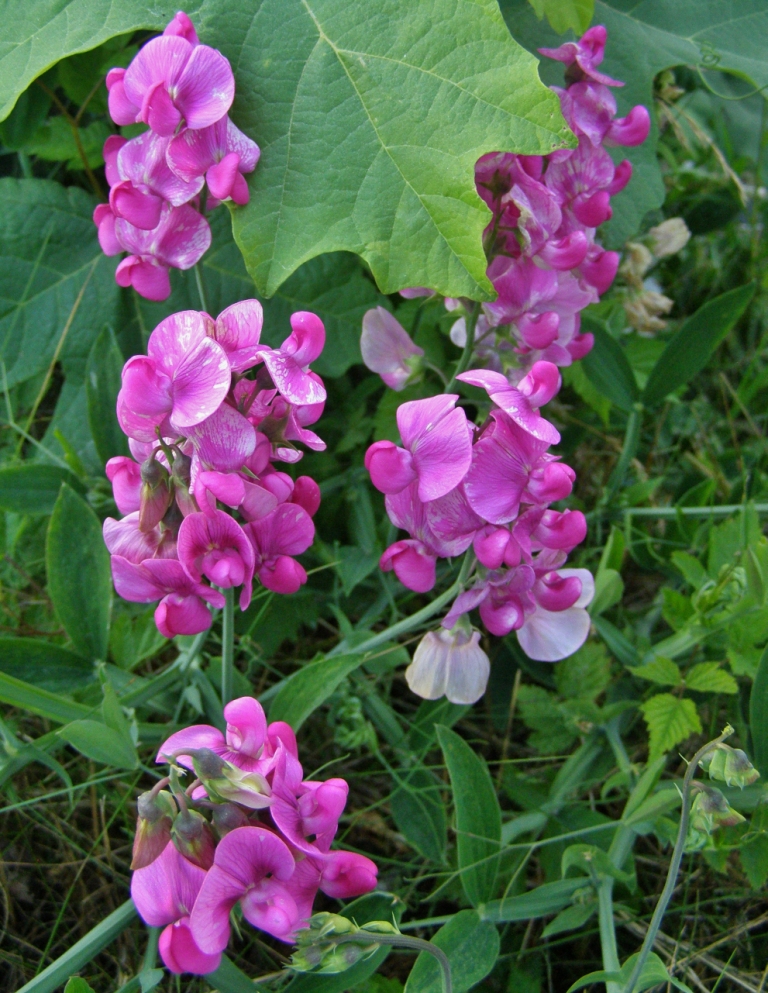
Perennial Sweet Pea - Lathyrus latifolius - naturalized at Pitt Lake, near Maple Ridge, B.C., August 2011.

Perennial Sweet Pea – Lathyrus latifolius – naturalized along the shores of  Pitt Lake, near Maple Ridge, B.C., August 2011. Image: HFN

Perennial Herbaceous Vine. Zone 3. Fabaceae, formerly Leguminosae.  Originally native to Southern Europe, now sometimes seen naturalized in disturbed-soil areas as a garden escapee throughout Europe, Great Britain, and parts of North America, including coastal British Columbia. Lathyrus is from the Greek lathyros, pea; latifolius from the Latin latus + folium, wide + leaf.

Clump former to 18 inches wide; sprawls or climbs 3 to 6 feet tall by twining tendrils in the leaf axils. Fine in average soil and moisture; prefers full sun. Established plants are reasonably drought tolerant, but thrives best with summer moisture and fertile soil.

This pretty climber/sprawler is rather rare in Cariboo-Chilcotin gardens, but I have seen it thriving often enough here and there in Zone 3 and 4 Williams Lake and Quesnel area plantings to be able to confidently recommend its hardiness and adaptability.

The plant forms a vigorous clump of rapidly elongating stems lined with paired, blue-green leaflets. Bloom stalks and twining tendrils emerge from the leaf axils as the stems lengthen. Clusters of very showy, sweet pea-like flowers bloom for a long period June through August, and are followed by typical large, flat pea-pods filled with big round seeds. (These are not considered edible, by the way, and occasionally are referenced as “poisonous”, though I have not seen any mention of actual incidents of poisoning.)

Sadly, the “sweet” reference is merely to its similar appearance to the highly fragrant annual sweet pea, Lathyrus odoratus, as Perennial Sweet Pea is not noticeably fragrant.

Vines reach 3 to 6 feet long – tallest where it can climb, and where grown in moist, fertile soil – and either sprawl along the ground or twine their way up whatever support they can find. Very nice grown on a bank where it can cascade, or on a sturdy trellis or garden obelisk arrangement. Vines are completely herbaceous, and die back to the ground in the winter, to re-sprout in spring. Sometimes late to emerge, so keep an eye out for it when digging about in the spring garden.

A very long-lived plant, which should be sited where it can remain as it does not transplant well. It may self sow, but though definitely a “survivor” where established, it is not aggressive and is not considered an invasive plant in our climate, though it is occasionally seen as a naturalized garden escapee in disturbed soil areas along coastal British Columbian roadsides where it has joined other exotics such as butterfly bush (Buddleja sp.), touch-me-not (Impatiens sp.), and the ubiquitous Himalayan Blackberries.

Lathyrus latifolius naturalized along the shoreline roadway at Pitt Lake, near Maple Ridge, B.C. August, 2011.

Lathyrus latifolius naturalized along the shoreline roadway at Pitt Lake, near Maple Ridge, B.C. August, 2011. Image: HFN

Lathyrus latifolius has been grown as a prized garden flower for centuries throughout Europe and the British Isles, and in North American colonial plantings, and the pink strain appears in the 1801 species inventory of Thomas Jefferson’s famed Monticello garden.

This plant often shows up on old herb garden lists, but no medicinal uses are recorded. Apparently the foliage was occasionally used as a pot herb, and the seeds cooked and consumed for their high protein content, but present-day consumption is definitely NOT recommended, as the seeds of some of the species in the Lathyrus genus do contain potentially harmful amino aids. Best to enjoy it for its beauty alone, as most of our gardening predecessors did.

Many species of bees and butterflies visit the flowers in search of nectar, as do occasional questing hummingbirds, but the floral structure is designed for pollination by bumblebees, as they alone are strong enough to part the keel petals which enclose the reproductive parts of the blooms.

Three old-fashioned named strains are still available; all are very lovely. ‘RED PEARL’  – rich carmine pink. ‘ROSE PEARL’ aka ‘PINK BEAUTY’ – pale pink flushed darker at petal edges. ‘WHITE PEARL’ – pristine snow white.

Lathyrus latifolius - Perennial Sweet Pea - 'Red Pearl'

Lathyrus latifolius – typical of  ‘Red Pearl’ colour strain – Maple Ridge, August 2011. Image: HFN