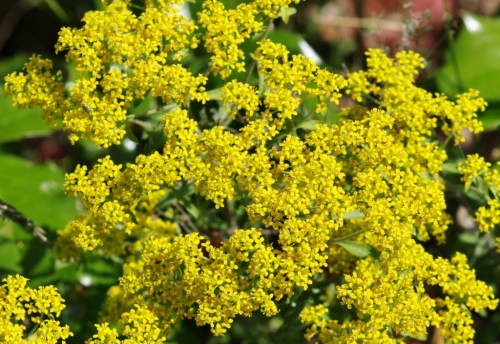
Archive for the ‘Summer’ Category

Giant Crambe - Crambe cordifolia - a Hill Farm plant growing in our good friend Ellen's Soda Creek, B.C. garden - July 2008. Image: HFN

Giant Crambe – Crambe cordifolia – a Hill Farm plant growing in our good friend Ellen’s Soda Creek, B.C. garden – July 2008. Image: HFN

Perennial. Zone 3. Brassicaceae (formerly Cruciferae.) Caucasus Mountains. A.k.a. COLEWORT, GIANT SEA KALE.

This plant has been grown in gardens for at least 100 years, and is much sought after by anyone who has seen it in the dramatic mixed perennial flower borders of famous British country estates.

A most substantial plant, this is! Imagine a Volkswagen Beetle sized space commitment for its admittedly brief bloom time, 3 weeks at best. Okay, perhaps that is a slight exaggeration. But this thing can get huge.

Large, thick-textured, hairy basal leaves produce tall, multi-branching stems from 3 to 6 feet tall, which produce clouds of very sweetly-scented, pure white flowers in early summer. Looks like a Baby’s Breath gone wild, is one comment a happy customer made when proudly showing me a photo of her immense 5-year-old plant.

Crambe cordifolia takes a while to reach full size, usually blooming year three or thereabouts. Site carefully, as it is tap-rooted and dislikes being moved. Though not at all invasive, it may also persistently re-sprout from chunks of taproot left in the soil if you do decide to  move it once it is established. Frequently the transplanted piece will languish and die, after a long, yellow-leaved decline, so think hard before getting out your shovel.

Being in the Brassica Family, Crambe cordifolia is attractive to Cabbage Moths, so keep an eye out for the caterpillars, as they can skeletonize those big leaves surprisingly quickly, leaving nothing but the centre ribs. Most gardeners cut off the bloom stalks once flowering is finished, but if you want to try to ripen seed, or just simply like the look of the thing for its curiousity factor, you can certainly leave it alone, though a stake is a good idea, as summer thunderstorms may topple the aging edifice.

When I first experimented with Crambe cordifolia I was rather worried about its hardiness; most Zone ratings were for 6 or thereabouts, but after almost 20 years of growing and selling it, and much customer feedback (most enthusiastic, though some people felt it got too big, or were troubled by resprouting roots after digging up established plants) I can firmly state that Zone 3 suits it just fine.

Full sun. Very drought tolerant once established, though it appreciates summer moisture and reasonable fertility for the best after-blooming foliage health.

bbb

One more look at Ellen’s Giant Crambe, with Asiatic lilies at its feet. Honey-scented, and alive with bees. Soda Creek, B.C., July 2008. Image: HFN

Read Full Post »

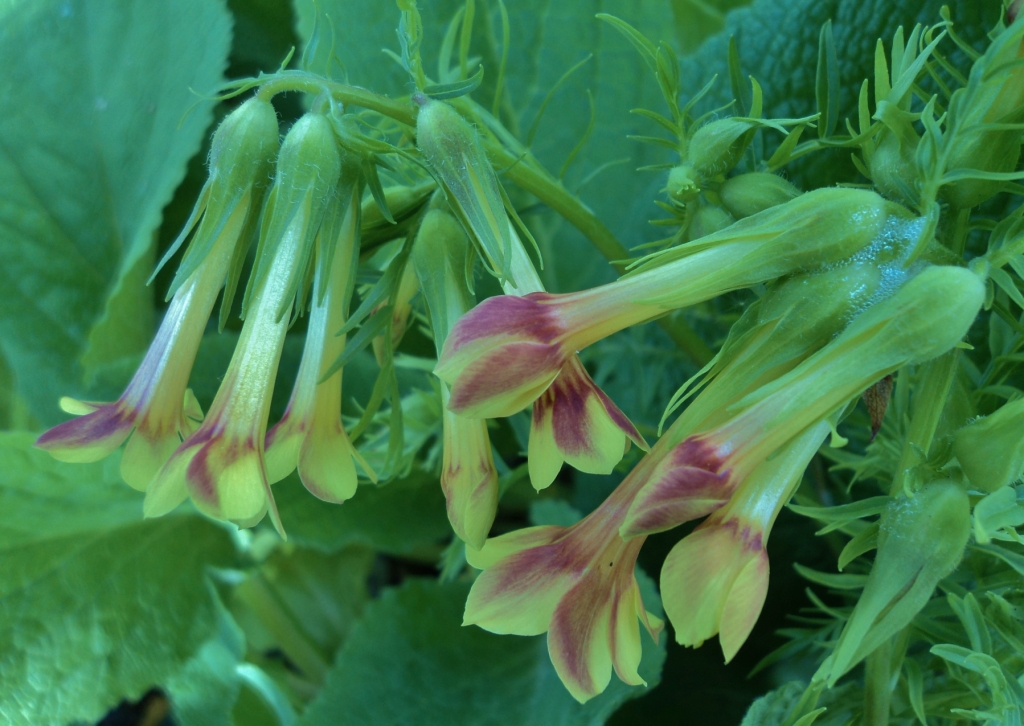
Polemonium pauciflorum - Yellow Jacob's Ladder - Hill Farm, June 2011. Image: HFN

Polemonium pauciflorum – Yellow Jacob’s Ladder – Hill Farm, June 2011. Image: HFN

Short-Lived Perennial. Zone 4. Polemoniaceae. Arizona, New Mexico, Texas.

This is a Jacob’s Ladder with a difference. Instead of the usual clusters of blue and lavender wide-open flowers, P. pauciflorum produces graceful downfacing sulphur yellow trumpets, blushed with dusky red.

The specific name, pauciflorum, translates as “few-flowered”, but this is a relative designation. There may be few in each cluster compared to the dense arrangements of many of its relatives, but there are many blooming stems produced. So many, in fact, that Yellow Jacob Ladder frequently “blooms itself to death”, fading away completely after its exertion.

Delicate, many-leafleted foliage in lush 12-inch wide clumps. The graceful flower clusters on slender, 12 to 18 inch stalks appear in spring and early summer.

A very nice little plant, rarely found commercially but popular in the “plant fanatic” seed exchange world, which is where I originally obtained mine, from a gardener in Wales. (A rather roundabout trip from its native home in southern North America!)

Polemonium pauciflorum frequently blooms profusely in its first season, so may be treated as an annual, though technically it is perennial. Allow it to set seed and self sow to ensure its continued presence in your garden. If collecting seed for sharing or growing out, be aware that it has a short viability period in dry, cool room temperature storage, of 6 months to a year at most in my experience.

Sun to light shade; average soil and moisture.

This plant's membership in the Phlox Family is very evident from the appearance of the tightly furled buds - something I hadn't really noticed regarding other species. Image: HFN

This plant’s membership in the Phlox Family is very evident from the appearance of the tightly furled buds – something I hadn’t really noticed regarding other species. Image: HFN

Read Full Post »

Star-of-Persia - Allium christophii - June 6, 2014

Star-of-Persia – Allium christophii. Summerland, B.C., June 6, 2014. Image: HFN

Perennial. Zone 4. Liliaceae. Syn. Allium albopilosum Originally native to Iran, Turkey, and central Asia – general region of ancient Persia.  This lovely plant has been grown in western gardens since its first introduction to England in 1884.

I first grew this beautiful ornamental onion over 20 years ago, and I well remember how the reality of it exceeded my already high expectations. It is a wonderful thing.

This is a spectacular allium, gorgeous in all its stages, bud to bloom to seed head. Clumps of long (to 20 inches), grey-green, strap-shaped leaves appear in early spring, soon followed by 12 to 24 inch stalks topped by a quickly expanding sheathed bud, which explodes in late May into a huge bloom cluster – up to 12 inches in diameter – which consists of many pale lavender star flowers.

Allium christophii - unfolding star flowers - a beautifully fascinating process. Image: HFN

Allium christophii – unfolding star flowers – a beautifully fascinating process. Image: HFN

These continue to look good for weeks, gradually transfiguring into plump green seed pods, which can be left alone to eventually dry in place, giving a rather surreal accent to the border. (Or they can be harvested just as they start to turn yellow and hung to dry as unique everlastings.) The fresh and green seed stage blooms are wonderful as cutflowers, too.

The foliage quickly withers and is gone by midsummer, by which time other plants have filled in to hide the yellowing leaves. Where happy, on well-drained soil in full sun, these bulbs will slowly reproduce to form an increasingly large colony.

Bulbs may be lifted in midsummer to early fall, and (if they have formed a cluster) separated and replanted. Because of the size of the blooms, it is best to space them fairly generously, up to a foot apart, or a bit closer if you are going for a cluster effect.

Sun; average soil & moisture. Quite drought tolerant. Appreciates good drainage.

A flourishing colony of Star-of-Persia in the Summerland Ornamental Garden. June, 2014. Image: HFN

A flourishing colony of Star-of-Persia in the Summerland Ornamental Garden. June, 2014. Image: HFN

Read Full Post »

??????????????????????

Achillea filipendulina – ‘Cloth of Gold’ Fernleaf Yarrow. Hill Farm, July 2014. Image: HFN

Perennial. Zone 2. Compositae. Syn. Achillea eupatorium (obsolete). Eupatorium referred to the plant’s native presence around the city of Eupatoria (Yevpatoria) on the Crimean coast. The species is native to Europe’s Caucasus Mountains, Turkey, Iran, Central Asia, and Afghanistan. There are a number of improved cultivars which are widely grown in gardens. ‘Cloth of Gold’ is a well-known older variety, which received the Royal Horticultural Society’s Award of Garden Merit in 1999.

Poor Fernleaf Yarrow – it seems to be named mainly for its resemblance to other plants! The specific names filipendulina refers to its foliar similarity to Meadowsweet, Filipendula species. The common name “Fernleaf” needs no explanation.

Esteemed horticulturalist William Robinson, in his 1883 masterwork, The English Flower Garden, had this to say:

Achillea eupatorium (sometimes called A. filipendulina) is a tall-growing, vigorous, herbaceous plant, somewhat woody in its lower growth. Its flowering corymbes are flat, bright yellow in colour, and elevated on stout stems to a height of 3 ft. to 4 ft.; they retain their beauty and freshness for at least two months. This is admirably adapted for a shrubbery border, where its brilliant yellow flowers and its erect habit of growth show to wonderful advantage amongst the evergreen foliage. It is native to the shores of the Caspian Sea, and is one of the finest of perennials.

Shining yellow flowers in flattened domes top strong 24-inch or taller stems. In habit, Fernleaf Yarrow is a non-invasive clump-former. Foliage is light sage-green, and warmly aromatic.

This is a superb everlasting and cutflower – heads can reach 5 inches or more across. Some years ago, when I was growing everlastings and making wreaths and arrangements for sale, this was outstanding for its effect and attractive colour.

Close-up of the tightly packed flower head, with 6-legged visitors.

Close-up of the tightly packed flower head, with 6-legged visitors. Completely pest-free, though frequented by insects of all sorts seeking nectar and pollen. Hill Farm, July 2014. Image: HFN

Fernleaf Yarrow is one of those bombproof plants which just keep on looking good (or at the very least decent) even in challenging conditions. It has times of great beauty – new spring foliage is downy-soft, pleasingly aromatic, and elegantly fern-like, while the huge corymbes of tiny, bright yellow flowers remain gloriously untarnished for an astounding length of time – but even when the gold fades to brown and the leaves get a bit dusty-looking round about the beginning of autumn it remains upright and respectable.

This plant is a star of the xeriscape garden, thriving in sunny and dry locations, though it is appreciative of some supplemental moisture at summer’s peak. However, too rich a soil and too much moisture will cause Fernleaf Yarrow to produce lush foliage at the expense of flowers.

This plant is reputed to be very deer resistant, likely because of its downy foliage and high aromatic oil content.


Read Full Post »

Slene dioica aurea - Ray's Golden Campion. Hill Farm, June 2012.

Silene dioica aurea – ‘Ray’s Golden Campion’. Hill Farm, June 2012. Image: HFN

Perennial. Zone 4. Caryophyllaceae. Syn. Melandrium rubrum; syn. Lychnis dioica. (Both names are now obsolete.)  The green-leaved Silene dioica, Rosy Campion, is a common European wildflower which has been grown in gardens for centuries. There are numerous cultivars, of which ‘Ray’s Golden’ is one of the most recent, and notable because of its ease of cultivation and trueness from seed.

This is one of those garden colour combinations which really shouldn’t work – shocking pink with chartreuse – but it does, and extremely well, too.

‘Ray’s Golden Campion’ is a recent introduction from English nurseryman Ray Brown at Plant World in Devon, who painstakingly stabilized this sport of the well-known Rosy Campion. When I received my packet of seed, I was warned to rogue out any green-leaved seedlings which appeared; this was tremendously easy to do, as the gold-foliaged seedlings were immediately conspicuous from the first unfolding of their cotyledons.

The first season the plants formed lush rosettes; the striking foliage colour remained true all summer. By late spring of the second year bloom stems appeared. I was very pleased to note that these were flushed with a contrasting red tint, as were the buds, which popped open into pretty, white-eyed, hot pink flowers in mid June. They bloomed and bloomed and bloomed, right through July, subsiding at last in mid August, when they started to mature seed in tiny, bottle-shaped capsules.

A few of the plants in my test row succumbed to their second winter, but most soldiered on. Self sown seedlings were mostly gold-leaved, and the population sustained itself quite nicely up in the “delphinium jungle” of my neglected growing-out garden. After the second year I did not bother rogueing out the green seedlings, and now, five years later, much of the stand has reverted to green foliage. Still very pretty – Rosy Campion is a nice cottage garden flower even in its “unimproved” state – but not nearly as eye-popping as the original planting.

This is a mid-sized sort of plant. Foliage rosettes are about a foot in diameter; bloom stalks are 12 inches or so tall when they first bloom, elongating to 18 inches by mid-summer. Nice in a foreground planting. These combine beautifully with delphiniums; the pink and gold of the Silene contrasting beautifully with any of the delphinium blues.

This plant appreciates full sun. It is not fussy as to soil, and, though it flourishes most lavishly with regular summer watering, it has proven itself quite drought tolerant, surviving and blooming for most of the summer among the grasses which have taken over the neglected sections of the nursery garden.


Blooming at the same time as delphiniums, Ray's Golden Campion is a eye-catching contrast plant and makes a grand foreground companion to the cobalts, azures, and sky blues of its garden neighbour. Hill Farm, July 2012.

Blooming at the same time as Delphinium, ‘Ray’s Golden Campion’ is a eye-catching contrast plant and makes a grand foreground companion to the cobalts, azures, and sky blues of its garden neighbour. Hill Farm, July 2012. Image: HFN


Read Full Post »

Aconitum lycoctonum ssp. vulparia; syn. Aconiyum lamarckii. Hill Farm, August 2011.

Aconitum lycoctonum ssp. vulparia; syn. Aconitum lamarckii. Hill Farm, August 2011. Image: HFN

Perennial. Zone 2. Ranunculaceae. A.k.a. NORTHERN WOLFSBANE, FOXBANE, YELLOW MONKSHOOD. The Aconitums are in general a rather complex genus, with much natural adaptation and inter-species hybridization, so this species (or slight variations thereof) may appear under various names. A. lycoctonum is frequently thought to be synonymous with A. lamarckii and/or A. pyrenaicum and/or A. ranunculifolium (obsolete); it may also appear under the name A. vulparia. This somewhat variable species is native to Southern Europe, being found in the wild in France, Spain, Morocco, Northern Greece, Bulgaria and Romania. It grows in high-shade forest, in meadows and by stream sides, and flowers in July and August.

The genus name Aconitum is thought to come from the ancient Greek village of Akonai, the site of which is now in Turkey. Nearby is a cave which was said to house the entrance to Hades, which was famously guarded by the three-headed dog Cerebus. The places where the froth from Cerebus’s maddened slavering fell to earth was thought to have been marked by these plants, which were notorious for their poisonous properties.

The species name lycoctonum originates from the Greek: lycos = wolf, and kteinein = kill, which is the origin of the common name wolfsbane, as the roots were used to formulate arrow poisons, and were added to meat left out to bait wolves and foxes.

The many members of the large Ranunculus (Buttercup) Family are in general excellent garden plants for colder regions such as the Cariboo-Chilcotin, and this unusual Monkshood is no exception, being hardy, attractive, and trouble free.

The foliage is lush, dark green, and raggedly cut. It forms clumps to 2 feet tall and wide, from which many slender stems arise in early summer. These produce clusters of intriguing greeny-yellow buds, which slowly expand into elongated, pale sulphur yellow, hooded blooms in mid and late summer. The bloom stalks tend to overbalance themselves when flowering is at its peak, so sturdy neighbours or a bit of modest staking is beneficial.

Buds and blooms are often tinted green. Hill Farm, August 2011.

Buds and blooms are often strongly tinted green. Hill Farm, August 2011. Image: HFN

Margery Fish, writing in 1964 in  A Flower for Every Day, has this to say:

Aconitum lycoctonum may not have enough colour for everybody, but some of us enjoy the greeny cream narrow flowers, perched like birds on rangy stems. It is not a compact plant and likes to behave in our gardens as it does in its native Austria. It doesn’t take kindly to restraint, so the thing to do is to grow it with perennials with which it can intermingle and make a pleasing picture. I have it in front of tall species Phlox paniculata, which has soft lavender flowers, and behind that is a big clump of Achillea [filipendulina] ‘Gold Plate’.

I share Margery’s fondness for this quietly attractive plant, and have a single sturdy clump which I rather cherish. It is very long-lived, and prefers a permanent garden spot where it can be undisturbed. I have occasionally moved my plant, and, several years ago, decided that it was large enough to divide for sale. I chopped it into what I thought were generous clumps and replanted several after potting up the majority of the divisions. While all took this treatment with fair aplomb, the pieces I replanted sulked flowerless for several years, obviously needing to get their roots well down until putting energy into blooming. The plant appears to be happy again, giving me a nice display in 2014, but I will think hard before I dig it up again. I may try it from seed in order to increase it for the nursery; there are some ripe seed heads now in October which I intend to shake out into a flat to stratify over winter.

Blooming stalks reach 4 feet or so, but are rather airy in effect, so mid-border is a good location. Aconitum lycoctonum appreciates humus-rich soil and generous summer moisture. It is happy in full sun to high shade, and would be perfect in a woodland garden setting.

Though one should definitely be aware of the plant’s potential toxicity, unless one gardens with small children prone to random leaf sampling, there should be no issues with using it in the flower border. The foliage is extremely bitter to taste and accidental poisonings are very rare; one would definitely notice something amiss very early on. Be careful when pruning and transplanting, wear gloves if you will be in contact with the running sap, don’t plant it in the culinary herb garden, grow it mid-border – away from small visitors and chewing puppies – and you should be fine.

Hill Farm, August 2011.

Yet another picture of the bloom cluster. Check out the typical “monk’s cowl” (or “birds-on-a-branch”) flower structure, as well as the developing bud cluster at bottom right. Hill Farm, August 2011. Image: HFN

Read Full Post »

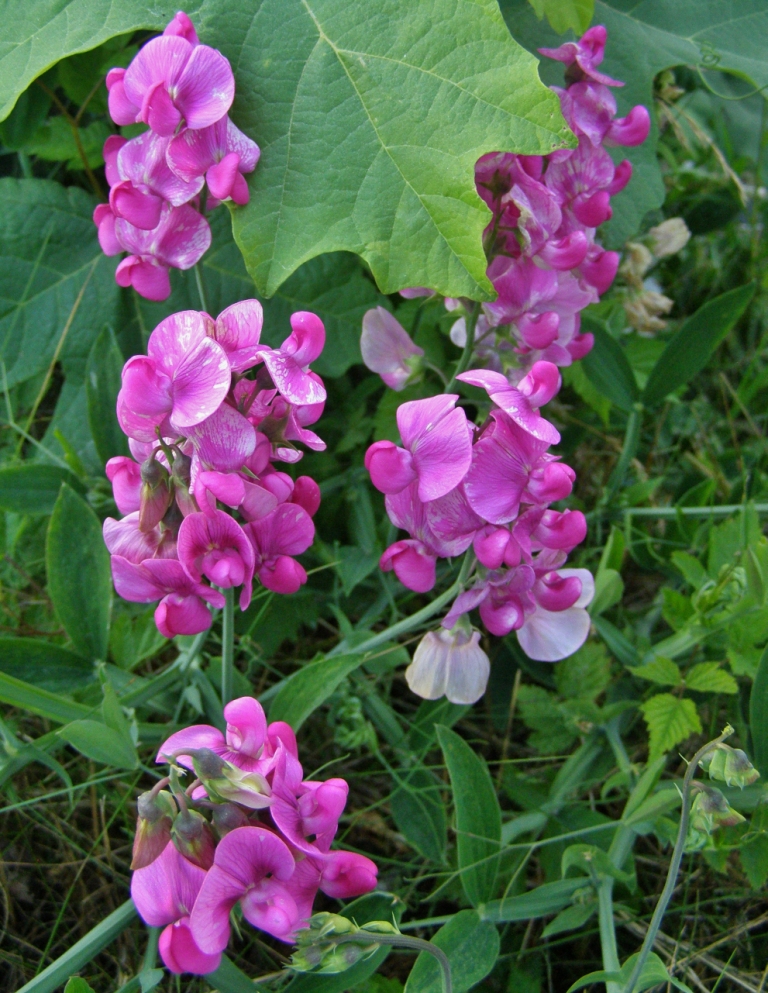
Perennial Sweet Pea - Lathyrus latifolius - naturalized at Pitt Lake, near Maple Ridge, B.C., August 2011.

Perennial Sweet Pea – Lathyrus latifolius – naturalized along the shores of  Pitt Lake, near Maple Ridge, B.C., August 2011. Image: HFN

Perennial Herbaceous Vine. Zone 3. Fabaceae, formerly Leguminosae.  Originally native to Southern Europe, now sometimes seen naturalized in disturbed-soil areas as a garden escapee throughout Europe, Great Britain, and parts of North America, including coastal British Columbia. Lathyrus is from the Greek lathyros, pea; latifolius from the Latin latus + folium, wide + leaf.

Clump former to 18 inches wide; sprawls or climbs 3 to 6 feet tall by twining tendrils in the leaf axils. Fine in average soil and moisture; prefers full sun. Established plants are reasonably drought tolerant, but thrives best with summer moisture and fertile soil.

This pretty climber/sprawler is rather rare in Cariboo-Chilcotin gardens, but I have seen it thriving often enough here and there in Zone 3 and 4 Williams Lake and Quesnel area plantings to be able to confidently recommend its hardiness and adaptability.

The plant forms a vigorous clump of rapidly elongating stems lined with paired, blue-green leaflets. Bloom stalks and twining tendrils emerge from the leaf axils as the stems lengthen. Clusters of very showy, sweet pea-like flowers bloom for a long period June through August, and are followed by typical large, flat pea-pods filled with big round seeds. (These are not considered edible, by the way, and occasionally are referenced as “poisonous”, though I have not seen any mention of actual incidents of poisoning.)

Sadly, the “sweet” reference is merely to its similar appearance to the highly fragrant annual sweet pea, Lathyrus odoratus, as Perennial Sweet Pea is not noticeably fragrant.

Vines reach 3 to 6 feet long – tallest where it can climb, and where grown in moist, fertile soil – and either sprawl along the ground or twine their way up whatever support they can find. Very nice grown on a bank where it can cascade, or on a sturdy trellis or garden obelisk arrangement. Vines are completely herbaceous, and die back to the ground in the winter, to re-sprout in spring. Sometimes late to emerge, so keep an eye out for it when digging about in the spring garden.

A very long-lived plant, which should be sited where it can remain as it does not transplant well. It may self sow, but though definitely a “survivor” where established, it is not aggressive and is not considered an invasive plant in our climate, though it is occasionally seen as a naturalized garden escapee in disturbed soil areas along coastal British Columbian roadsides where it has joined other exotics such as butterfly bush (Buddleja sp.), touch-me-not (Impatiens sp.), and the ubiquitous Himalayan Blackberries.

Lathyrus latifolius naturalized along the shoreline roadway at Pitt Lake, near Maple Ridge, B.C. August, 2011.

Lathyrus latifolius naturalized along the shoreline roadway at Pitt Lake, near Maple Ridge, B.C. August, 2011. Image: HFN

Lathyrus latifolius has been grown as a prized garden flower for centuries throughout Europe and the British Isles, and in North American colonial plantings, and the pink strain appears in the 1801 species inventory of Thomas Jefferson’s famed Monticello garden.

This plant often shows up on old herb garden lists, but no medicinal uses are recorded. Apparently the foliage was occasionally used as a pot herb, and the seeds cooked and consumed for their high protein content, but present-day consumption is definitely NOT recommended, as the seeds of some of the species in the Lathyrus genus do contain potentially harmful amino aids. Best to enjoy it for its beauty alone, as most of our gardening predecessors did.

Many species of bees and butterflies visit the flowers in search of nectar, as do occasional questing hummingbirds, but the floral structure is designed for pollination by bumblebees, as they alone are strong enough to part the keel petals which enclose the reproductive parts of the blooms.

Three old-fashioned named strains are still available; all are very lovely. ‘RED PEARL’  – rich carmine pink. ‘ROSE PEARL’ aka ‘PINK BEAUTY’ – pale pink flushed darker at petal edges. ‘WHITE PEARL’ – pristine snow white.

Lathyrus latifolius - Perennial Sweet Pea - 'Red Pearl'

Lathyrus latifolius – typical of  ‘Red Pearl’ colour strain – Maple Ridge, August 2011. Image: HFN


Read Full Post »

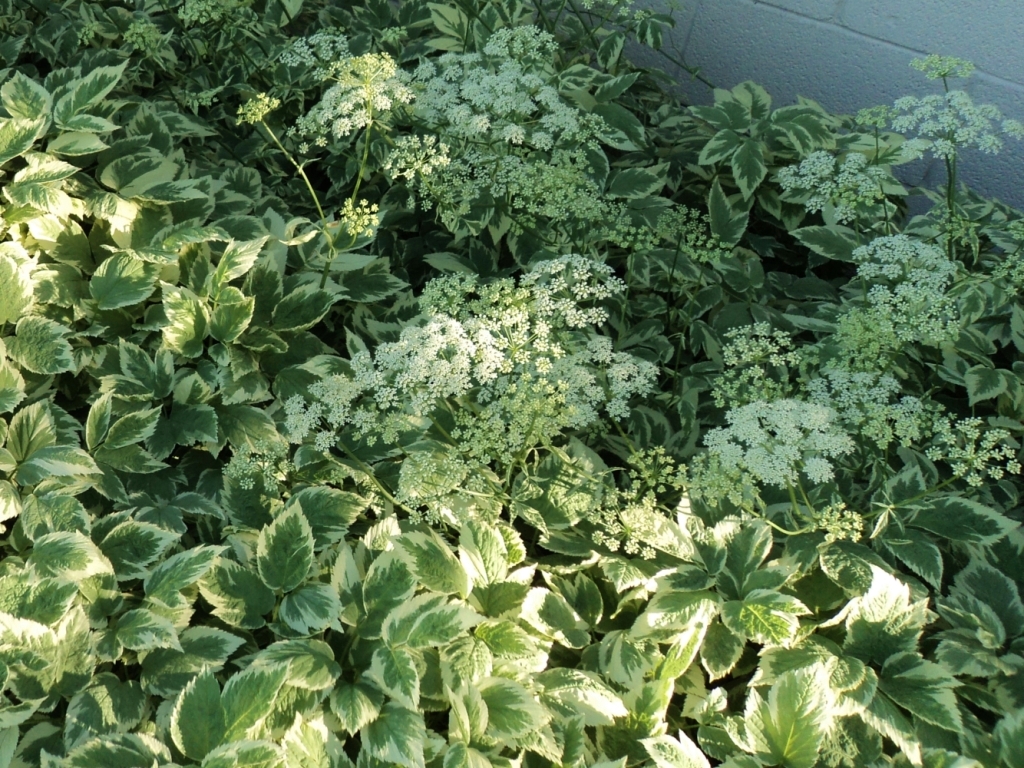
Aegopodium podagraria

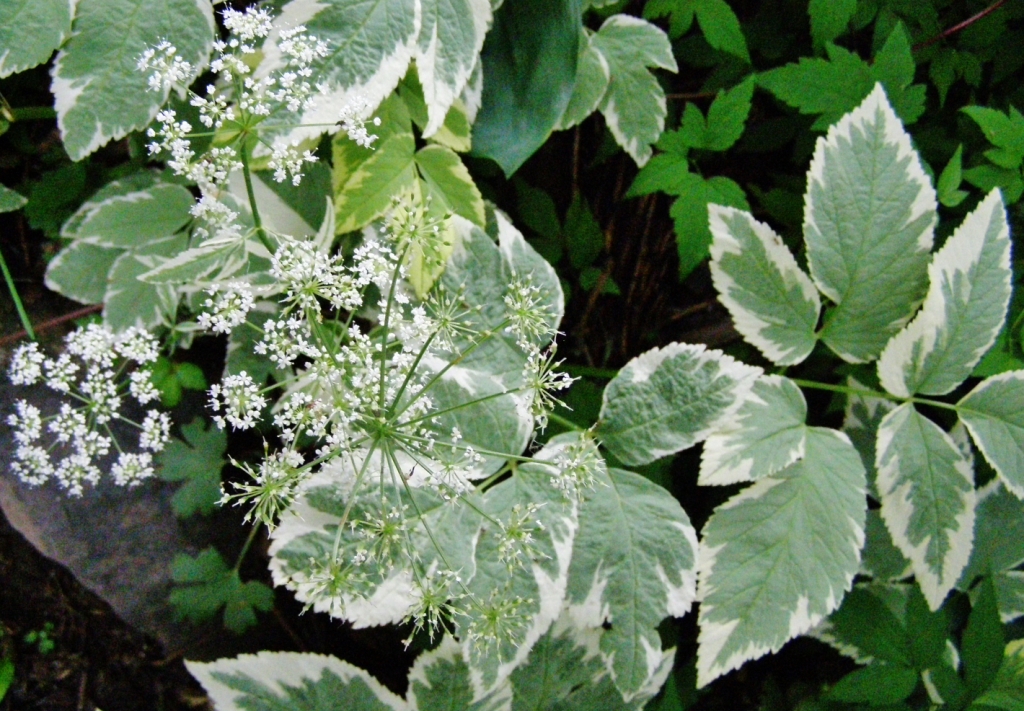
Variegated Bishop’s Goutwort – Aegopodium podagraria ‘variegata’. Penticton, B.C., June 2014. Image: HFN

Perennial. Zone 1. Apiaceae, formerly Umbelliferae.  Europe, Northeast Asia. Aka HANSEL-AND-GRETEL, JACK-JUMP-ABOUT, BISHOPSWEED, SNOW-ON-THE-MOUNTAIN, GROUND ELDER. 12 to 16  inches tall; spread infinite. Any soil, average moisture, sun to shade.

Aegopodium is derived from the Greek aix or aigos (a goat) and pous or podos (a foot), from the fancied resemblance in the shape of the leaves to a goat’s foot. Podagraria comes from the Latin word for gout, podagra, because this plant was highly valued as a treatment for that ailment in medieval times.

Goutwort is an attractively variegated pale green and ivory foliage plant, though it does produce umbels of tiny, creamy white flowers in summer.  It is an insidiously invasive but very valuable groundcover for difficult sites. A solid edging or path will generally contain it.

Avoid planting in a mixed border, as it will gobble up less rambunctious neighbours. I have had success growing it with other hold-your-own plants, namely with Lily-of-the-Valley (Convallaria majalis), Ribbon Grass (Phalaris arundinaceae ‘picta’), and Joe-Pye Weed (Eupatorium purpureum), but I do believe it is generally best alone, in a place where it can flourish to its (and the gardener’s) heart’s delight.

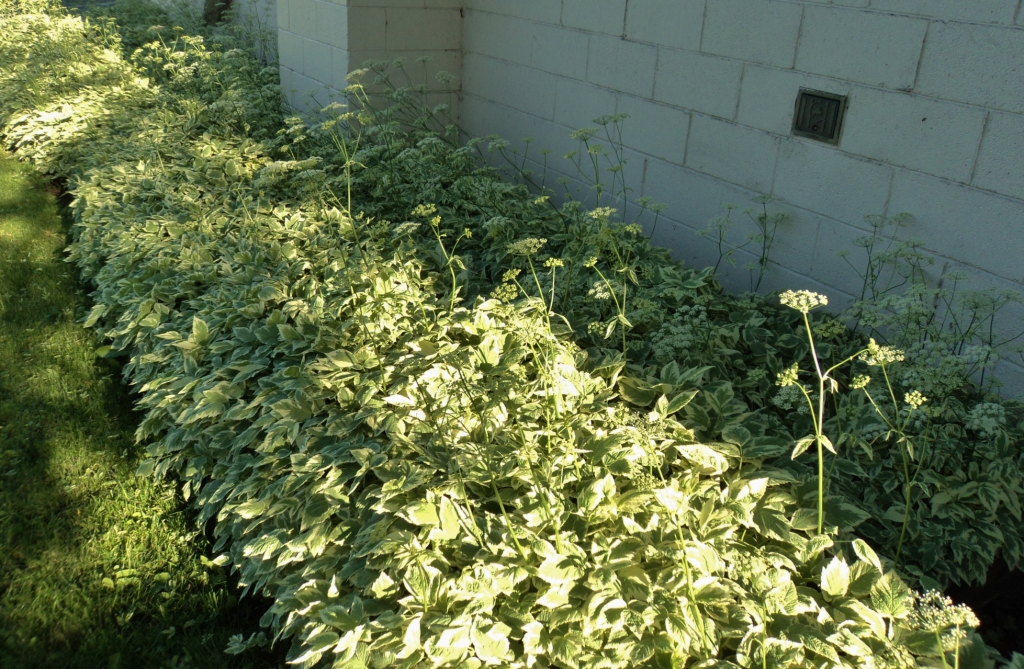
An excellent example of perfect placement of this exceediningly successful groundcover. Aegopodium podagraria grown in a shady border between a structure and a mown lawn in Penticton, B.C.  June 2014

An excellent example of perfect placement of this exceediningly successful groundcover. Aegopodium podagraria grown in a shady border between a structure and a mown lawn in Penticton, B.C., June 2014. Image: HFN

Bishop’s Goutwort is an old-time, pre-Medieval garden plant, once used in medicine and cookery. From Maude Grieve’s 1930 Modern Herbal:

 It has a creeping root-stock and by this means it spreads rapidly and soon establishes itself, smothering all vegetation less rampant than its own. It is a common pest of orchards, shrubberies and ill-kept gardens, and is found on the outskirts of almost every village or town, being indeed rarely absent from a building of some description. It is possible that Buckwheat might drive it out if planted where Goutweed has gained a hold.

It was called Bishopsweed and Bishopswort, because so frequently found near old ecclesiastical ruins. It is said to have been introduced by the monks of the Middle Ages, who cultivated it as a herb of healing. It was called Herb Gerard, because it was dedicated to St. Gerard, who was formerly invoked to cure the gout, against which the herb was chiefly employed.

The white root-stock is pungent and aromatic, but the flavour of the leaves is strong and disagreeable. (However) Linnaeus recommends the young leaves boiled and eaten as a green vegetable, as in Sweden and Switzerland, and it used also to be eaten as a spring salad.

A poultice made from the boiled leaves and roots was used with reportedly good effect as a treatment for all sorts of joint pains.

Aegopodium podagraria 'variegata'- Hill Farm, July 2011.

Aegopodium podagraria ‘variegata’– Hill Farm, July 2011. Image: HFN

Nowadays this plant is grown strictly as an ornamental, and it is a very good plant for difficult sites, as long as its land-grabbing habits are taken into consideration. Propagation of the variegated form is by division; it seldom sets viable seed. There original species is solid green, even more vigorous than its creamy-leaved sport, and a profuse self-seeder. Luckily it is not at all common in our country – the variegated version is sufficiently successful in our gardens.

Bishop’s Goutwort is frequently seen in old gardens and around abandoned homesteads. A particularly nice Cariboo planting is behind the Theatre Royal in the restored 1860s’ Gold Rush town of Barkerville, B.C., where it thrives in a lush colony hemmed in by Mountain Bluet (Centaurea montana) and Lady’s Mantle (Alchemilla species), both vigorous survivor-type plants in their own right.

Read Full Post »

White Moth Mullein - Verbascum blattaria albiflorum. Hill Farm, July 14, 2014.

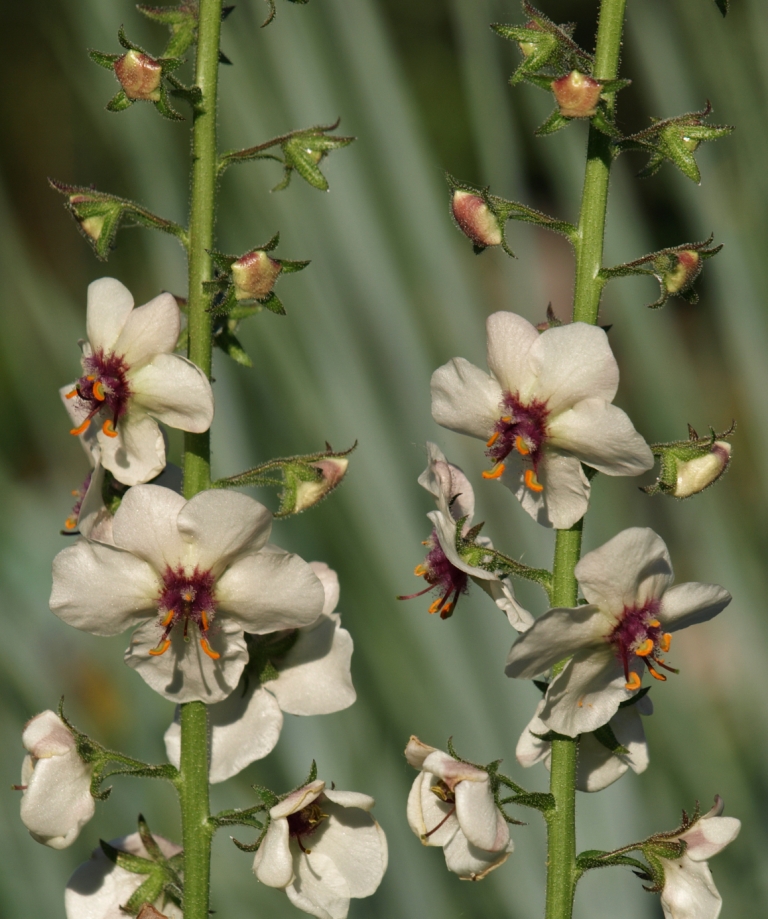
White Moth Mullein – Verbascum blattaria albiflorum. Hill Farm, July 14, 2014. Image: HFN

Biennial. Zone 3. Scrophulariaceae. Europe, northern Africa. Verbascum is from the Latin barbascum, bearded. Blattaria comes from the Latin blatta, cockroach, in homage to the plant’s history as an insect repellant. Thrives in full sun to part shade. Happy in a wide variety of soils. Quite drought tolerant.

A dainty and lovely biennial.

In its first year, smooth, deep green leaf rosettes form and lie close to the ground, giving no hint of next year’s tall and graceful flower stalks.

The rosettes overwinter and start to show signs of further development in the spring of the second year, when slender, multi-branched stems emerge and elongate, reaching an ultimate height of 4 feet or so for the white form, and up to 6 feet for the yellow. Though tall, Moth Mullein’s general effect is airy enough for the front of the border.

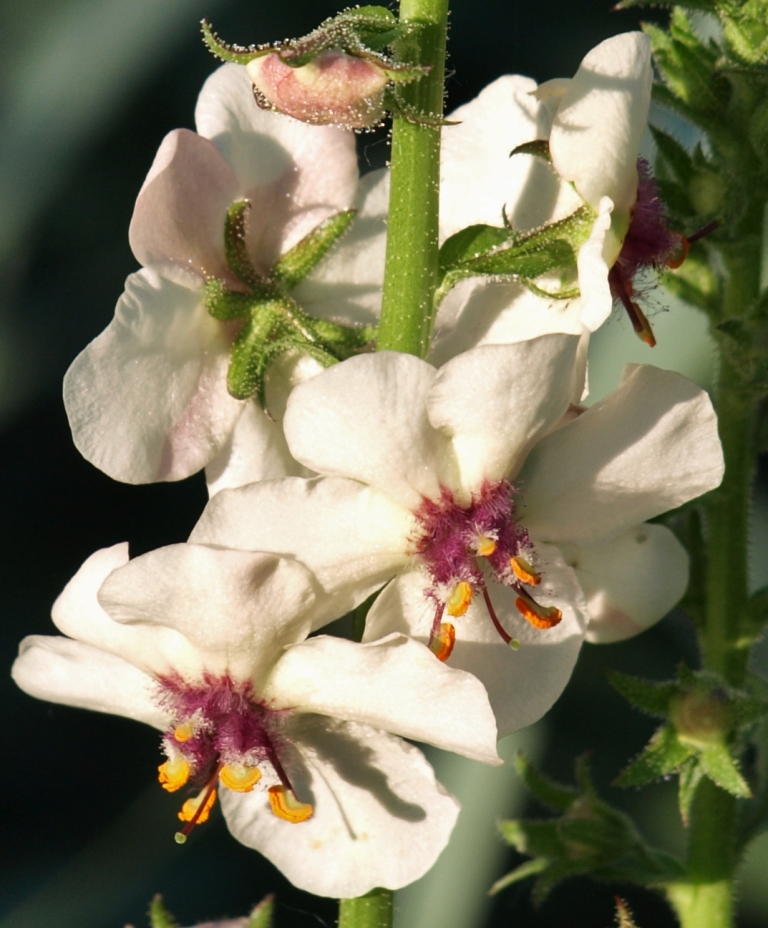
Neatly folded, angular buds on short pedicels pop open into large, gleaming white flowers blushed on the petal backs with purple, echoing the bright purple, intricately furred stamens tipped with brilliant orange pollen. Blooms unfold in late June or early July, and continue through summer, ending at last in September.

Bloom detail, Verbascum blattaria albiflorum. Hill Farm, July 2014.

Bloom detail, Verbascum blattaria albiflorum. Hill Farm, July 2014. Image: HFN

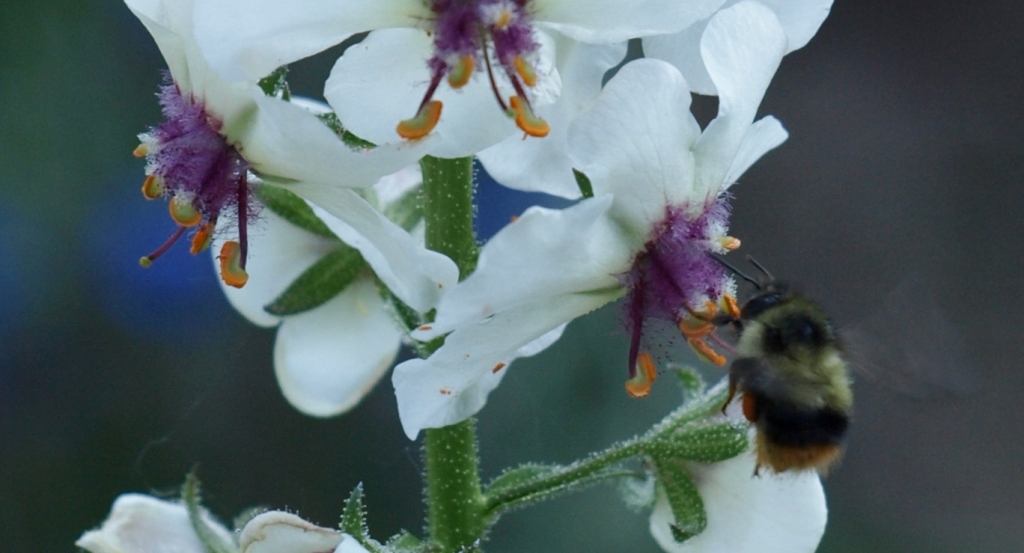
The common name of Moth Mullein is thought to come from the resemblance of the stamens to the intricately haired antennae of moths. The flowers are also attractive to all sorts of insects, including nocturnal moths and early-foraging bees. Blooms unfold in earliest morning, and subside by noon, to reopen the following day.

An early-foraging bee visits Moth Mullein just before sunrise. Hill Farm, July 14, 2014. (All of the Verbascum family are veritable bee magnets.)

An early-foraging wild bee visits Moth Mullein just before sunrise. Hill Farm, July 14, 2014. (All of the Verbascum family are veritable bee magnets.) Image: HFN

Neatly dropped flowers are followed by hard, round seed pods, each containing hundreds of small, black seeds. Seeds of this species remain viable in soil for a long time; in one well-documented experiment  initiated by Michigan State University Professor William James Beal in 1879, Moth Mullein seeds sprouted over 120 years after their storage outdoors in an upside-down bottle buried in dry sand.

Arriving with early European colonists, Moth Mullein has been known to grow in North America since at least the early 1800s. It has become naturalized to various degrees across the United States and into southern Canada, being particularly successful at establishing itself on freshly disturbed ground.

Moth Mullein was traditionally used to safeguard fabrics against moths and other insects; American colonial gardens grew Moth Mullein for this purpose and also for use as a dye plant. With appropriate mordants Moth Mullein yields green and yellow dyes.

Verbascum blattaria has been investigated for various medicinal properties, and in 1974 was the subject of a study on its insecticidal properties, showing some intriguing possibilities as its application killed over half of the mosquito larvae in the study.


Read Full Post »

Yellowtuft Alyssum - Alyssum murale - Agriculture Canada Research Station, Summerland, B.C., June 7, 2014.

Yellowtuft Alyssum – Alyssum murale – Agriculture Canada Research Station, Summerland, B.C., June 7, 2014. Image: HFN

Perennial. Zone 5, and probably colder. Brassicacea. Syn. Alyssum argenteum, A. chalcidicum. A.k.a. Rock Alyssum, Wall Alyssum. Native to the Mediterranean and Eurasia, where it is locally abundant on mineral-rich serpentine soils.  Introduced populations found in British Columbia, Washington, Oregon and California, where the plant has escaped cultivation from its experimental use as a heavy metal hyperaccumulator species being tested for use in mine reclamation.

On a recent trip to the Okanagan we stopped to explore the Summerland Ornamental Gardens located at the Agriculture Canada Research Station in Summerland, just outside of Penticton.

Established almost a century ago, in 1916, the gardens served as a testing ground for the local suitability of ornamental trees, shrubs and herbaceous plants. When the ornamental horticulture programs of the Station were phased out in the 1980s, the gardens seriously deteriorated through lack of maintenance. Luckily a community organization was formed to rescue the gardens from complete dissolution, and the result of thousands of hours of mostly volunteer labour is visible in the well maintained and updated plantings, in particular an ambitious and beautifully landscaped hillside xeriscape garden.

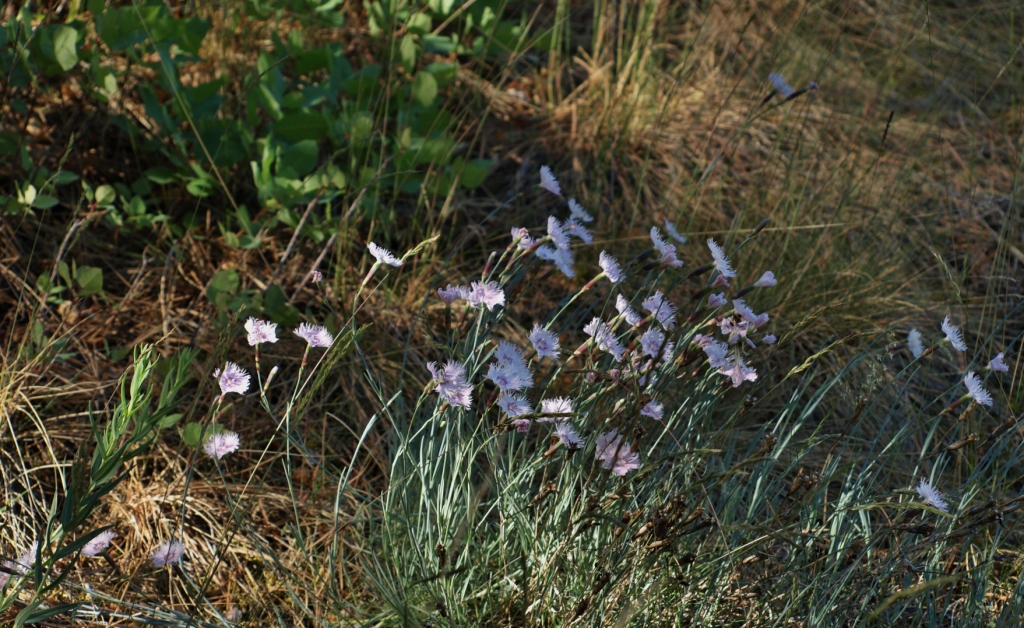
Lovely as the cultivated area of the Gardens are, though, we found some of the most interesting areas to be those on the outskirts of the manmade plantings, where the wild and the tame meet, with rather telling results. Domestic roses, clumps of iris, peonies and other old garden stalwarts flourish unpruned and gloriously untidy amidst the native grasses, and the steep sides of the Trout Creek ravine are starred with fragrant dianthus flowers obviously self-seeded from cultivars grown in the garden above.
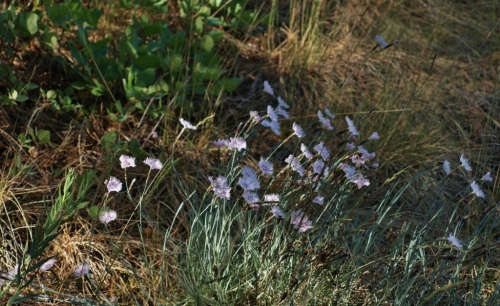
Naturalized dianthus sp., just under the Kettle Valley Railway trestle over the Trout Creek ravine, Summerland Ornamental Gardens. We were visiting early in he morning, and the sun was just warming the ground, and the spicy fragrance of the dianthus flowers was astonishing in its clarity and reach.

Naturalized Dianthus species, just under the Kettle Valley Railway trestle over the Trout Creek ravine, Summerland Ornamental Gardens. We were visiting early in the morning, and the sun was just reaching the hillside, and the spicy fragrance of the dianthus flowers was astonishing in its clarity and reach. Image: HFN

And there was this unusual plant, which I didn’t recognize, at first thinking it might be some sort of Galium (Bedstraw) species, but on closer examination realizing that it did not fit into that family after all, for though the flowers were small and four-petalled and the leaf arrangement generally whorled, the bloomhead was more of an umbel than a spike, and the aged seedpods were round and silver. What could it be?
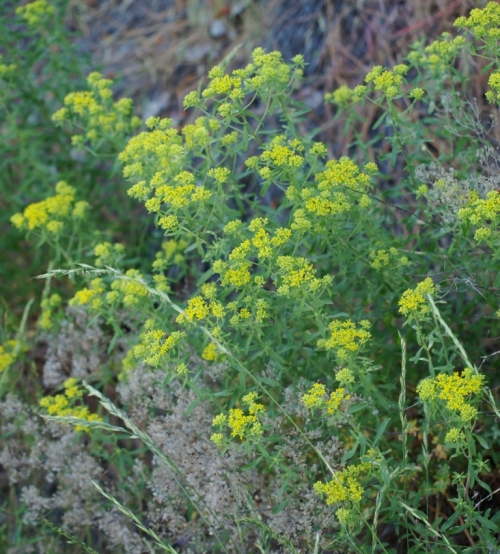
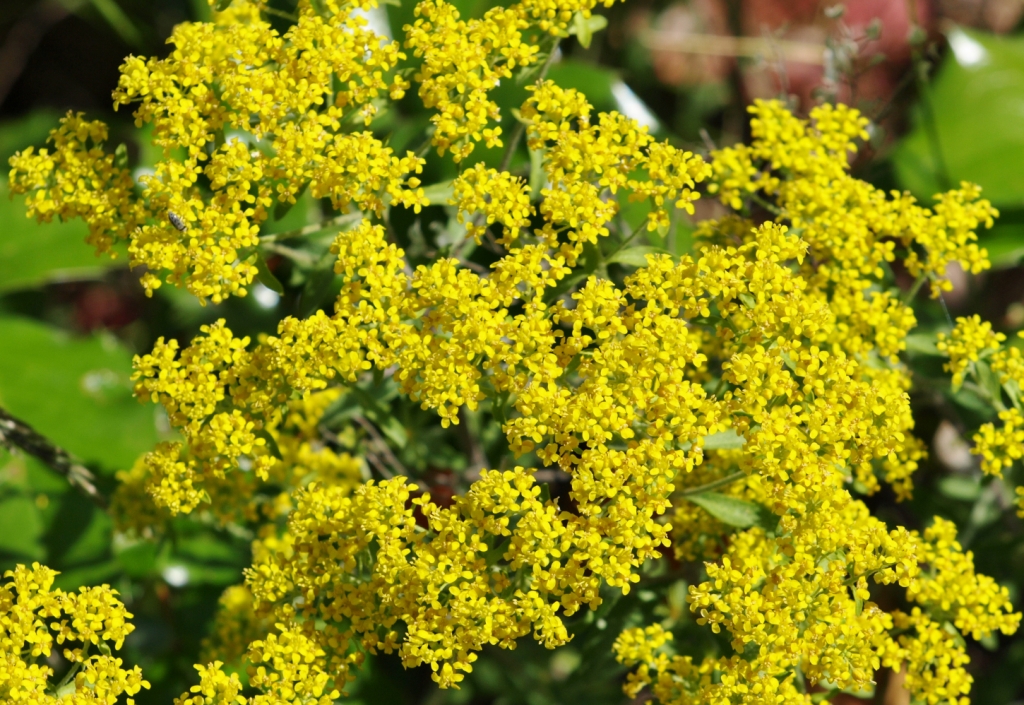
The mystery plant, showing cloudy yellow blooms, silver seedpods and a sturdy, tufting habit. Obviously a survivor, as it was happily growing among grasses and on the steep and eroding hillside. Wildflower, or another garden escapee?

The mystery plant, early morning under the shade of the Ponderosa pines at Summerland, B.C., June 8, 2014, showing cloudy yellow blooms, silver seedpods and a sturdy, tufting habit. Obviously a survivor, as it was happily growing among grasses and on the steep and eroding hillside. Wildflower, or another garden escapee? Image: HFN

One of the first things I did upon my return home was to search out the plant in my wildflower books. This was unsuccessful, so I turned to the internet, where I soon made a positive identification. The mystery plant is an exotic escapee, and a rather worrisome one at that, being classified as a noxious weed in several U.S. states due to its rapid spread in biologically sensitive ecosystems and its potential toxicity to livestock.

Alyssum murale, Yellowtuft Alyssum, is a native of Mediterranean regions, through central and southeastern Europe, being particularly common in Romania and Albania. It has been grown as an ornamental in North America for at least a century, being a prized rockery plant grown for its attractive habit and long bloom period.
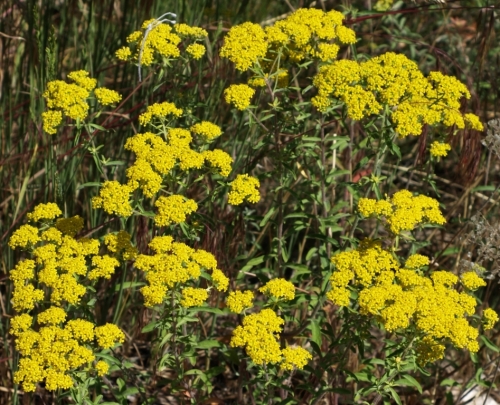
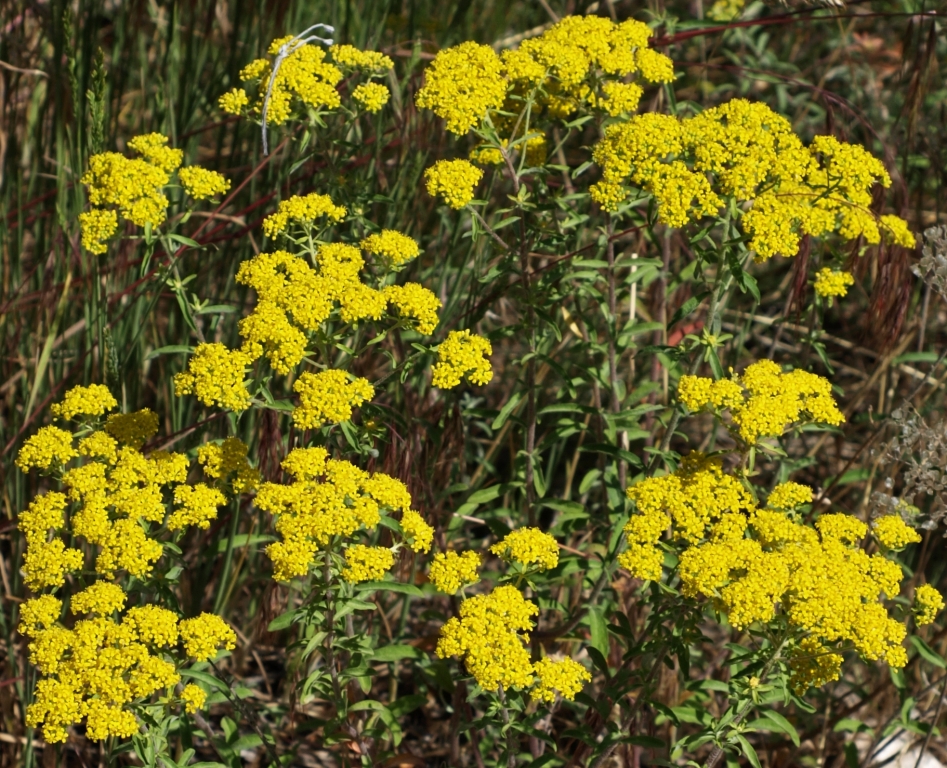
Alyssum murale showing clump-forming habit and umbel arrangement of the flowers. Summerland, June 7, 2014.

Alyssum murale showing clump-forming habit and umbel arrangement of the flowers. Summerland, June 7, 2014. Image: HFN

The plant is clump-forming, with multiple stems reaching from one to three feet tall. (The Summerland plants were about a foot tall; the three-foot height might be attained under cultivation with supplementary water and fertilization.) Yellow flowers in generous umbels appear in late May, and bloom for several months. Stems are covered by fine white hairs, and show a variable red coloration on the older portions. Seeds are produced in clusters of round or oval flattened fruits, with an ornamental, silver-grey, papery silicle persisting after the outer sheaths and the large, flat black seed is dropped.

Undoubted visual appeal aside, Alyssum murale has some other qualities which make it both potentially valuable as a commercial crop and dangerous as an invasive.

The species is unique in that it has an extremely high tolerance to heavy metals in the soil, in particular copper, chromium and nickel, and it actually functions as a hyperaccumlator of these metals, uptaking them during the growth period and concentrating them in intense quantities in its stems, shoots and foliage.

In certain parts of Europe the plant is deliberately cultivated in a process referred to as phytomining, where the plants are cultivated on mineral-rich soils, and then harvested and burned, with the ashes being further refined to yield the desirable metals. Within the last decade, the plant has received serious study in North America as a potentially useful species for mine reclamation work, being planted on tailings areas to take up excess potentially toxic heavy metals; the plants are then removed and burned, yielding a small but significant amount of usable metals. The process is repeated until the site shows a marked reduction in the minerals-of-concern.

This unique adaptation of Alyssum murale becomes a drawback when the plant is consumed by wildlife or livestock, as it then becomes a highly toxic meal.

Alyssum murale is a generous seed producer and is highly drought tolerant and very adaptable to native soils, and has escaped from cultivation in areas where it is or was being tested and used in the mining industry, to become a vigorous invasive weed in some sensitive ecosystems in the western U.S. states.

I wonder where the Summerland Alyssum murale population originated? Is it an escapee from the research station, or from the ornamental plantings of the garden?

It is a rather pretty thing, and I can definitely see its appeal as a garden flower. It has apparently been grown as a desirable and problem-free ornamental throughout North America, Europe and Great Britain since its first collection and distribution by botanists in the late 1700s, but its new reputation as an invasive escapee from industrial applications does give serious pause when contemplating acquiring it for one’s own garden…
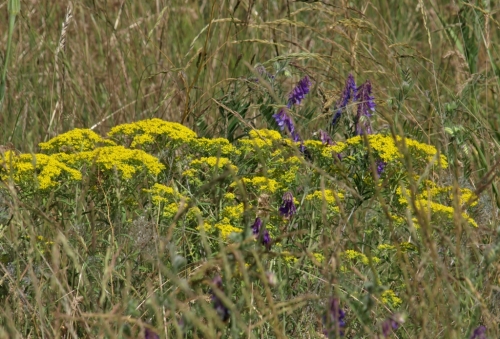
 

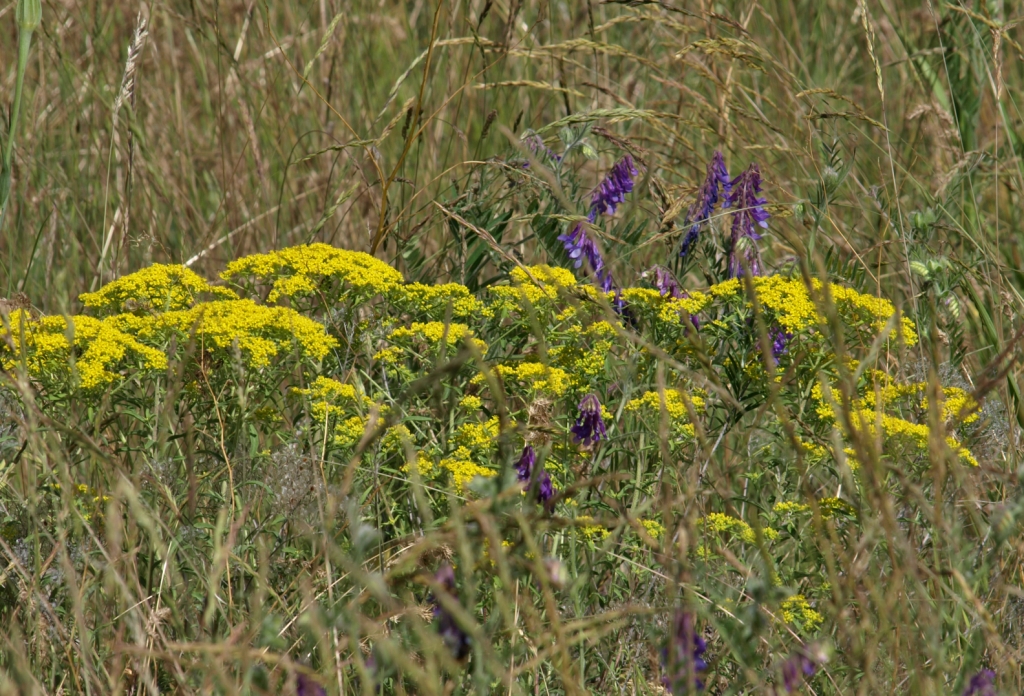
Alyssum murale naturalized among native grasses and cow vetch (Vicia cracca), fringes of the Summerland Ornamental Gardens, June 7, 2014.

Alyssum murale naturalized among native grasses and cow vetch (Vicia cracca), growing on the fringes of the Summerland Ornamental Gardens, June 7, 2014. Image: HFN


Read Full Post »

« Newer Posts - Older Posts »