Archive for the ‘Plant Portraits’ Category

Biennial/Monocarpic Perennial. Zone 3. Campanulaceae. Bosnia and Herzegovina. Syn. Campanula hofmannii. A.k.a. PENDULOUS BELLFLOWER, HOFMANN’S RINGED BELLFLOWER.

Most people are not terribly familiar with any of the Symphyandra, for while they are widely grown in botanic and alpine gardens, the genus is rather rare in the mainstream plant trade. But there are many keen gardeners who grow the various species with great pleasure, including well-known British Columbia garden writer, Helen Chestnut. Here is what she had to say in her column in the Victoria Times Colonist, July 17, 2008:

The description of a Campanula relative, Symphyandra hofmannii (pendulous bellflower), in a 2006 seed catalogue caught my attention. Placed in the front garden early last summer, the plants resulting from those seeds are pure enchantment this summer. They have grown to form slender pyramids of soft leaves and stems heavily hung with large, creamy white, bell-shaped flowers. My plants are about 40 cm (16 inches) high. They are very unusual, and utterly charming.

“Charming” is indeed an apt word for this quietly pretty flower, in any of its dozen or so species. Symphyandra hofmannii is particularly nice.

The plant is monocarpic, which means it dies after flowering and setting seed, and therefore is generally classed among the biennials.

The first year long-leaved, rather wrinkly foliage rosettes form. The second year brings the bloom. Many upright-to-gently-arching 12 to 18 inch long stems arise from the basal clump. These are lined with inflated, down-facing buds, which open into a succession of large, ivory white blooms for a long period in summer.

Symphyandra hofmannii is happy in sun to part shade, in good soil with average moisture. It will set seed generously, and may be allowed to self sow to perpetuate itself in the garden. Clipping off the bloom stalks before seed matures may allow another season of bloom, but then again your plant may decide to expire without replicating itself, having done its best to bloom itself to death as its nature intends it to, so I don’t recommend this.

A note on nomenclature:

Symphyandra is as close as close to Campanula. In fact, by the time of this writing, the genera may again be combined, as botanists play their endless game of familial and generic splitting and lumping, aided (encouraged?) by botanical DNA analysts.

What separates the sheep from the goats – er – the Symphyandra from the Campanula – is a small detail regarding the anthers, the parts of a flower’s stamen which produces pollen. In Campanula the anthers are separate. In Symphyandra they are united to form a tube surrounding the style. (I should probably stop here, unless I want to add diagrams. Probably too much information already!) In any event, this explains the genus name, from the Greek symphio – “to grow together” – and andros – “anther”.

The specific name commemorates botanist Florian Hoffmann, who collected this plant in the mountains of Yugoslavia in the late 19th Century; the name was first assigned in 1881.

Read Full Post »

Biennial. Zone 2. Caryophyllaceae. Dianthus barbatus originated in the mountains of southern Europe.

‘Sooty’ is often billed as the “black” Sweet William, but in reality it is a deep, rich crimson, with nicely contrasting pure white stamens. Though ‘Sooty’ is often described as “new and improved”, in reality it is almost indistinguishable in my experience from the venerable English heirloom variety, ‘Dunnett’s Deep Crimson’, introduced in the late 1800s.

Many heads of clove-fragranced, velvety crimson flowers are produced in midsummer of the plant’s second year. Foliage shows a distinctive dark red blush, as do stems, particularly at the leaf joints. ‘Sooty’ tends not to be as tall or as substantial in form as many of the other traditional Sweet Williams, reaching only 12 to 18 inches tall, and proving occasionally rather lax in habit.

‘Sooty’ blooms for a fairly extended time. You may get a few flowers in autumn of its first year, but the best show comes in year two, when the cluster-heads bristling with dark-blushed, sharply pointed, modified leaflets unfold their blooms from early June and well into summer. For continued flower production, promptly deadhead when the clusters finally fade, or harvest at peak perfection for bouquets.

Something of a curiousity in the garden, though a very pleasant one.

I must confess that I have sometimes found ‘Sooty’ a little difficult to place. Self-sown seedlings generally manage to find a niche where they can blend well with their neighbours, but my greatest success with Sweet Williams in general, including ‘Sooty’, was way back when I grew ambitious vegetable gardens, which always included several rows of annual flowers for cutting. For a few years I included “biennial rows” which I planted out in late summer, full of Sweet Williams and Canterbury Bells and their like. With abundant fertility and regular watering, these bloomed the following spring and summer with great vigour, providing armfuls of flowers for arrangements. In the mixed border, fighting it out for growing space among various companions, I find that the Sweet Williams don’t reach such majestic proportions as when treated more as “crop” plants.

A true biennial which may carry on by offsets, but usually by self-seeding, so allow a few bloom heads to mature seed to re-sow.

Sun is best, though light shade is tolerated.  Good soil and moisture are appreciated.

Read Full Post »

'New Millenium' unnamed variety growing at Hill Farm from a packet of mixed seed - 2 year old plant. July 2014. Image: HFN

‘New Millennium’ unnamed delphinium variety growing at Hill Farm from a packet of hand-pollinated breeder’s mixed seed – 2 year old plant. July 2014. Image: HFN

Perennial. Zone 2. Ranunculaceae.

Delphiniums are such stalwarts of our Cariboo-Chilcotin gardens that we tend to take them somewhat for granted. But there are delphiniums, and then there are Delphiniums. I’ve long been aware but not particularly envious of the many British cultivars which are being continually introduced in such an amazing array of variations: rich buttery yellows, warm salmon pinks, bicolours, doubles and triples, and ever more and “better” blues. “Very nice,” I think to myself, “but not terribly hardy, because of their complicated ancestry involving numerous tender species. And only available from cuttings, if at all…these are not for us.”

Then I heard rumour of a new strain of delphinium coming out of New Zealand, under the trade name ‘New Millennium’. Seed grown, hardy in the colder zones, and strikingly beautiful. I investigated the website of the breeder, and highly impressed by what I saw there, and what I’d heard elsewhere – these were just then coming into commercial production and were receiving early rave reviews – I took the plunge. Off I sent for seed, taking a deep breath at the cost, NZ$18.50 for 50 seeds, which worked out to something like 35 cents per seed Canadian. But hey, if a substantial number sprouted, that’s not too bad, right? And they germinated promptly in reasonable numbers, and I ended up with a goodly number of young plants, most of which made their way to that year’s market, though I kept a few back for myself.

'New Millenium' Hill Farm, July 2013. Image: HFN

‘New Millennium’ Delphinium – ‘Moonlight Blues’ strain – 3 year old plant. Hill Farm, July 2013. Image: HFN

'New Millenium' Hill Farm, July 2014. Image: HFN

‘New Millennium’ Delphinium – ‘Dusky Maidens’ strain – Second year plant –  Hill Farm, July 2014. Image: HFN

'New Millenium' Hill Farm July 2014 Image: HFN

‘New Millennium’ Delphinium – unnamed seedling from breeder’s hand-pollinated mixture. Second year plant. Hill Farm, July 2014. Image: HFN

'New Millenium' Hill Farm July 2014

‘New Millennium’ Delphinium – unnamed second year seedling from breeder’s hand-pollinated mixture. Hill Farm, July 2014. Image: HFN

If you love delphiniums, take a look here: Dowdeswell’s Delphiniums. Their seed comes fresh and ready to sprout; if you are even the tiniest bit experienced with growing things from indoor-sown seed, give these a go. Much too costly to scatter about the garden, but with a bit of care the germination in starter packs is excellent. (Grow these cool, as too-hot temperatures are fatal.)

Colour and form of every strain of these we’ve tried have been outstanding. If you love delphiniums these will make you a very happy gardener!

Most are traditionally tall, from 6 to 8 feet once established, with multiple strong bloom stalks from basal clumps of healthy foliage.

Definitely prepare to stake these before they bloom, for though nicely sturdy they will snap off in summer storms if unsupported while in bloom. There are some shorter strains, which also need to be supported. The flowers are huge, and the bloom stalks very heavy.

At Dowdeswell’s the delphiniums are grown through grids, and a planting I recently visited at Van Dusen Garden in Vancouver had done much the same, with bamboo stakes neatly tied together. In my own garden I use upright stakes, but the grid idea has a lot of appeal, and would definitely be best in a dedicated planting to save much time and energy over tying every stalk up individually.

Delphiniums of all sorts thrive best in rich garden soil, with average moisture. Full sun is preferred, though they will take very light shade for part of the day.

A plot of seedling 'New Millenium' Delphiniums at Van Dusen Garden in Vancouver, B.C. - October 2014. The young plants frequently put out bloom in the autumn of their first year, a teasing foretaste of the glories to come when they reach full maturity. Note the bamboo grid arrangement, for support of the heavy bloom stems. Image: HFN

A plot of seedling ‘New Millennium’ Delphiniums at Van Dusen Garden in Vancouver, B.C., October 2014. The young plants frequently put out bloom in the autumn of their first year, a teasing foretaste of the glories to come when they reach full maturity. Note the bamboo grid arrangement, for support of the heavy bloom stems. Image: HFN

Here are the named ‘New Millennium’ strains we’ve grown so far. The following photos are from the breeder, and, from what we’ve personally experienced, do truly reflect the quality of these flowers.


 For more, take a look at the Dowdeswell’s website.

Read Full Post »

Perennial. Zone 3. Compositae. North Africa, Spain, Mediterranean regions. Syn. Anacyclus depressus, syn. A. maroccanus. A.k.a. SPANISH CHAMOMILE, ALEXANDER’S FOOT. Though I can find no reference to it other than the name on a number of alpine plant society lists, I am assuming that the latter allusion is to Alexander the Great and his historical presence in the areas where this plant grows.

This small charmer completely bewitched me the first time I grew it many years ago, with its tidy, fern-leaved, very furry foliage rosettes, and I was thrilled when it overwintered and bloomed enthusiastically in the spring. I’d rather wondered, what with its warm-climate origins, but hardiness doesn’t appear to be a problem, as long as the plant has its roots down in well-drained soil.

Little white daisy flowers with crimson petal undersides emerge in spring from mats of ferny, curling foliage. These open wide in the sun, but close up on cloudy days and in the evening, showing off the vividly contrasting rosy blush on the petal undersides. Bloom stems radiate in a circle from a central point; plants are literally circular in shape, and tightly hugging the ground.

A quietly beautiful rockery or edging plant. To about 4 inches tall, and a foot or so wide. Its only flaw is that it often blooms itself to death, so you will want to leave some seed heads to mature to self-sow, or to collect seed for a guarantee of replacement plants.

Full sun, and well-drained soil. Very happy among rocks, or on a slope.

Read Full Post »

Giant Crambe - Crambe cordifolia - a Hill Farm plant growing in our good friend Ellen's Soda Creek, B.C. garden - July 2008. Image: HFN

Giant Crambe – Crambe cordifolia – a Hill Farm plant growing in our good friend Ellen’s Soda Creek, B.C. garden – July 2008. Image: HFN

Perennial. Zone 3. Brassicaceae (formerly Cruciferae.) Caucasus Mountains. A.k.a. COLEWORT, GIANT SEA KALE.

This plant has been grown in gardens for at least 100 years, and is much sought after by anyone who has seen it in the dramatic mixed perennial flower borders of famous British country estates.

A most substantial plant, this is! Imagine a Volkswagen Beetle sized space commitment for its admittedly brief bloom time, 3 weeks at best. Okay, perhaps that is a slight exaggeration. But this thing can get huge.

Large, thick-textured, hairy basal leaves produce tall, multi-branching stems from 3 to 6 feet tall, which produce clouds of very sweetly-scented, pure white flowers in early summer. Looks like a Baby’s Breath gone wild, is one comment a happy customer made when proudly showing me a photo of her immense 5-year-old plant.

Crambe cordifolia takes a while to reach full size, usually blooming year three or thereabouts. Site carefully, as it is tap-rooted and dislikes being moved. Though not at all invasive, it may also persistently re-sprout from chunks of taproot left in the soil if you do decide to  move it once it is established. Frequently the transplanted piece will languish and die, after a long, yellow-leaved decline, so think hard before getting out your shovel.

Being in the Brassica Family, Crambe cordifolia is attractive to Cabbage Moths, so keep an eye out for the caterpillars, as they can skeletonize those big leaves surprisingly quickly, leaving nothing but the centre ribs. Most gardeners cut off the bloom stalks once flowering is finished, but if you want to try to ripen seed, or just simply like the look of the thing for its curiousity factor, you can certainly leave it alone, though a stake is a good idea, as summer thunderstorms may topple the aging edifice.

When I first experimented with Crambe cordifolia I was rather worried about its hardiness; most Zone ratings were for 6 or thereabouts, but after almost 20 years of growing and selling it, and much customer feedback (most enthusiastic, though some people felt it got too big, or were troubled by resprouting roots after digging up established plants) I can firmly state that Zone 3 suits it just fine.

Full sun. Very drought tolerant once established, though it appreciates summer moisture and reasonable fertility for the best after-blooming foliage health.

bbb

One more look at Ellen’s Giant Crambe, with Asiatic lilies at its feet. Honey-scented, and alive with bees. Soda Creek, B.C., July 2008. Image: HFN

Read Full Post »

Polemonium pauciflorum - Yellow Jacob's Ladder - Hill Farm, June 2011. Image: HFN

Polemonium pauciflorum – Yellow Jacob’s Ladder – Hill Farm, June 2011. Image: HFN

Short-Lived Perennial. Zone 4. Polemoniaceae. Arizona, New Mexico, Texas.

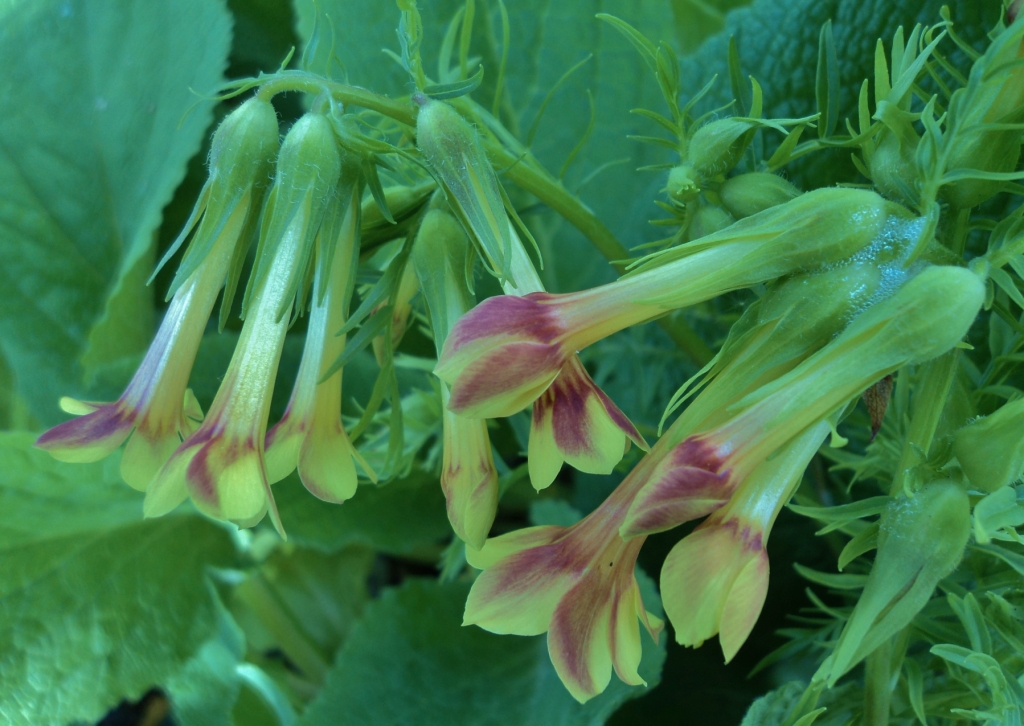
This is a Jacob’s Ladder with a difference. Instead of the usual clusters of blue and lavender wide-open flowers, P. pauciflorum produces graceful downfacing sulphur yellow trumpets, blushed with dusky red.

The specific name, pauciflorum, translates as “few-flowered”, but this is a relative designation. There may be few in each cluster compared to the dense arrangements of many of its relatives, but there are many blooming stems produced. So many, in fact, that Yellow Jacob Ladder frequently “blooms itself to death”, fading away completely after its exertion.

Delicate, many-leafleted foliage in lush 12-inch wide clumps. The graceful flower clusters on slender, 12 to 18 inch stalks appear in spring and early summer.

A very nice little plant, rarely found commercially but popular in the “plant fanatic” seed exchange world, which is where I originally obtained mine, from a gardener in Wales. (A rather roundabout trip from its native home in southern North America!)

Polemonium pauciflorum frequently blooms profusely in its first season, so may be treated as an annual, though technically it is perennial. Allow it to set seed and self sow to ensure its continued presence in your garden. If collecting seed for sharing or growing out, be aware that it has a short viability period in dry, cool room temperature storage, of 6 months to a year at most in my experience.

Sun to light shade; average soil and moisture.

This plant's membership in the Phlox Family is very evident from the appearance of the tightly furled buds - something I hadn't really noticed regarding other species. Image: HFN

This plant’s membership in the Phlox Family is very evident from the appearance of the tightly furled buds – something I hadn’t really noticed regarding other species. Image: HFN

Read Full Post »

Biennial or short-lived perennial. Zone 2. Brassicaceae. Syn. Cheiranthus x marshallii. Despite the common name, Siberian Wallflower is most accurately described as originating in England. It was a deliberate cross made by John Marshall in 1846 between Erysimum perofskianum, originally native to the Middle East, in specific Persia, and E. decumbens, from northern Spain, the Pyrenees and the southwestern Alps.

The Brassica Family makes up for its generally utilitarian foliage – think of the humble cabbage, and kale, and all of the mustards, not to mention the inconspicuous foliage of our cottage garden stalwarts such as Dame’s Rocket (Hesperis) and Stocks (Matthiola) – by frequently having the sweetest scented of flowers. The Wallflowers surpass all of their relatives in this characteristic, being famously planted in combination with less-fragrant spring bulbs such as tulips, both for the contrasting beauty of their velvety flowers and for their outpouring of honey-rich, spicy fragrance.

Sadly, the “traditional” English wallflowers, Cheiranthus/Erysimum cheiri, with their large blooms in shades of antique red and rich brown, copper, cream and crimson are not reliably hardy in our Canadian climate, unless one happens to live in gentler-wintered regions such as B.C.’s lower mainland. The Siberian Wallflower happily steps in to fulfill the role of its more delicate cousin for us Northerners, and it does so in a most eye-catching and deliciously fragrant way.

Siberian Wallflower is technically a biennial, but I have had it flower profusely in its first year from early-sown seed. From fast-growing clumps of strap-shaped foliage sprouted in early March, an abundance of bud clusters appear in May, which quickly pop open in an endless succession of very fragrant, absolutely neon-bright orange blooms well into mid-summer.

The plants elongate and get a bit weedy looking as summer advances, but it is best to ignore this and leave at least a few plants to mature their seeds, because this pretty flower is quite happy to establish itself as a self-sowing permanent resident in the garden. It naturalizes quite nicely; we’ve seen it used among other wildflowers as a bank erosion planting, as well as in more traditional plantings.

Despite the self-sowing trait, it is considered non-invasive; seedlings are shallow rooted and very easy to eliminate, but are generally welcome wherever they appear, or you can clip the plants back after blooming.

Siberian Wallflower is a fairly modest thing, size-wise, growing about a foot or so tall. It is easy to tuck in here and there where its vibrant colour will accent other spring and early summer flowers, and it harmonizes particularly beautifully with its fellow biennial Forget-Me-Not (Myosotis), the warm orange and cool sky blue proving the artistic theory of contrasting colours to be a Very Good Thing in the garden as well as on the canvas.

Siberian Wallflower is occasionally offered in a bright yellow variation, ‘Citrona Yellow’, and in a number of other named strains in various degrees of yellow, gold and orange.

Full sun is preferred, and any sort of soil. Thrives with average fertility and watering care, and is quite drought tolerant once established.

Read Full Post »

Geum triflorum - Prairie Smoke, Nodding Avens - Alice Wolyzuk Botanical Garden, University of Northern British Columbia, Prince George, B.C. May 2014. Image: HFN

Geum triflorum – Prairie Smoke, Nodding Avens – Alice Wolczuk Alpine Garden, University of Northern British Columbia, Prince George, B.C., May 2014. Image: HFN

Perennial.  Zone 1. Rosaceae. A.k.a. PURPLE AVENS, THREE-FLOWERED AVENS, OLD MAN’S WHISKERS. Native to a large area of North America, from British Columbia through the prairie provinces, as far south as California, and eastward across the northern United States. Geum comes from the Latin name gaeum, “a plant with aromatic roots” which is derived from the Greek geno, “to yield an agreeable fragrance”. Triflorum = three-flowered, from the habit of the blooms to appear in clusters of three.

One of my favourite spring wildflowers, this pretty plant flourishes from the dry hillsides of the Cariboo to the prairie grasslands east of the Rockies. It happily adapts to the garden, and I always enjoy meeting it unexpectedly, flourishing in alpine and botanical gardens in its quiet way, as content to be treated with care in a plant collection as it is on the rocky slopes of the higher points of Hill Farm.

According to Plants of Northern British Columbia (1992: MacKinnon, Pojar, Coupé), Geum triflorum was used by the Thompson and Okanagan First Nations people to make a root tea for treating colds, flu and fever. The Blackfoot in Alberta were reported to use the crushed seed as a perfume.

Geum triflorum - flower details. Macalister, B.C., May 2010. Image: HFN

Geum triflorum – flower details. Macalister, B.C., May 2010. Image: HFN

Tidy clumps send up multiple 6 to 12 inch tall stems topped by triplets of dusky pink, nodding, bell shaped blooms. These never properly open, but are sought out regardless be tenacious early-foraging wild bees, which force their way into the downfacing bells. The insects’ great pollinating success is evident by the profuse seed heads which develop a little later.

These seed heads are Geum triflorum’s main attraction, and its showiest feature in June and July. Large, feathery, often spiralled, and very long lasting, they are prettily blushed with pink, which makes a delicate contrast to the soft green of the developing seeds at the centre of each cluster.

After pollination, the feathery seed heads start to expand. Prince George, May 2014. Image: HFN

After pollination, the feathery seed heads start to expand. Prince George, May 2014. Image: HFN

Foliage is softly downy, a gently sage green, and rather ferny in effect. It forms basal clusters, and stays attractive all season, eventually blushing rich red in autumn.

Nodding Avens has a rhizomatous root system, and gently spreads to form a generous colony where happy, but is never invasive or ill-behaved. Very nice for spring and early summer interest in the rockery or at the border front. Very good on slopes.

Best in sun but will tolerate light shade. Very adaptable to all sorts of soil. Very drought tolerant, but appreciates some extra moisture at the peak of summer.

Read Full Post »

Star-of-Persia - Allium christophii - June 6, 2014

Star-of-Persia – Allium christophii. Summerland, B.C., June 6, 2014. Image: HFN

Perennial. Zone 4. Liliaceae. Syn. Allium albopilosum Originally native to Iran, Turkey, and central Asia – general region of ancient Persia.  This lovely plant has been grown in western gardens since its first introduction to England in 1884.

I first grew this beautiful ornamental onion over 20 years ago, and I well remember how the reality of it exceeded my already high expectations. It is a wonderful thing.

This is a spectacular allium, gorgeous in all its stages, bud to bloom to seed head. Clumps of long (to 20 inches), grey-green, strap-shaped leaves appear in early spring, soon followed by 12 to 24 inch stalks topped by a quickly expanding sheathed bud, which explodes in late May into a huge bloom cluster – up to 12 inches in diameter – which consists of many pale lavender star flowers.

Allium christophii - unfolding star flowers - a beautifully fascinating process. Image: HFN

Allium christophii – unfolding star flowers – a beautifully fascinating process. Image: HFN

These continue to look good for weeks, gradually transfiguring into plump green seed pods, which can be left alone to eventually dry in place, giving a rather surreal accent to the border. (Or they can be harvested just as they start to turn yellow and hung to dry as unique everlastings.) The fresh and green seed stage blooms are wonderful as cutflowers, too.

The foliage quickly withers and is gone by midsummer, by which time other plants have filled in to hide the yellowing leaves. Where happy, on well-drained soil in full sun, these bulbs will slowly reproduce to form an increasingly large colony.

Bulbs may be lifted in midsummer to early fall, and (if they have formed a cluster) separated and replanted. Because of the size of the blooms, it is best to space them fairly generously, up to a foot apart, or a bit closer if you are going for a cluster effect.

Sun; average soil & moisture. Quite drought tolerant. Appreciates good drainage.

A flourishing colony of Star-of-Persia in the Summerland Ornamental Garden. June, 2014. Image: HFN

A flourishing colony of Star-of-Persia in the Summerland Ornamental Garden. June, 2014. Image: HFN

Read Full Post »

??????????????????????

Achillea filipendulina – ‘Cloth of Gold’ Fernleaf Yarrow. Hill Farm, July 2014. Image: HFN

Perennial. Zone 2. Compositae. Syn. Achillea eupatorium (obsolete). Eupatorium referred to the plant’s native presence around the city of Eupatoria (Yevpatoria) on the Crimean coast. The species is native to Europe’s Caucasus Mountains, Turkey, Iran, Central Asia, and Afghanistan. There are a number of improved cultivars which are widely grown in gardens. ‘Cloth of Gold’ is a well-known older variety, which received the Royal Horticultural Society’s Award of Garden Merit in 1999.

Poor Fernleaf Yarrow – it seems to be named mainly for its resemblance to other plants! The specific names filipendulina refers to its foliar similarity to Meadowsweet, Filipendula species. The common name “Fernleaf” needs no explanation.

Esteemed horticulturalist William Robinson, in his 1883 masterwork, The English Flower Garden, had this to say:

Achillea eupatorium (sometimes called A. filipendulina) is a tall-growing, vigorous, herbaceous plant, somewhat woody in its lower growth. Its flowering corymbes are flat, bright yellow in colour, and elevated on stout stems to a height of 3 ft. to 4 ft.; they retain their beauty and freshness for at least two months. This is admirably adapted for a shrubbery border, where its brilliant yellow flowers and its erect habit of growth show to wonderful advantage amongst the evergreen foliage. It is native to the shores of the Caspian Sea, and is one of the finest of perennials.

Shining yellow flowers in flattened domes top strong 24-inch or taller stems. In habit, Fernleaf Yarrow is a non-invasive clump-former. Foliage is light sage-green, and warmly aromatic.

This is a superb everlasting and cutflower – heads can reach 5 inches or more across. Some years ago, when I was growing everlastings and making wreaths and arrangements for sale, this was outstanding for its effect and attractive colour.

Close-up of the tightly packed flower head, with 6-legged visitors.

Close-up of the tightly packed flower head, with 6-legged visitors. Completely pest-free, though frequented by insects of all sorts seeking nectar and pollen. Hill Farm, July 2014. Image: HFN

Fernleaf Yarrow is one of those bombproof plants which just keep on looking good (or at the very least decent) even in challenging conditions. It has times of great beauty – new spring foliage is downy-soft, pleasingly aromatic, and elegantly fern-like, while the huge corymbes of tiny, bright yellow flowers remain gloriously untarnished for an astounding length of time – but even when the gold fades to brown and the leaves get a bit dusty-looking round about the beginning of autumn it remains upright and respectable.

This plant is a star of the xeriscape garden, thriving in sunny and dry locations, though it is appreciative of some supplemental moisture at summer’s peak. However, too rich a soil and too much moisture will cause Fernleaf Yarrow to produce lush foliage at the expense of flowers.

This plant is reputed to be very deer resistant, likely because of its downy foliage and high aromatic oil content.


Read Full Post »

« Newer Posts - Older Posts »