Archive for the ‘Perennial’ Category


Viola riviniana - Van Dusen Garden, Vancouver, B.C. - June 2011. Image: HFN

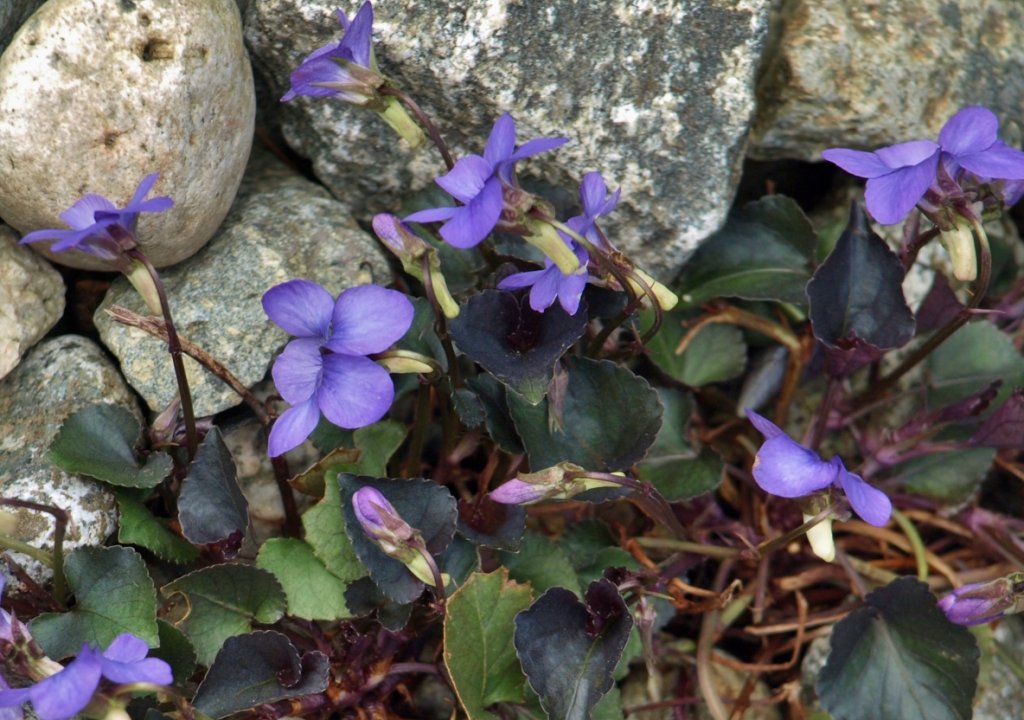
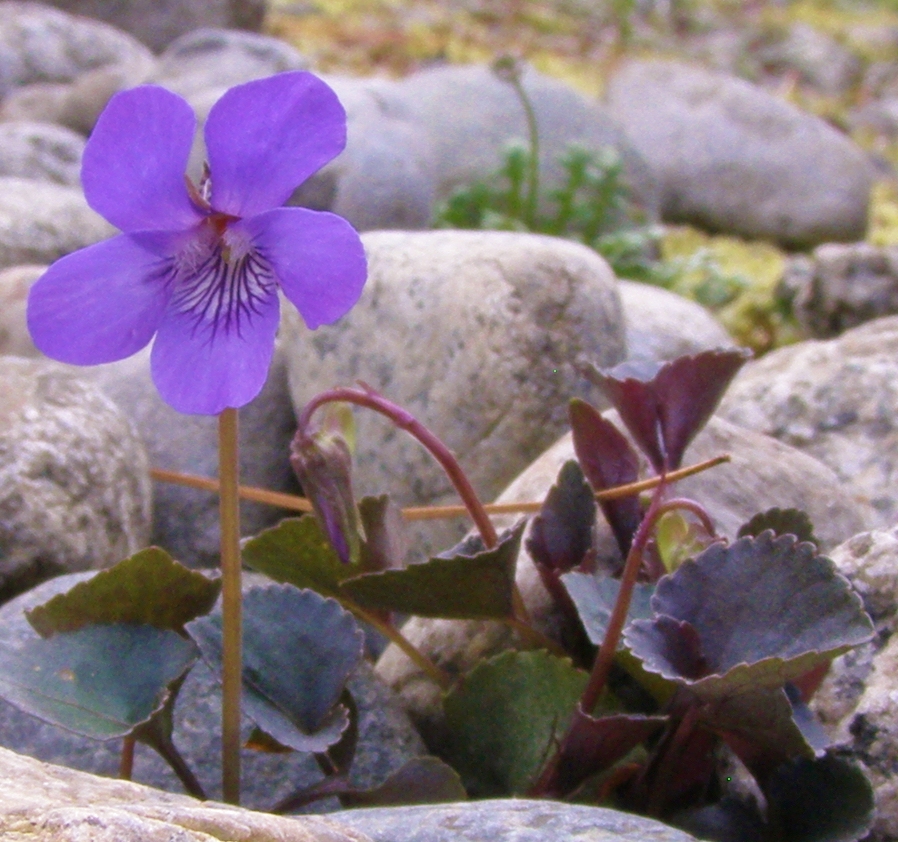
Viola labradorica ‘purpurea’/Viola riviniana ‘Purple Group’ – “Labrador Violet” – Van Dusen Garden, Vancouver, B.C. – June 2011. Image: HFN

Perennial. Zone 2. Violaceae. Eastern North America, or possibly Europe.

There presently exists some confusion among botanists as to whether the plant widely distributed in the plant trade as Viola labradorica (from eastern North America, including Labrador, and also in Greenland) is actually a very similar European species, Viola riviniana. Until the final verdict is in, there seems to be a broad agreement to keep calling this pretty little violet by the best-known common name, Labrador Violet.

Whatever the classification, it is most garden-worthy.

Viola labradorica 'purpurea Van Dusen Garden, Vancouver, B.C. - April 8, 2014. Image: HFN

Viola labradorica ‘purpurea’/Viola riviniana ‘Purple Group’ – Van Dusen Garden, Vancouver, B.C. – April 8, 2014. New spring foliage is darkest in colour, and decidedly glossy in texture. Image: HFN

The most instantly noticeable thing about this violet is its silken-textured red-purple flushed foliage. This is particularly noticeable in early spring, but the foliage remains dark-blushed all summer, with deeper shades developing in autumn. Plants reach 6 inches or so tall, and spread in a gently determined sort of way to form substantial colonies. It self-seeds about quite abundantly, but the young plants are easy to transplant or pull out if they overstep their allotted bounds.

Classic small purple violet flowers are produced in great abundance in spring and early summer. Sadly, these are not noticeably fragrant, but they are beautifully decorative. A hardy and attractive groundcover for under ferns, taller perennials, and shrubs, or in the nooks and crannies of rockwork.

Labrador Violet is content in sun to deep shade, in average soil with some summer moisture.

Viola labradorica purpurea (?) - "Labrador Violet" - May 2014, Hill Farm. Image: HFN

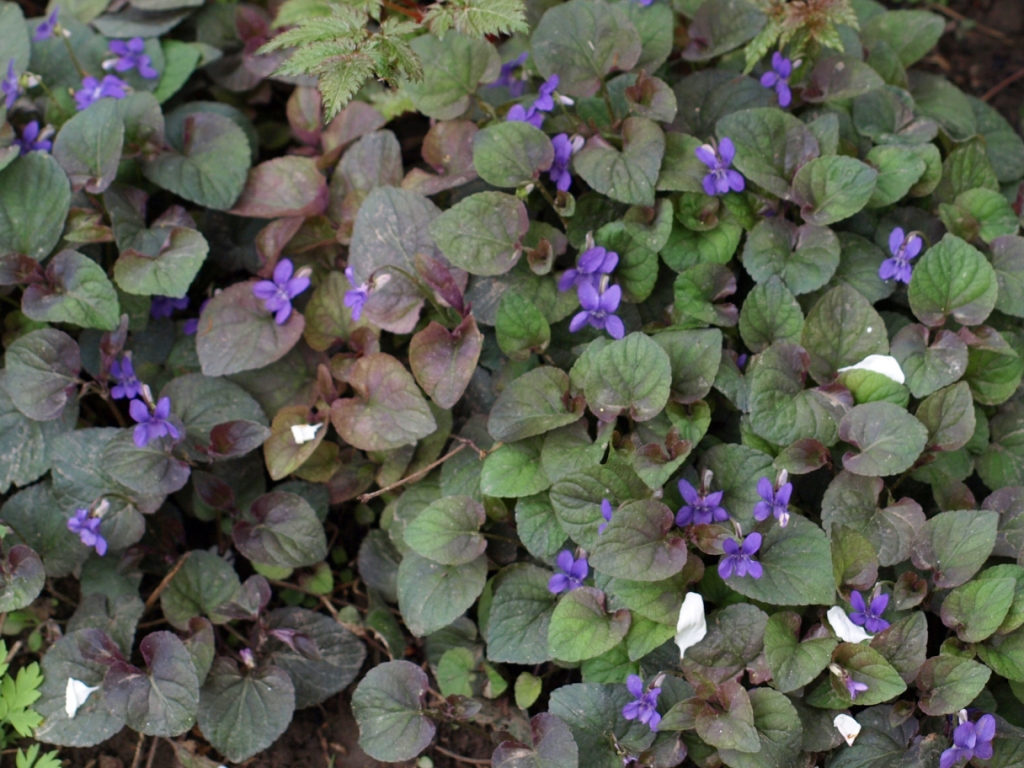
Viola labradorica purpurea (?) – “Labrador Violet” in a lush carpet under an old apple tree – note the fallen petals – May 2014, Hill Farm. Image: HFN

Another look at this pretty plant - "Labrador Violet" - May 2014. Image: HFN

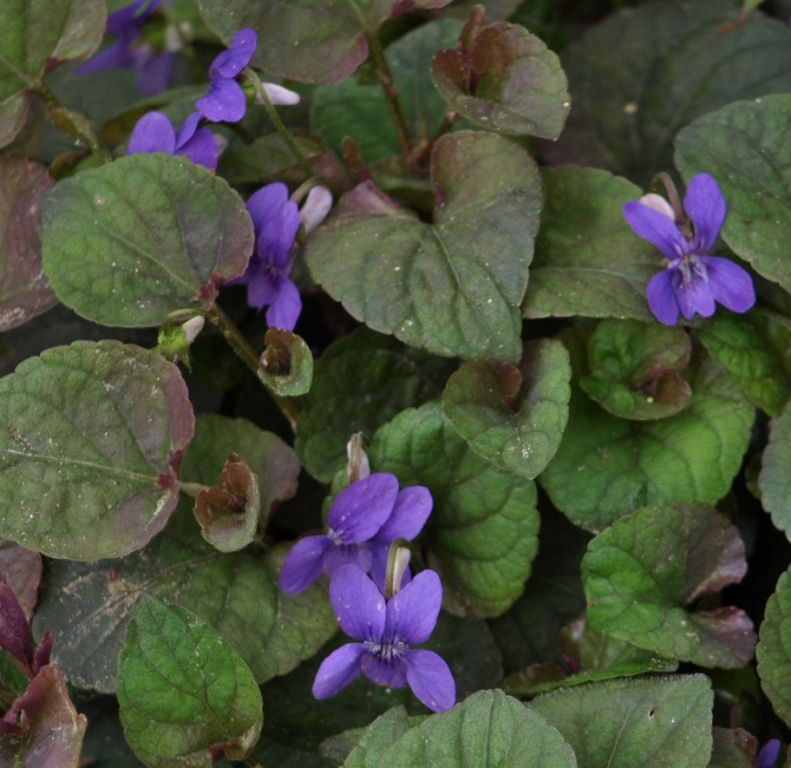
Another, closer look at this pretty plant (and possible imposter) – “Labrador Violet” – May 2014. Image: HFN

Read Full Post »

Lysimachia punctata - Dotted Loosestrife - July 2011 - Hill Farm. Image: HFN

Lysimachia punctata – Dotted Loosestrife – July 2011 – Hill Farm. Image: HFN

Perennial. Zone 2. Myrsinaceae, formerly Primulaceae. A.k.a. YELLOW LOOSESTRIFE, GOLDEN STARFLOWER. Austria, Italy, and east to Turkey.

This rather romping species is native to Europe, and has been grown in gardens for centuries. It was thought to have medicinal properties, being used as a wound herb to stop bleeding, and also to repel insects. Now we grow it strictly for ornament, for its adaptability and the summer beauty of its bright yellow star flowers.

Looking at the vivid yellow, unmarked flowers, you may wonder why Dotted Loosestrife is a common name, but if you look very closely at the undersides of the leave, you will see the tiny dark oil glands which led to Linnaeus choosing punctata – in Latin, “a point” – as its specific designation.
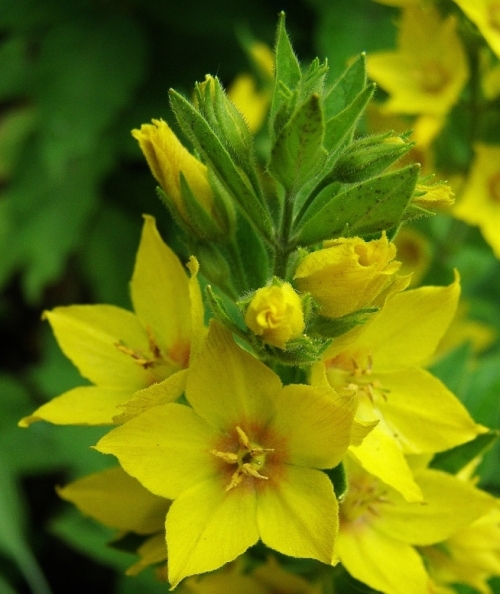
Lysimachia punctata detail Image: HFN

Lysimachia punctata detail, showing the tiny oil glands – the dark specks on the leaf undersides, looking rather like little spots of dirt – which have led to the “dotted” designation. Image: HFN

This plant is quite a tidy clump former its first few years, but keep an eye on it, as it will suddenly decide it needs more ground and it will expand outwards in all directions, though not by runners, merely by shouldering aside less robust neighbours. Lysimachia punctata is a well-respected garden plant, but it is not exactly what one would call shy, so you will want to site it appropriately.

Though Dotted Loosestrife is decidedly a moisture lover, I have had great success with it in a rather dry, neglected bed. It shares its space with a huge clump of ribbon grass (Phalaris arundinacea picta), ‘Europa’ tawny daylily (Hemerocallis flava), and a perennial sunflower, Heliopsis helianthoides, all of which are equally vigorous and have reached a kind of boundary stalemate. This combination has been working nicely for over ten years, though I do occasionally steal a few divisions to put elsewhere or to sell. I did initially grow it in a moist, fertile, newly prepared bed, but it was much too happy there and overran some more delicately precious plants, hence its relative exile to its present location.
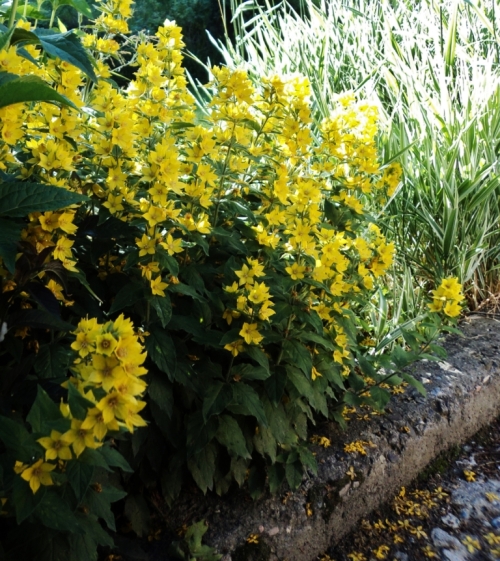
Lysimachia punctata and Ribbon Grass (Phalaris arundinaceae picta) - summer morning - Hill Farm - July 2012. Image: HFN

Lysimachia punctata and Ribbon Grass (Phalaris arundinaceae picta) – backlit by summer morning sun – Hill Farm – July 2012. Image: HFN

Lysimachia punctata grows to about 2 feet tall and wide in its present place; I suspect it would be even taller with more care. It’s a beautiful plant when in bloom, and something I particularly enjoy is its habit of shedding spent flowers like a cloud of star-shaped confetti all over the ground. It blooms for weeks and weeks, mid June right through July and into August most years, and even after flowering the foliage stays handsome, though a few leaves will brown a bit. It is also an excellent cutflower, though it does shed flowers from the bottom up.
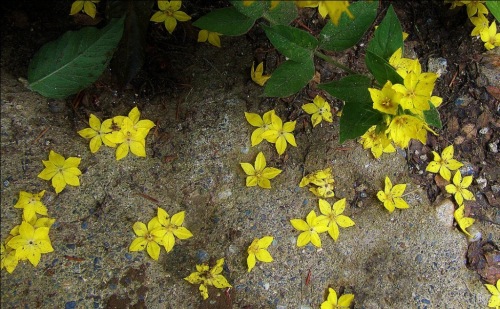
A galaxy of fallen starts - Lysimachia punctata - Hill Farm - July 2011. Image: HFN

A galaxy of fallen stars – Lysimachia punctata – Hill Farm – July 2011. Image: HFN

There are two variegated varieties which are now in cultivation, both developed from spontaneous colour breaks in plantings of Lysimachia punctata in England.

The first is a white-edged sport called ‘Alexander’, or sometimes ‘Alexander’s’, named after the late husband of its discoverer, Pauline Alexander. First identified in 1990, the plant was patented in 1998, after nursery trials proved its colour stability and growth trait predictability.
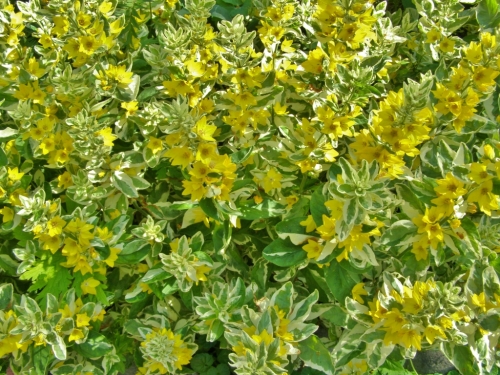
Lysimachia punctata 'Alexander'. Hill Farm, July 2013. Image: HFN

Lysimachia punctata ‘Alexander’. Hill Farm, July 2013. Image: HFN

‘Alexander’ is much slower growing than its mother species, and needs a bit of nurturing and a good moist soil at least the first few years. It has extremely appealing pink-blushed emerging growth in spring, very exotic! If this cultivar has a fault it is that the variegation causes puckering along much of the foliage; “purse-stringing”, as it is called. This puckering looks rather like disease or insect damage at first glance, and may be worrisome if you’re not aware that this is a varietal characteristic.

Spring foliage

‘Alexander’ Lysimachia punctata – exceptionally attractive early spring foliage. Image: HFN

Whatever genetic mutation was at work was not quite finished yet, for in 1998 another colour break was observed, this time in a test planting of ‘Alexander’ at Walburton Nursery in England. The leaf edges were golden, instead of white, and without the drawstring puckering which marked ‘Alexander’. ‘Golden Alexander’ was separated out, reproduced, and patented as a separate variety in 2003.

Both ‘Alexander’ and ‘Golden Alexander’ are hardy and suitable for the Cariboo-Chilcotin. They are not as vigorous as the green-leafed species, and require some care to ensure they reach full potential, but their bright colour is very appealing and they are worth growing for their strong curiousity value.

Something to watch out for in both of these cultivars is their strong tendency to revert to their all-green state. Vigilantly nip out any green shoots appearing in your colony, as these will quickly take over if allowed to remain.

Lysimachia punctata in all its colour variations thrives in full sun to part shade. It can happily be grown very moist, but accepts drier conditions with aplomb. It appreciates average garden soil – don’t grow it too rich. In general, a tough and trouble free species.

Read Full Post »
Perennial. Zone 4. Labiatae. Central and southern Russia, Romania, most notably in the Transylvanian Alps.

We are fortunate in the Cariboo in regard to our many summer perennial plant choices. The Salvias in particular appreciate our generally hot and dry summer season, and this handsome species puts on a grand show in July and August.

Large, dusky indigo-blue-violet flowers, “dragon head” shaped as is typical of all members of the Salvia genus (the Sage Family), are produced in loose whorls on multi-branching 18 to 24 inch tall bloom spikes. These arise from substantial rosettes of long, prettily wrinkled, rather hairy, deep green leaves. Foliage is slightly aromatic when touched, but is much less pungent than many of its relatives. A vigorous plant can be 2 feet or more in diameter, and rather sprawling in habit. Great on a slope, or under high-pruned, not-too-dense shrubs such as roses or spirea.

Transylvanian Sage blooms for a long period in summer, and, if spent spikes are clipped off occasionally, well into autumn. Grand for a sunny border, and drought tolerant enough to be a good xeriscape plant.

Plant it under roses in the traditional border, or with sedums and ornamental mulleins in the dry border. The colour harmonizes marvellously well with almost anything, and can be used for gentle compliment of other pastel shades or to set off hotter colours.

I have found that Salvia transylvanica overwinters extremely well as a young plant, but sometimes tends to bloom itself out, so I do not consider it particularly long lived. Allow it to set seed, and you will find enough babies to keep it going in your garden. These transplant well if you move them at a young age. Older plants should be left undisturbed; I wouldn’t recommend transplanting or dividing.

Sun is best, though very light shade is acceptable. Average to well drained soil; average fertility; average watering. Nicely drought tolerant once established.

Salvia transylvanica in full summer show in a Williams Lake garden, July 2014. Image: HFN

A Hill Farm-sourced Salvia transylvanica in full summer show in a Williams Lake garden, July 2014. Image: HFN

Read Full Post »

'New Millenium' unnamed variety growing at Hill Farm from a packet of mixed seed - 2 year old plant. July 2014. Image: HFN

‘New Millennium’ unnamed delphinium variety growing at Hill Farm from a packet of hand-pollinated breeder’s mixed seed – 2 year old plant. July 2014. Image: HFN

Perennial. Zone 2. Ranunculaceae.

Delphiniums are such stalwarts of our Cariboo-Chilcotin gardens that we tend to take them somewhat for granted. But there are delphiniums, and then there are Delphiniums. I’ve long been aware but not particularly envious of the many British cultivars which are being continually introduced in such an amazing array of variations: rich buttery yellows, warm salmon pinks, bicolours, doubles and triples, and ever more and “better” blues. “Very nice,” I think to myself, “but not terribly hardy, because of their complicated ancestry involving numerous tender species. And only available from cuttings, if at all…these are not for us.”

Then I heard rumour of a new strain of delphinium coming out of New Zealand, under the trade name ‘New Millennium’. Seed grown, hardy in the colder zones, and strikingly beautiful. I investigated the website of the breeder, and highly impressed by what I saw there, and what I’d heard elsewhere – these were just then coming into commercial production and were receiving early rave reviews – I took the plunge. Off I sent for seed, taking a deep breath at the cost, NZ$18.50 for 50 seeds, which worked out to something like 35 cents per seed Canadian. But hey, if a substantial number sprouted, that’s not too bad, right? And they germinated promptly in reasonable numbers, and I ended up with a goodly number of young plants, most of which made their way to that year’s market, though I kept a few back for myself.

'New Millenium' Hill Farm, July 2013. Image: HFN

‘New Millennium’ Delphinium – ‘Moonlight Blues’ strain – 3 year old plant. Hill Farm, July 2013. Image: HFN

'New Millenium' Hill Farm, July 2014. Image: HFN

‘New Millennium’ Delphinium – ‘Dusky Maidens’ strain – Second year plant –  Hill Farm, July 2014. Image: HFN

'New Millenium' Hill Farm July 2014 Image: HFN

‘New Millennium’ Delphinium – unnamed seedling from breeder’s hand-pollinated mixture. Second year plant. Hill Farm, July 2014. Image: HFN

'New Millenium' Hill Farm July 2014

‘New Millennium’ Delphinium – unnamed second year seedling from breeder’s hand-pollinated mixture. Hill Farm, July 2014. Image: HFN

If you love delphiniums, take a look here: Dowdeswell’s Delphiniums. Their seed comes fresh and ready to sprout; if you are even the tiniest bit experienced with growing things from indoor-sown seed, give these a go. Much too costly to scatter about the garden, but with a bit of care the germination in starter packs is excellent. (Grow these cool, as too-hot temperatures are fatal.)

Colour and form of every strain of these we’ve tried have been outstanding. If you love delphiniums these will make you a very happy gardener!

Most are traditionally tall, from 6 to 8 feet once established, with multiple strong bloom stalks from basal clumps of healthy foliage.

Definitely prepare to stake these before they bloom, for though nicely sturdy they will snap off in summer storms if unsupported while in bloom. There are some shorter strains, which also need to be supported. The flowers are huge, and the bloom stalks very heavy.

At Dowdeswell’s the delphiniums are grown through grids, and a planting I recently visited at Van Dusen Garden in Vancouver had done much the same, with bamboo stakes neatly tied together. In my own garden I use upright stakes, but the grid idea has a lot of appeal, and would definitely be best in a dedicated planting to save much time and energy over tying every stalk up individually.

Delphiniums of all sorts thrive best in rich garden soil, with average moisture. Full sun is preferred, though they will take very light shade for part of the day.

A plot of seedling 'New Millenium' Delphiniums at Van Dusen Garden in Vancouver, B.C. - October 2014. The young plants frequently put out bloom in the autumn of their first year, a teasing foretaste of the glories to come when they reach full maturity. Note the bamboo grid arrangement, for support of the heavy bloom stems. Image: HFN

A plot of seedling ‘New Millennium’ Delphiniums at Van Dusen Garden in Vancouver, B.C., October 2014. The young plants frequently put out bloom in the autumn of their first year, a teasing foretaste of the glories to come when they reach full maturity. Note the bamboo grid arrangement, for support of the heavy bloom stems. Image: HFN

Here are the named ‘New Millennium’ strains we’ve grown so far. The following photos are from the breeder, and, from what we’ve personally experienced, do truly reflect the quality of these flowers.


 For more, take a look at the Dowdeswell’s website.

Read Full Post »

Lychnis chalcedonica - Scarlet Maltese Cross - Prince George, B.C. - July 2013. Image: HFN

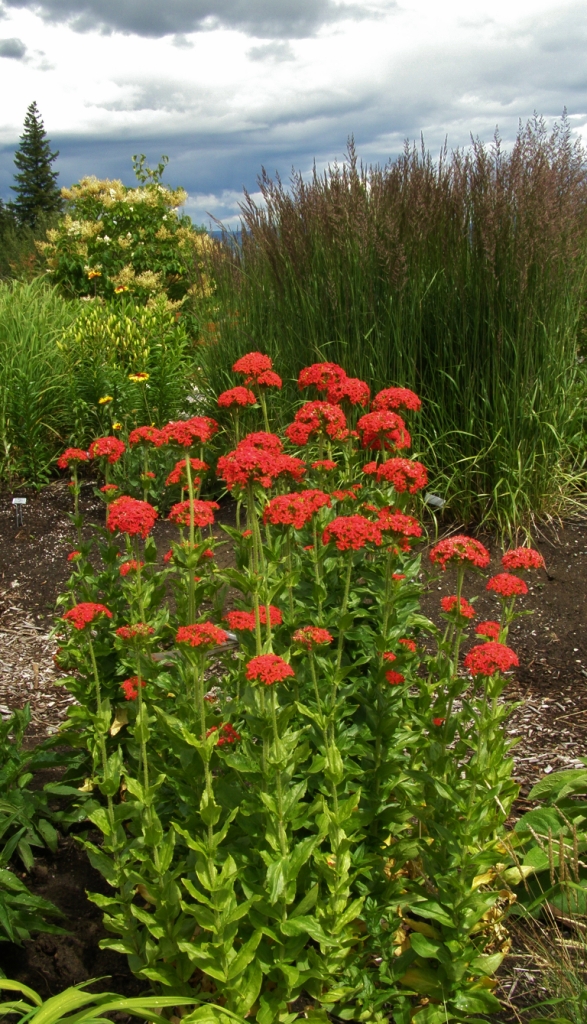
Lychnis chalcedonica – Scarlet Maltese Cross – Prince George, B.C. – July 2013. Image: HFN

Perennial. Zone 1. Caryophyllaceae. Russia, Northern Asia. A.k.a., according to the Royal Horticultural Society, an astounding number of common names, among them: Cross of Jerusalem, Fireball, Flower of Bristow, Flower of Constantinople, Gardener’s Delight, Great Candlestick, Knight’s Cross, London Pride, None-Such, Red Robin, Scarlet Lightning,Tears of Christ.

If I think back to the gardens of my childhood, during the late 1960s and early 1970s, Maltese Cross is ever-present. My mother grew it and viewed it with great fondness, as did all of her gardening friends. It flourished in its scarlet glory in remote ranch gardens on the Chilcotin plateau as enthusiastically as it did in the town gardens we frequently visited in Williams Lake and 100 Mile House.

I sometimes muse on what a recreated Cariboo heritage garden would contain. Always a lilac bush, of course, and a massive clump of rhubarb. Red currants drooping with their luminescent clusters, promises of sweet jelly and mouth-puckering cordial to come. Raspberries, in generous wire-supported rows. Golden Glow lolling brightly by the fence, tied back with a length of sisal baler twine. In spring, a profusion of grape hyacinths, Johnny-Jump-Ups, striped ‘Pickwick’ crocuses, under a pinker-than-pink Flowering Almond bush. Red and yellow tulips. ‘Persian Yellow’ roses, blooming for a brief but wonderful time in June. Red-and-black oriental poppies, royal purple Cluster Bellflower, those ubiquitous purple and white bearded iris smelling strongly of grape Kool-Aid to my childish nose, identified in later years as the venerable variety ‘Wabash’. Double-flowered Achillea ptarmica – I can’t remember a common  name, though it must have had one. Did Mom call this one ‘Baby’s Breath’? I think she might have, though she had “real” baby’s breath, too – Gypsophila paniculata. Lanky delphiniums in shades of the sky. A colony of tall, pale purple phlox, alongside a fragrant yellow daylily. Columbines everywhere. Canterbury Bells and Sweet Williams. Orange tiger lilies in late summer. Cerise Rose Campion in the most unexpected places, and, inevitably, a sturdy clump of quite ridiculously red Maltese Cross.

My goodness. I should stop right there, before a tear comes to my eye. Our gardens are indeed full of memories…

Lychnis chalcedonica in a contemporary garden setting, in te perennial border at the University of Northern British Columbia in Prince George, July 2013. Image: UFN

Lychnis chalcedonica in a contemporary garden setting, perfectly combined with tall ornamental grasses in the perennial border at the University of Northern British Columbia in Prince George, July 2013. Image: UFN


So – here are the basics regarding Lychnis chalcedonica.  It forms strong clumps to 2 feet or taller. The sturdy stems topped by domed heads of brilliant scarlet, cross-like (though 5-petalled) flowers for a reasonably long period in mid-summer, 3 to 4 weeks. It reliably reblooms if cut back.

Maltese Cross prefers full sun, good soil, and average amounts of moisture. Mature clumps may be carefully divided, but so easy from seed that I never bother with division. Not at all invasive; well behaved in all its habits. You may wish to unobtrusively stake it, as it can occasionally birdsnest with summer thundershowers. But it is a truly sturdy thing, and requires minimal fussing.

Garden legend has it that this was one of those plants brought back to England from the Holy Land by returning Crusaders, but this is apparently not the case. More likely it came via regular trade routes from European travellers; the species originated in Russian and northern Chinese forests and steppes, and still can be found growing in the wild. Its first mention in garden literature predates the 1590s.

Can you see the cross-shaped form that leads to the common name? The fact that the blooms actually have five lobes versus four is a bit of a surprise - the effect is definitely geometric and cross-like. Image: HFN

Can you see the flower form that leads to the common name? The fact that the blooms actually have five fused petals versus four is a bit of a surprise – the overall effect is definitely geometric and cross-like. Image: HFN

Siting Maltese Cross in the contemporary garden can prove something of a dilemma, mostly for those who worry about colour harmony and contrasts. Here are some wise words from Cape Breton garden writer Jo Ann Gardner, in her 1992 book, The Heirloom Garden:

I have found folk gardeners to be less intimidated by Jerusalem-cross’s brilliant colour than are contemporary gardeners, who are often afraid of offending sensibilities by planting it near the varicoloured flowers of early summer and mid-summer. But it blends surprisingly well with soft pink Musk Mallow (Malva moschata), Lupines of all sorts, Siberian Iris, Bellflower, Foxglove, the lilac-white plumes of Clary Sage, and the yellow daisy-flowered Golden-Marguerite. One is often advised to banish Jerusalem-cross to the to the safety of low-growing evergreens, where its glowing colour will be reduced or neutralized. Consider that Gertrude Jekyll, the mistress of colour in the garden, grouped it among orange Daylilies, Dahlias, Marigolds and Nasturtiums…

There are a number of variations of Lychnis chalcedonica which you may find interesting. Last heard of in the 1920s and possibly lost forever – though one can hope they exist in some isolated cottage garden, waiting for their rediscovery – are double scarlet (first written about in 1629) and double white (1772) forms, but we do have some pretty singles to console ourselves with. A blushing pink – ‘Morgenrote’ a.k.a. ‘Morning Red’, sometimes sold as ‘Dusky Salmon’ – and a pristine white – ‘Raureif’ a.k.a. ‘Hoarfrost’, sometimes sold as ‘Snowbird’ – are still in the seed trade, and just a year or so ago I saw mention of a more compact scarlet variety, ‘Burning Love’, reported to be a compact 12 to 18 inches tall – perhaps easier to tuck into a small suburban planting?

Lychnis chalcedonica 'rosea' - 'Morgenrote', a.k.a. 'Morning Red', a.k.a. 'Dusky Salmon'. Image HFN

Lychnis chalcedonica ‘rosea’ – ‘Morgenrote’, a.k.a. ‘Morning Red’, a.k.a. ‘Dusky Salmon’. Heads of pale, rosy-salmon-pink blooms change colour as they age to give a variegated effect to the bloom clusters.  Williams Lake, B.C. – July 2014. Image HFN


Read Full Post »

Perennial. Zone 3. Compositae. North Africa, Spain, Mediterranean regions. Syn. Anacyclus depressus, syn. A. maroccanus. A.k.a. SPANISH CHAMOMILE, ALEXANDER’S FOOT. Though I can find no reference to it other than the name on a number of alpine plant society lists, I am assuming that the latter allusion is to Alexander the Great and his historical presence in the areas where this plant grows.

This small charmer completely bewitched me the first time I grew it many years ago, with its tidy, fern-leaved, very furry foliage rosettes, and I was thrilled when it overwintered and bloomed enthusiastically in the spring. I’d rather wondered, what with its warm-climate origins, but hardiness doesn’t appear to be a problem, as long as the plant has its roots down in well-drained soil.

Little white daisy flowers with crimson petal undersides emerge in spring from mats of ferny, curling foliage. These open wide in the sun, but close up on cloudy days and in the evening, showing off the vividly contrasting rosy blush on the petal undersides. Bloom stems radiate in a circle from a central point; plants are literally circular in shape, and tightly hugging the ground.

A quietly beautiful rockery or edging plant. To about 4 inches tall, and a foot or so wide. Its only flaw is that it often blooms itself to death, so you will want to leave some seed heads to mature to self-sow, or to collect seed for a guarantee of replacement plants.

Full sun, and well-drained soil. Very happy among rocks, or on a slope.

Read Full Post »

Giant Crambe - Crambe cordifolia - a Hill Farm plant growing in our good friend Ellen's Soda Creek, B.C. garden - July 2008. Image: HFN

Giant Crambe – Crambe cordifolia – a Hill Farm plant growing in our good friend Ellen’s Soda Creek, B.C. garden – July 2008. Image: HFN

Perennial. Zone 3. Brassicaceae (formerly Cruciferae.) Caucasus Mountains. A.k.a. COLEWORT, GIANT SEA KALE.

This plant has been grown in gardens for at least 100 years, and is much sought after by anyone who has seen it in the dramatic mixed perennial flower borders of famous British country estates.

A most substantial plant, this is! Imagine a Volkswagen Beetle sized space commitment for its admittedly brief bloom time, 3 weeks at best. Okay, perhaps that is a slight exaggeration. But this thing can get huge.

Large, thick-textured, hairy basal leaves produce tall, multi-branching stems from 3 to 6 feet tall, which produce clouds of very sweetly-scented, pure white flowers in early summer. Looks like a Baby’s Breath gone wild, is one comment a happy customer made when proudly showing me a photo of her immense 5-year-old plant.

Crambe cordifolia takes a while to reach full size, usually blooming year three or thereabouts. Site carefully, as it is tap-rooted and dislikes being moved. Though not at all invasive, it may also persistently re-sprout from chunks of taproot left in the soil if you do decide to  move it once it is established. Frequently the transplanted piece will languish and die, after a long, yellow-leaved decline, so think hard before getting out your shovel.

Being in the Brassica Family, Crambe cordifolia is attractive to Cabbage Moths, so keep an eye out for the caterpillars, as they can skeletonize those big leaves surprisingly quickly, leaving nothing but the centre ribs. Most gardeners cut off the bloom stalks once flowering is finished, but if you want to try to ripen seed, or just simply like the look of the thing for its curiousity factor, you can certainly leave it alone, though a stake is a good idea, as summer thunderstorms may topple the aging edifice.

When I first experimented with Crambe cordifolia I was rather worried about its hardiness; most Zone ratings were for 6 or thereabouts, but after almost 20 years of growing and selling it, and much customer feedback (most enthusiastic, though some people felt it got too big, or were troubled by resprouting roots after digging up established plants) I can firmly state that Zone 3 suits it just fine.

Full sun. Very drought tolerant once established, though it appreciates summer moisture and reasonable fertility for the best after-blooming foliage health.

bbb

One more look at Ellen’s Giant Crambe, with Asiatic lilies at its feet. Honey-scented, and alive with bees. Soda Creek, B.C., July 2008. Image: HFN

Read Full Post »
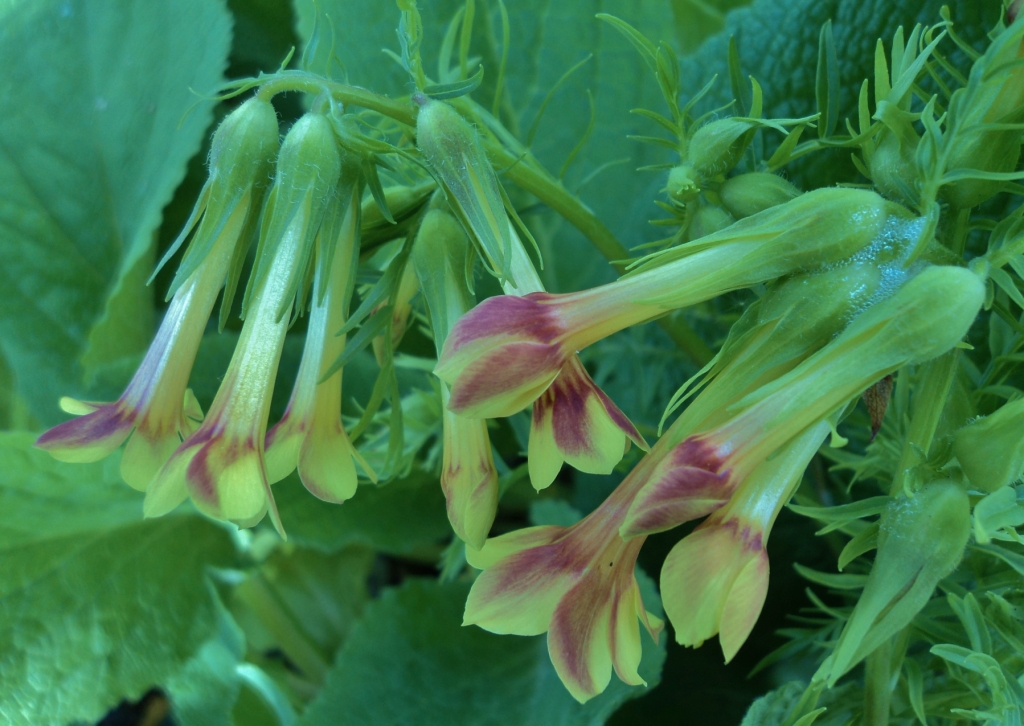
Polemonium pauciflorum - Yellow Jacob's Ladder - Hill Farm, June 2011. Image: HFN

Polemonium pauciflorum – Yellow Jacob’s Ladder – Hill Farm, June 2011. Image: HFN

Short-Lived Perennial. Zone 4. Polemoniaceae. Arizona, New Mexico, Texas.

This is a Jacob’s Ladder with a difference. Instead of the usual clusters of blue and lavender wide-open flowers, P. pauciflorum produces graceful downfacing sulphur yellow trumpets, blushed with dusky red.

The specific name, pauciflorum, translates as “few-flowered”, but this is a relative designation. There may be few in each cluster compared to the dense arrangements of many of its relatives, but there are many blooming stems produced. So many, in fact, that Yellow Jacob Ladder frequently “blooms itself to death”, fading away completely after its exertion.

Delicate, many-leafleted foliage in lush 12-inch wide clumps. The graceful flower clusters on slender, 12 to 18 inch stalks appear in spring and early summer.

A very nice little plant, rarely found commercially but popular in the “plant fanatic” seed exchange world, which is where I originally obtained mine, from a gardener in Wales. (A rather roundabout trip from its native home in southern North America!)

Polemonium pauciflorum frequently blooms profusely in its first season, so may be treated as an annual, though technically it is perennial. Allow it to set seed and self sow to ensure its continued presence in your garden. If collecting seed for sharing or growing out, be aware that it has a short viability period in dry, cool room temperature storage, of 6 months to a year at most in my experience.

Sun to light shade; average soil and moisture.

This plant's membership in the Phlox Family is very evident from the appearance of the tightly furled buds - something I hadn't really noticed regarding other species. Image: HFN

This plant’s membership in the Phlox Family is very evident from the appearance of the tightly furled buds – something I hadn’t really noticed regarding other species. Image: HFN

Read Full Post »

Geum triflorum - Prairie Smoke, Nodding Avens - Alice Wolyzuk Botanical Garden, University of Northern British Columbia, Prince George, B.C. May 2014. Image: HFN

Geum triflorum – Prairie Smoke, Nodding Avens – Alice Wolczuk Alpine Garden, University of Northern British Columbia, Prince George, B.C., May 2014. Image: HFN

Perennial.  Zone 1. Rosaceae. A.k.a. PURPLE AVENS, THREE-FLOWERED AVENS, OLD MAN’S WHISKERS. Native to a large area of North America, from British Columbia through the prairie provinces, as far south as California, and eastward across the northern United States. Geum comes from the Latin name gaeum, “a plant with aromatic roots” which is derived from the Greek geno, “to yield an agreeable fragrance”. Triflorum = three-flowered, from the habit of the blooms to appear in clusters of three.

One of my favourite spring wildflowers, this pretty plant flourishes from the dry hillsides of the Cariboo to the prairie grasslands east of the Rockies. It happily adapts to the garden, and I always enjoy meeting it unexpectedly, flourishing in alpine and botanical gardens in its quiet way, as content to be treated with care in a plant collection as it is on the rocky slopes of the higher points of Hill Farm.

According to Plants of Northern British Columbia (1992: MacKinnon, Pojar, Coupé), Geum triflorum was used by the Thompson and Okanagan First Nations people to make a root tea for treating colds, flu and fever. The Blackfoot in Alberta were reported to use the crushed seed as a perfume.

Geum triflorum - flower details. Macalister, B.C., May 2010. Image: HFN

Geum triflorum – flower details. Macalister, B.C., May 2010. Image: HFN

Tidy clumps send up multiple 6 to 12 inch tall stems topped by triplets of dusky pink, nodding, bell shaped blooms. These never properly open, but are sought out regardless be tenacious early-foraging wild bees, which force their way into the downfacing bells. The insects’ great pollinating success is evident by the profuse seed heads which develop a little later.

These seed heads are Geum triflorum’s main attraction, and its showiest feature in June and July. Large, feathery, often spiralled, and very long lasting, they are prettily blushed with pink, which makes a delicate contrast to the soft green of the developing seeds at the centre of each cluster.

After pollination, the feathery seed heads start to expand. Prince George, May 2014. Image: HFN

After pollination, the feathery seed heads start to expand. Prince George, May 2014. Image: HFN

Foliage is softly downy, a gently sage green, and rather ferny in effect. It forms basal clusters, and stays attractive all season, eventually blushing rich red in autumn.

Nodding Avens has a rhizomatous root system, and gently spreads to form a generous colony where happy, but is never invasive or ill-behaved. Very nice for spring and early summer interest in the rockery or at the border front. Very good on slopes.

Best in sun but will tolerate light shade. Very adaptable to all sorts of soil. Very drought tolerant, but appreciates some extra moisture at the peak of summer.

Read Full Post »

Star-of-Persia - Allium christophii - June 6, 2014

Star-of-Persia – Allium christophii. Summerland, B.C., June 6, 2014. Image: HFN

Perennial. Zone 4. Liliaceae. Syn. Allium albopilosum Originally native to Iran, Turkey, and central Asia – general region of ancient Persia.  This lovely plant has been grown in western gardens since its first introduction to England in 1884.

I first grew this beautiful ornamental onion over 20 years ago, and I well remember how the reality of it exceeded my already high expectations. It is a wonderful thing.

This is a spectacular allium, gorgeous in all its stages, bud to bloom to seed head. Clumps of long (to 20 inches), grey-green, strap-shaped leaves appear in early spring, soon followed by 12 to 24 inch stalks topped by a quickly expanding sheathed bud, which explodes in late May into a huge bloom cluster – up to 12 inches in diameter – which consists of many pale lavender star flowers.

Allium christophii - unfolding star flowers - a beautifully fascinating process. Image: HFN

Allium christophii – unfolding star flowers – a beautifully fascinating process. Image: HFN

These continue to look good for weeks, gradually transfiguring into plump green seed pods, which can be left alone to eventually dry in place, giving a rather surreal accent to the border. (Or they can be harvested just as they start to turn yellow and hung to dry as unique everlastings.) The fresh and green seed stage blooms are wonderful as cutflowers, too.

The foliage quickly withers and is gone by midsummer, by which time other plants have filled in to hide the yellowing leaves. Where happy, on well-drained soil in full sun, these bulbs will slowly reproduce to form an increasingly large colony.

Bulbs may be lifted in midsummer to early fall, and (if they have formed a cluster) separated and replanted. Because of the size of the blooms, it is best to space them fairly generously, up to a foot apart, or a bit closer if you are going for a cluster effect.

Sun; average soil & moisture. Quite drought tolerant. Appreciates good drainage.

A flourishing colony of Star-of-Persia in the Summerland Ornamental Garden. June, 2014. Image: HFN

A flourishing colony of Star-of-Persia in the Summerland Ornamental Garden. June, 2014. Image: HFN

Read Full Post »

« Newer Posts - Older Posts »