Archive for the ‘Mid Height’ Category

Wild Four-O-Clocks - Mirabilis nyctaginea. Spences Bridge, B.C. May 30, 2014.

Wild Four-O-Clocks – Mirabilis nyctaginea. Spences Bridge, B.C. May 30, 2014. Image: HFN

Perennial. Zone 6, possibly colder. Nyctaginaceae. A.k.a. Heart-Leaved Four-O’Clock, Umbrellawort. Native to the Great Plains of the United States, as well as southern regions of Manitoba, Saskatchewan and Ontario. Isolated introduced populations found throughout B.C., Alberta and Quebec.

On a recent road trip, heading through the arid rangelands and rolling hills south of Cache Creek and following the Thompson River’s deeply carved valley as it heads towards its spectacular rendezvous with the Fraser at Lytton, my attention was caught by several tall clumps of lush, dark green foliage, showing clusters of small but vivid magenta-pink blooms. Pulling over in a wide spot on the road, I looped back to take a closer look.

An initial examination of the flower structure and foliage gave me an “Aha!” moment. Could this possibly be wild four-o’clocks? It wasn’t in any of the wildflower field guides I had along, nor, when back home, in my trusty and comprehensive Lewis J. Clark’s Wild Flowers of British Columbia, but an internet search yielded an immediate confirmation.
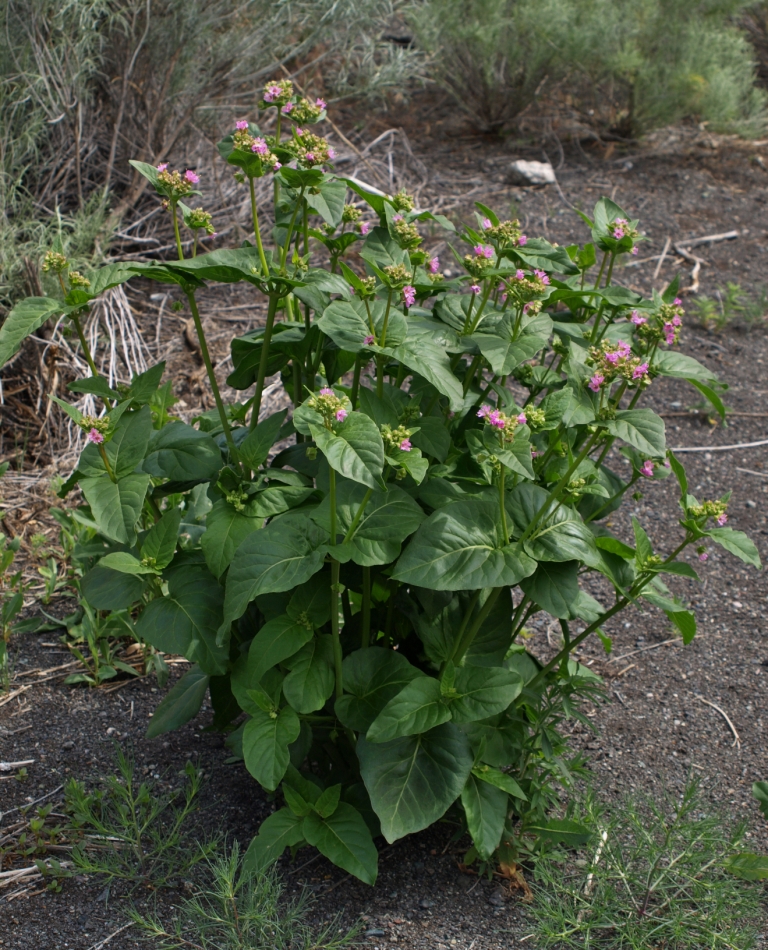
Plant habit is eye-catching, in this case because of its unexpectedly lush greenness set against a background of silver-green sagebrush and bunchgrass-tufted hills.

Near Spences Bridge, May 30, 2014. Plant habit is eye-catching, in this case because of its unexpectedly lush greenness set against a background of silver-green sagebrush and bunchgrass-tufted hills. Image: HFN

My online research yielded these details.

The plants grow in vigorous clumps from 1 to 3 feet tall (these were about 2 feet tall), with broad, heart-shaped, opposite leaves clasping the angle-sided stems. Flower clusters show green bracts at the bases of the tubular flowers, which are of a bright magenta pink. Stamens are also magenta, tipped with yellow pollen. After flowering, the bracts enlarge into a papery “umbrella” centered by a cluster of large, rather hairy nutlet-type seed. These bracts then act as parachutes during the seed dispersion stage.

The plant forms a large, tuberous tap-root, which extends a foot or more into the soil, allowing the plant to thrive in arid conditions. This root is what has led this plant to be classified as a weed-of-concern in some regions, as it is very hard to eradicate once established, being highly herbicide resistant, and able to resprout from root fragments left in the soil after pulling. (And of course the wind-dispersed seeds would also be a major factor in its ability to spread, especially in areas of disturbed soil.)

The sweet-tasting roots of this plant were used by indigenous peoples as a poultice for skin ailments and burns, and as a medicinal tea to expel worms, and to treat fevers and bladder complaints. Though pigs apparently dig up and eat the roots with great relish – they are recommended for eradication in agricultural infestations – there is some speculation that Mirabilis nyctaginea may contain some mildly toxic alkaloids, so experimentation with herbal use is not advised.

I suspect that this plant would not be winter hardy in the Cariboo-Chilcotin, but it might well succeed as an annual, as its domestic relative, the lovely and fragrant Mirabilis jalapa (the commonly grown garden flower Four-O’Clocks, or Marvel-of-Peru) blooms generously as a summer-flowering annual, and forms a similar fleshy root which does not withstand freezing soil.

While decidedly pretty in a low-key way, Mirabilis nyctaginea is not particularly showy, and reports of its “weedy” tendencies would make me cautious to recommend this plant, though it might be an interesting addition to a wildflower planting if one is feeling adventurous, and is prepared to remove seedheads before they can disperse. Seed is often available for this plant through botanical seed exchanges, and commercially through some specialist native plant seed houses.

Near Spences Bridge, B.C. May 30, 2014.

Near Spences Bridge, B.C. May 30, 2014. Image: HFN
 

Read Full Post »

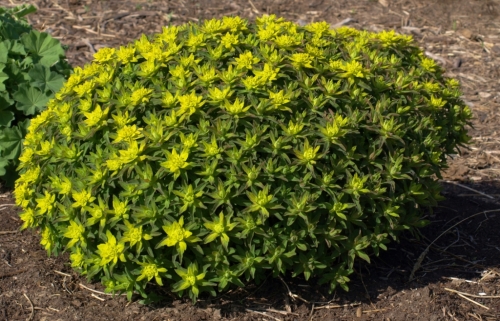
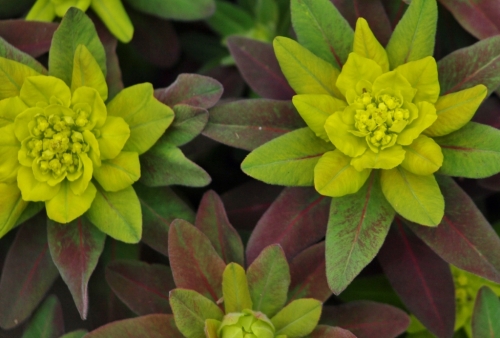
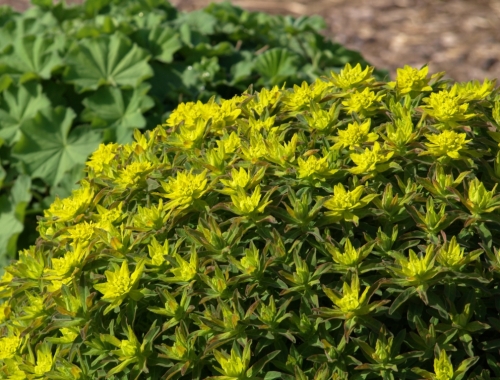
Cushion Spurge - Euphorbia polychroma (syn. E. epithymoides) - Prince George, B.C. - May 18, 2014

Cushion Spurge – Euphorbia polychroma (syn. E. epithymoides) – Prince George, B.C. – May 18, 2014 Image: HFN

Perennial. Zone 1. Euphorbiaceae. Native of Europe from southern Germany to the Ukraine, Bulgaria, Greece and Turkey, where it grows in dry forests, mixed meadows, and on rocky hillsides.

Euphorbia was named by Linnaeus in 1753 for Euphorbus, the Greek physician of King Juba II (circa 12 B.C.E.) of ancient Numidia and Mauretania (approximately present-day Morocco), who reportedly discovered medicinal uses for the local species. While Linnaeus assigned the species name epithymoides for this plant, it was renamed polychroma in the 1850s by yet another classifying botanist, Anton Josef Kerner, and this name soon took precedence and is the more commonly recognized designation today. Polychroma is after the Greek polu – ‘many’ – and xrwma – ‘colour’, a reference to the shaded colours of the bracted stem tops and ornate flower clusters.

Sun to part shade; average conditions. This appears to be a deer resistant plant – something to note for those of you afflicted by these increasingly bold and destructive garden pests.

It’s well into May, and everywhere I go these days I note the unmistakably glow of this unique specimen plant. It flourishes happily in mature, well established gardens as much as in newer, more avant-garde plantings accenting newly built homes in the posher parts of town. When (and where) the lilacs bloom, then (and there) too the cushion spurge.

I first became aware of this rather unusual and eye-catching ornamental during our first spring living in an older neighbourhood in a small Alberta town. Many of the front porches of the modest clapboard-sided 1930s’ and 40s’ era homes were flanked by perfectly globular, neon-yellow-tipped twin bushes. Some kind of exotic shrub? – I wondered to myself, until a visit to the botanical garden at the Calgary Zoo acquainted me with its Latin name, and I was able to track it down in the gardening books. (This was long pre-internet – I smile at the memory of how laborious this sort of rather basic research used to be, before the wonders of the Google image search!)

The natural form of this plant is neatly globular, though it may occasionally "birdsnest" with summer thunderstorms. If this happens, a hard trim to within 6 inches or so of the crown will result in quick regrowth to tidy cushion shape.

The natural form of this plant is neatly globular, though it may occasionally “birdsnest” with summer thunderstorms. If this happens, a hard trim to within 6 inches or so of the crown will result in quick regrowth to tidy cushion shape. Image: HFN

Cushion spurge grows to 18 inches tall and 2 ft. wide where happy – which is most places, as it is an adaptable, good-natured thing. It thrives in sun to part shade, and in modestly moist to dry soils, though it doesn’t care for overly soggy ground. Once established it is very drought tolerant, though it will definitely appreciate the occasional soaking in hot summers.

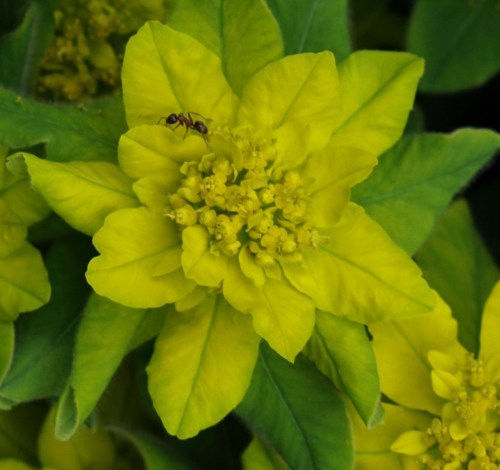
Clumps of woody-based stems are lined with whorls of soft green, rounded foliage, which are tipped with the modified leaves commonly referred to as bracts, though the correct term in this case is cyathium leaves. These turn a vivid, glowing, chartreuse-yellow, centered with clusters of tiny, even brighter yellow petal-less florets. These clusters include nectar-rich glands – nectaries – which reward foraging pollinators. I have not noticed that bees are particularly attracted to the blooms – though they do visit – but the highest traffic seems to be small flies, and ants and other crawling insects.

??????????????????????

Note the small visitor. Image: HFN

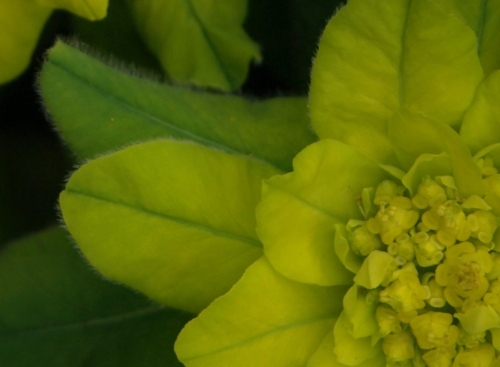
An even closer view showing flower structure, and the downy hairs which give the entire plant its velvety texture.

An even closer view showing flower structure, and the downy hairs which give the entire plant its velvety texture. Image: HFN

After blooming and pollination – peak bloom time is all through May and into June – the yellow colour fades to a uniform green. Seed capsules form which eventually pop open later in the summer, catapulting seeds out into the garden, where they sprout in modest numbers. Seedlings are easily removed or transplanted to more desirable locations, where they quickly settle down to the business of growing and forming yet another perfect little globe.

Cushion spurge remains attractive through summer, and can be left to fend for itself or clipped back to produce fresh foliage. The plant fades to yellow in the autumn, frequently showing a red stage before the leaves finally wither after the last, hardest frosts.

Several “improved” (or perhaps one might say “enhanced”) cultivars of Euphorbia polychroma are popular in the nursery trade, including the burgundy-blushed ‘Bonfire’, a patented selection of the Euphorbia polychroma ‘purpurea’ sport which has been grown as a desirable rarity for many years, sometimes under the cultivar name ‘Candy’, and the white-pink-green ‘First Blush’. Of these two types I much prefer the red-leaved variety, as I’ve noticed that the white-variegated form is much less vigorous, and seems to show a high percentage of deformed and puckered leaves.

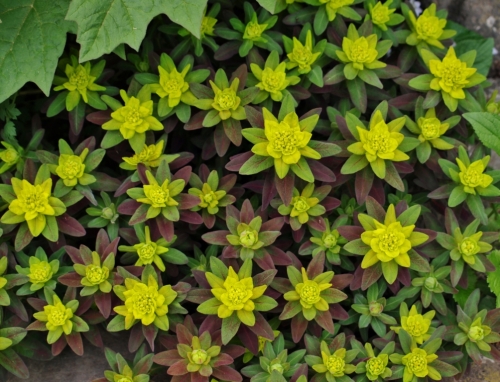
Euphorbia polychrome 'purpurea' - red-leafed form - an excellent specimen plant, more restrained and smaller than the green-leaved original.

Euphorbia polychrome ‘purpurea’ – red-leaved form – an excellent specimen plant, slightly more restrained and measurably smaller than the green-leaved original. Hill Farm, May 21, 2014. Image: HFN

E. polychroma 'purpurea' shows its richest dark red shading just before the yellow bracts fully develop; after blooming it fades to a uniform green.

E. polychroma ‘purpurea’ shows its richest dark red shading just before the yellow bracts fully develop; after blooming it fades to a uniform green. Image: HFN

The common form of this handsome plant is a venerable garden old-timer, having been grown for centuries both for ornament and for occasional medicinal use. John Gerard’s masterwork The herball, or Generall historie of plantes, first published in England in 1633, reported of  Spurge that “…the juice or milke is good to stop hollow teeth…”  A modern commentator theorizes that the poisonous latex probably destroyed the nerve endings. The specific species of Euphorbia referred to is unknown, though all share the same milky (and irritating) sap. 

Another medicinal use, and the origin of the common name of this very large genus (over 2000 species, found worldwide), is that of a purgative – a vigorous laxative – though one that was prescribed with some caution, as the violence of its action could be fatal if the decoction was too strong. From the French medical term describing the process, “espurgier”, came  the English “purge”, and hence “spurge”, or so the theorizing goes. Though we no longer find ourselves partaking of the plant in any way except that of enjoying its attractive appearance, it is a good idea to treat the plant with sensible respect.

The sap of some species was used to beautify the complexion, and to remove warts, but the herbalists warned about the dangers of letting it get into the eyes, as it could cause severe damage, even blindness, a caveat which has been brought forward to the present day. Some people experience a skin rash from handling the cut foliage, so it is best to be on the safe side and use gloves while pruning. Avoid contact with the milky sap, and supervise young garden visitors if they are too young to heed “don’t touch” warnings.

Don’t let this last bit about the fearsome qualities of the sap put you off – this is a very widely grown plant and incidents of problems with it are exceedingly rare. It doesn’t need much fussing, and can safely be handled with the same common sense that applies throughout the garden. “Don’t put the monkshood leaves in the salad; don’t poke yourself in the eye with the spurge.” There, see how easy that is?! 🙂

One final note. Euphorbia polychroma/epithymoides was awarded the Royal Horticultural Society’s prestigious Award of Garden Merit in 1993, confirming its excellent ornamental qualities to the world at large. Experienced gardeners will have taken this as a confirmation of what they already knew. This is a quietly grand garden plant.


Read Full Post »

Big-Leaf White Tansy at Hill Farm, July 2012.

Tanacetum macrophyllum – Big-Leaf White Tansy at Hill Farm, July 2012. Image: HFN

Perennial. Zone 2. Asteraceae. (Formerly Compositae.) Syn. Chrysanthemum macrophyllum. Native from central and eastern Europe to southern Russia; the Carpathian Mountains south to Macedonia.

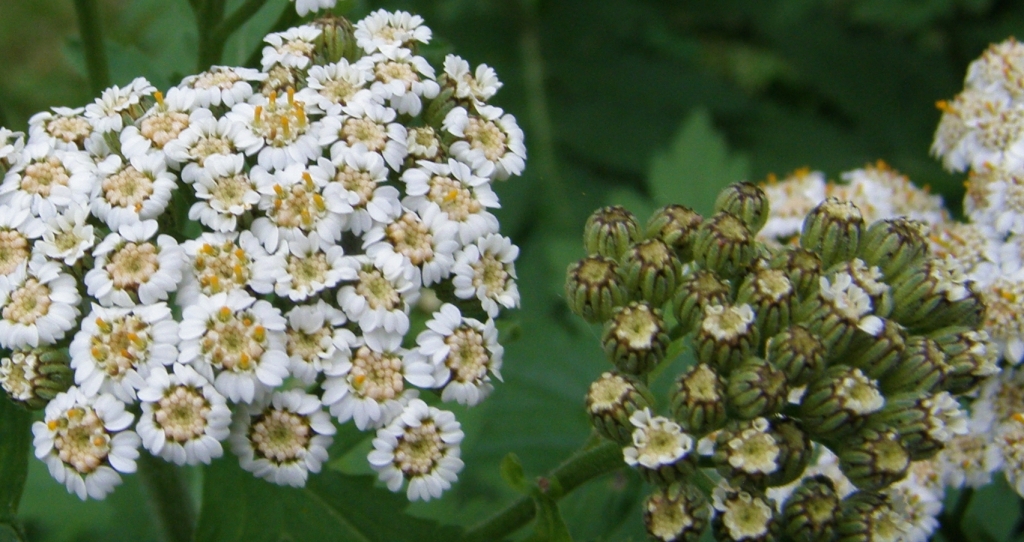
Grey-green, silky-textured, toothed leaves to 8 inches in length line 24 to 36 inch tall stems, which are topped by dense corymbes of ivory-white, yellow-stamened, yarrow-like flowers in June and July. Whole plant is pungently aromatic when touched.

Detail of flowers and bracted buds. Hill Farm, Macalister, B.C. - July 2011.

Tanacetum macrophyllum – Detail of flowers and bracted buds. Hill Farm, Macalister, B.C. – July 2011. Image: HFN

Detail of ray-and-disk composite flowers. Note small pollinator, mid-right. July 2011.

Detail of ray-and-disk composite flowers. Note small pollinator, mid-right. July 2011. Image: HFN

I recently came upon an interesting ethnobotanical report from Albania which reports that there is a traditional herbal use for Tanacetum macrophyllum. On St. George’s Day, May 6 – one of the most important rural religious festivals which is focussed around taking the flocks of sheep and goats to their summer pastures – this tansy in combination with nettles is rubbed on the goats’ udders in order to increase milk production. Also on St. George’s Day, a close relative, Tanacetum vulgare – Common Tansy, which we know as an introduced European species whose bright yellow button flowers are a common summer sight along rural Cariboo roadsides – is hung in Albanian and Macedonian stables and on butter churns as a good luck charm for abundant milk production.

Tanacetum macrophyllum has also been used to produce an essential oil which is being researched for its effectiveness as an antibacterial and antinflammatory.

If one doesn’t have a dairy goat around, or ambitions to pursue herbal medicine, one can still enjoy Big-Leaf Tansy in the garden. The early foliage is very lovely, being curled and frond-like with contrasting pale undersides, and the flower clusters quietly handsome in bloom. The bloom corymbs turn a mellow shade of greyish-brown as the florets fade; these can be clipped off for tidiness or allowed to remain on the plants, as they are not at all obtrusive.

Big-Leaf White Tansy forms a substantial clump in a year or two, reaching 2 feet in diameter and  3 to 4 feet in height. It is healthily vigorous but generally well-mannered. You may occasionally find a few seedlings, but they are easy to trowel out. Mature plants may be divided, the woody centers cut away, and the younger sections replanted.

This plant is good in mid-border as a contrast plant to showier-flowered things, and in the herb or wildflower garden.

Content in sun to light shade, and very happy with average garden conditions. The richer the soil the lusher it grows, but it is adaptable and can be quite drought tolerant if need be.

???????????????????????????????

Tanacetum macrophyllum – a look at the rather attractive foliage. Image: HFN


Read Full Post »

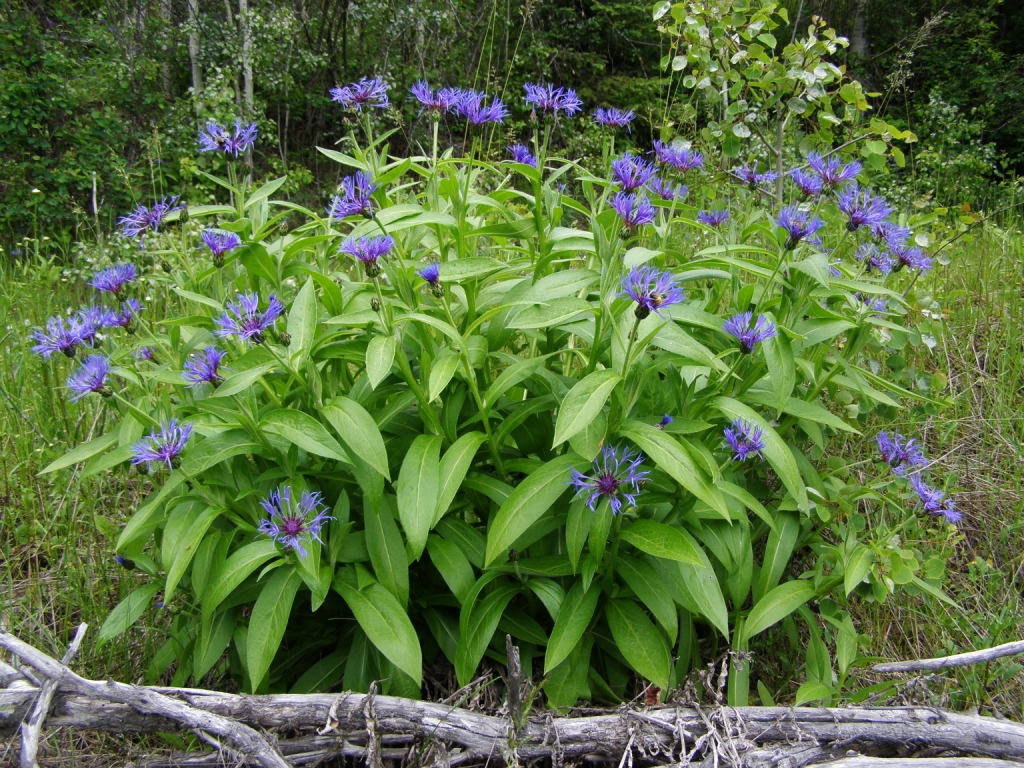
Perennial Cornflower blooming in late May, 2014 around the ruined foundation of an old ranch house near Roberts Lake.

Centaurea montana – Perennial Cornflower blooming in late May, 2014 around the ruined foundation of an old ranch house near Roberts Lake, northeast of Williams Lake, B.C. Obviously a relic of a one-time cherished garden, for nestled in the grass growing over the tumbled foundation stones we also found creeping sedums and a solitary Dianthus deltoides (Maiden Pink), as well as the ubiquitous rhubarb plants and a few straggly lilacs. Image: HFN

Perennial. Zone 2.  Asteraceae. Europe, “from the Ardennes in Belgium south to the Pyrenees in Spain and east to Poland and Yugoslavia, growing in subalpine meadows and open woods, flowering in May-July”, according to the reliable Roger Phillips and Martyn Rix, in their two-volume masterwork, The Random House Book of Perennials.

This is a clump former which spreads to 2 feet or so in diameter where happy, depending on stoloniferous underground stems to slowly expand its girth every year. Though not exactly shy about advancing on its garden neighbours, it is easy to keep in check in the garden by some judicious trowel work in the spring.

Deep green, silky-haired, broadly lanceolate leaves alternate up the multiple sturdy stems, which are topped by numerous black-bracted buds. These open into large, electric blue cornflowers in late May, and continue well into July.

Some years the plants may “bird’s nest” in heavy rainfall. If this happens, ruthlessly shear the whole plant back to 6 inches or so, and tactfully ignore it for a week or two; it will quickly recover and regrow into a much more tidy clump, and will usually rebloom later in the season.

An excellent bee plant and attractive to numerous species of butterflies.

Esteemed Ontario gardener Patrick Lima, in his 1987 book The Harrowsmith Perennial Garden, has this to say about the Mountain Bluet:

Early in June…and for almost a month, 2½ foot stems rise up, carrying the many dark blue thin-petalled blossoms that always remind me of little jets of flame.

Perennial cornflowers look best set in groups of three or more – a single plant makes little show – just back of front [in the border] in company with poppies, irises of any colour, dianthus and the like…They might be left out of smaller garden in favour of something showier…but are a good choice for next-to-no-maintenance flowerbeds that could include Siberian irises and daylilies.

Although they are not spectacular, perennial cornflowers are practically indestructible; A. Clutton-Brock says in Studies in Gardening (1916) that if the hardy cornflower “were not so easy, it would be prized, and it deserves to be more prized for its easiness.”

There is a white mutation of the common blue variety, ‘Alba’, which is very pretty, and a number of recent hybrids, of which the purple-centered, white-petalled ‘Amethyst in Snow’ shows great promise in my garden. There is also a golden-leaved, blue-flowered form, ‘Gold Bullion’, which looks rather interesting. These last two are patented hybrids from the venerable Blooms of Bressingham in England, and are often found in the “premium perennials” section of our better nurseries. (Try Richbar Nursery in Quesnel, and Art Knapp’s in Prince George.)

Flower bud detail showing the distinctive bracts. The Centaureas are also known as "Knapweed", and the highly invasive range Diffuse and Spotted knapweeds, Centaurea diffusa and Centaurea biebersteinii, are serious rangeland invaders, being highly unpalatable to grazers and browsers both wild and tame. We pulled some knapweed last year which appeared on the side of the railroad tracks which pass through Hill Farm, and the plants left a bitter residue on our hands even through our leather gloves, which took several days to completely subside despite numerous scrubbings. Our garden denizen Centaurea montana does not appear to be quite as unpalatable, but keep an eye on it and confine it to your garden, just to be on the safe side.

Flower bud detail showing the distinctive bracts. The Centaureas are also known as “Knapweeds” due to these overlapping bracts, and the highly invasive Diffuse and Spotted knapweeds, Centaurea diffusa and C. biebersteinii, are serious rangeland invaders, being completely unpalatable to grazers and browsers both wild and tame. We pulled some knapweed last year which appeared on the side of the railroad tracks which pass through Hill Farm, and the plants left a bitter residue on our hands even through our leather gloves, which took several days to completely subside despite numerous scrubbings. Our garden denizen C. montana does not appear to be quite as unpalatable – I have seen sheep eat it with great relish – but keep an eye on it regardless and confine it sternly to your garden, just to be on the safe side. Image: HFN

This Centaurea will be very familiar to those who garden in the Quesnel and Prince George regions, as it thrives in the cool, moist subclimates of the aspen-forested areas, and in some places has escaped gardens to form thriving naturalized colonies along road edges and in ditches, where it is very lovely in its long bloom season. There are some handsome specimens growing in Wells-Barkerville area gardens, and it grows up on the hillside behind the Barkerville Heritage Site buildings, where it coexists quite nicely with native lupines, Indian paintbrush (Castilleja), arnica and wild valerian.

The invasive plant people are keeping an eye on it, being concerned that it might some day become a pest, but I am not overly worried about it, as it has been grown in our region for well over a century, and its “naturalization” appears to be confined to areas of disturbed soil, or places where there have been previous gardens. In my own microclimate it has in fact proved rather difficult, apparently not caring much for my clay soil and sun-baked summers.

Sun to light shade; average soil and moisture. Very long-lived.

Naturalized at the site of an old garden, near Roberts Lake, B.C.

Naturalized at the gone-to-bush site of an old garden, near Roberts Lake, B.C. Image: HFN

Read Full Post »

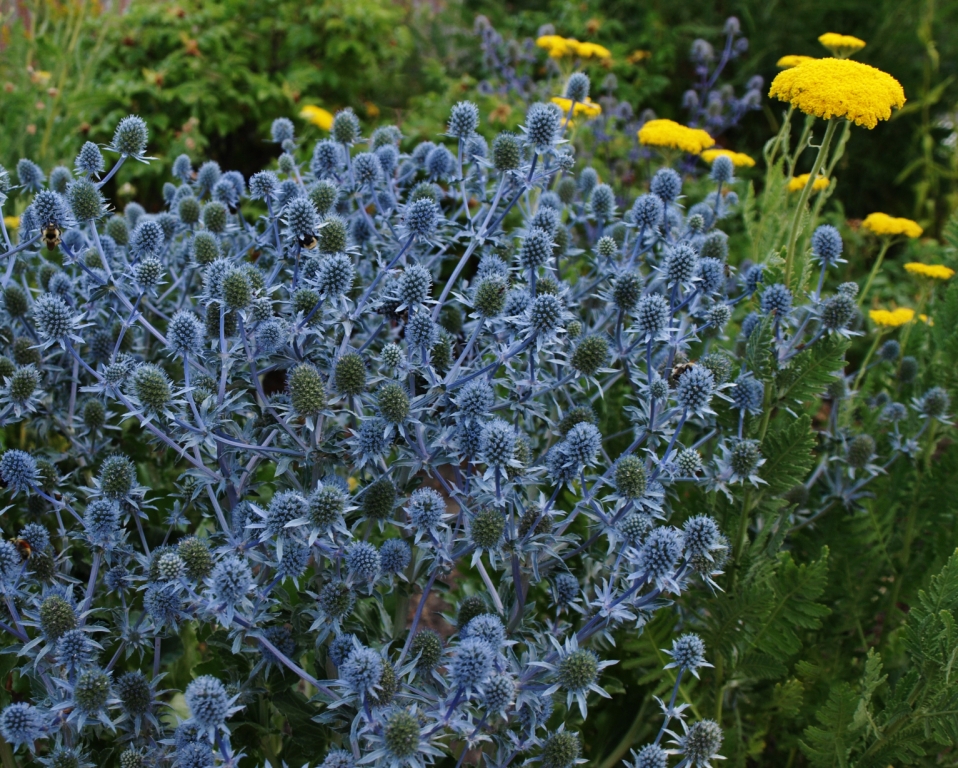
Eryngium planum 'Blue Cap" - thriving in less than ideal conditions at the 108 Heritage Site, Lac La Hache. We planted the raised perennial beds at the rest stop over 10 years ago with "tough, no-maintainence" plants, and it is quite interesting to see what has survived and, in some cases, thrived. This sea holly and Achillea filipendulina, Salvia nemerosa, Lychnis coronaria and Silene maritime, a goodly number of columbines, Erigeron 'Pink Jewel' and various sedums are hanging right in there. Exposed site, no supplementary water or fertilizer, and lots of traffic back and forth - we're pretty happy with how this planting has held up.

Eryngium planum ‘Blue Cap” – thriving in less than ideal conditions at the 108 Roadhouse Heritage Site, Lac La Hache. We planted the raised perennial beds at the rest stop there over 10 years ago with “tough, no-maintainence” plants, and it is quite interesting to see what has survived and, in most cases, thrived. This sea holly and Achillea filipendulina, Salvia nemerosa, Lychnis coronaria and Silene maritima, a goodly number of columbines, Erigeron ‘Pink Jewel’ and various sedums are hanging right in there. Exposed site, no supplementary water or fertilizer, and lots of traffic back and forth – we’re pretty happy with how this planting has held up. Photo taken in the late evening while stopping by for a quick break to stretch our road-trip weary legs, mid-August, 2012. Image: HFN

Perennial. Zone 2. Apiaceae. Central Europe, from Germany and Austria eastward to Russia; throughout the Caucasus Mountain region and into central Asia, where it grows happily in grassy meadows and on rocky, sun-baked hillsides.

I’ve been a die-hard fan of the sea hollies in general and this species in particular ever since my mother planted one out on her difficult-ground shale hillside north of Williams Lake over four decades ago. It self seeded about, and made a thriving colony, and provided untold hundreds of sturdy bloom stems which ended up being dried and made into everlasting wreaths and arrangements which Mom then gave to friends and sold at various arts-and-crafts sales.

It really is as blue as it looks, and the stems carry that cobalt blush as well, almost as if the whole thing were dusted with spray paint by someone seeking to enhance things.

Leathery, silvery-green, rounded leaves in basal rosettes send up 18-24” tall multi-branched stems topped by loose clusters of bristly, bracted, cone-shaped flower heads summer through fall.  Stems and flowers are flushed a deep electric blue. A very long season of bloom through summer into autumn.

An excellent cutflower and everlasting. A popular bee and butterfly flower, always alive with insect activity.

‘Blue Cap’ – translated from ‘Blaukappe’ – is a premium German selection of the species, and is even more compact and floriferous (and darker blue) than its attractive ancestor. A number of other E. planum cultivars have appeared in recent years, such as the very dwarf ‘Blue Hobbit’, and white forms such as ‘Silver Salentino’ and ‘White Glitter’.

A variegated form, ‘Jade Frost’, with pink-blushed, white-edged foliage, has been appearing in garden centres for a few years; I have a small planting of this cultivar and am at this point not terribly impressed, as one of the original trio mysteriously withered and died, and the other two are less vigorous than I had hoped for from this generally reliable species.

Sun; any soil; drought tolerant. Fantastic xeriscape plant. A generous self-seeder, but not a “runner” – individual plants stay put, and are tap rooted and very long lived. Oh – and it is reasonably deer resistant, too!

???????????????????????????????

Definitely approved by bees! A late evening forager on ‘Blue Cap’ Sea Holly at the 108 Roadhouse Heritage Site at Lac La Hache, B.C., mid-August, 2012. Image: HFN

Read Full Post »

Perennial. Zone 2. Lamiaceae. Native to Great Britain, Europe, West Asia, North Africa.

Deep green, pebbly-textured, rather pungently aromatic foliage is arranged in basal rosettes. The plant sends up numerous multi-branching stems to 2 ft. or so, which produce hundreds of large “dragon’s head” flowers from late spring into summer. These are a bright violet blue in the original species, and shades of indigo-violet, mauve-pink and white in a number of named cultivars.

Meadow Clary is very showy during its bloom phase; the spent flowers drop neatly off and new buds at the top of the bloom spikes open in succession for many weeks. These flowers are alive with bees and butterflies on sunny summer days, and are frequently visited by hummingbirds. Meadow Clary is also reported to be a deer resistant plant, which may be of interest if you are one of the many Cariboo gardeners besieged by our increasingly bold garden-invading deer population.

Historically, Meadow Clary was used by brewers as a substitute for true Clary Sage, Salvia sclarea, as a flavouring in beer making. Though there are a few mentions made in literature of its medicinal use, generally in cough mixtures and so on, Salvia pratensis is not considered a medicinal herb. Its centuries-old inclusion in gardens must therefore be assumed to be purely for the pleasure of its blooms, and quite possibly for its attractiveness to bees.

There are a number of modern named cultivars of Meadow Clary. ‘INDIGO’, a deep rich purple-blue, has received the coveted Royal Horticultural Society’s Award of Garden Merit. The ‘Meadow Ballet’ series is an excellent group, and includes ‘SWAN LAKE’ (pure white), ‘ROSE RHAPSODY’ (soft mauve-pink), ‘SWEET ESMERALDA’ (warm rich reddish violet), and ‘TWILIGHT SERENADE’ (soft violet blue). ‘MADELINE’ is a bi-coloured violet and white, and ‘MIDSUMMER’ is a pale violet-blue. There are numerous other pratensis cultivars available, especially in Germany, where the “meadow garden” incorporating ornamental grasses and grassland flowers is something of an art form. Some exciting new inter-specific crosses are being introduced which I will be watching for, such as a pratensis x sylvestris ‘ROYAL CRIMSON DISTINCTION’, a rich red-violet.

The original “unimproved” wild variety is also a very lovely thing!

Though the wild plants are reportedly very rare now in much of the former native range, Salvia pratensis and its cultivars are highly valued in ornamental gardens. I have grown this species and its cultivars for many years, and have found it easy, reliable and very lovely; it blooms with the earliest rugosa roses, and the rich violet blues, soft mauves and pure whites of the Meadow Clary set off the roses beautifully. Meadow Clary is also an excellent cutflower. Sun to very light shade; average soil & moisture. Drought tolerant once established. Mature plants are hardy and long lived, and self-sown seedlings are easy to either relocate to a desired location, or to weed out.

The plants will self-sow, but as the seeds take some time to fully ripen and drop, clipping off the bloom stalk when the last blossoms fall will prevent its seeding, if this is a concern. To purposely save seed for re-sowing, it is best to examine the maturing bloom stalks fairly frequently, and clip or pinch off the individual florets as the seeds, four small nutlets in a tight cluster, turn from tan to black. These should be further dried (I use paper lunch bags to allow for good air circulation) before storing away. Salvia pratensis germinates readily at warm temperatures, and the large seeds pressed gently into the surface of a flat of starter mix (light is beneficial to germination of all Salvias) should show sprouts within a few days.

Note: Though Meadow Clary has been grown worldwide in gardens for centuries as an ornamental, with the recent hyper-awareness regarding non-native (“exotic”) invasive species, there is some concern in parts of the United States that this species might naturalize and become a noxious weed in rangeland areas. It is therefore suggested that gardeners be aware of the self-seeding tendencies of their plants, and  prevent spread of Salvia pratensis (and, indeed, any ornamental plants) beyond the garden area. Clipping the bloom stalks after flowering is the best way to ensure this, though modest self-seeding within the perimeters of the garden is often encouraged by gardeners. I include this note not because I have found this species to be a problem in my garden, or in any others that I am aware off, but merely in the interests of “responsible gardening” at large.

Read Full Post »

« Newer Posts