• Home
  • ABOUT/FAQs
  • PLANT PORTRAITS
  • PLANT PORTRAITS INDEX – Search By Botanical Name
  • THE PLANT ARCHIVES & MASTER LIST ~ 1991-2022
  • THE TOMATO ARCHIVES ~ 1991 to 2025
  • This & That
  • Welcome!

Hill Farm Nursery

Cariboo-Grown & Cariboo-Hardy Perennials. Since 1991.

Myrrhis odorata – SWEET CICELY

November 12, 2014 by leavesandpages

Myrrhis odorata - Sweet Cicely - Hill Farm - June 2013. Image: HFN

Myrrhis odorata – Sweet Cicely – Hill Farm – June 2013. Image: HFN

Perennial. Zone 3. Apiaceae syn. Umbelliferae. Central Europe, the Pyrenees and the Caucasus. Widely naturalized in Europe and Great Britain. Myrrhis is from the Greek, in reference to the similarity of this plant’s aroma to that of the sap of the tropical myrrh tree (Commiphora species), much valued for perfumery. (The true myrrh was traditionally one of the costly gifts presented to the Baby Jesus by the Three Wise Men.) Odorata is from the Latin, “scented”.

I have never seen this lovely herb for sale in commercial nurseries in our area, which is why I was so thrilled to find it in a small roadside nursery near Bella Coola way back in 1998. I tucked it into a corner of the flower border, where it has maintained itself ever since, forming quite a vigorous colony of ferny, liquorice-scented foliage accented by lacy umbels of pure white blooms in spring.

The lacy flowers of Sweet Cicely are highly attractive to pollinating insects of all sorts. Hill Farm, May 2013. Image: HFN

The delicate flowers of Sweet Cicely are highly attractive to pollinating insects of all sorts. Hill Farm, May 2013. Image: HFN

I’ve transplanted seedlings – very carefully, for Myrrhis odorata has a long, brittle tap root – into various shady spots, where it happily settles in and adds its delicate leafiness to the general green tapestry effect. The blooms are followed by upright clusters of huge, light green seeds, which slowly darken to glossy black.
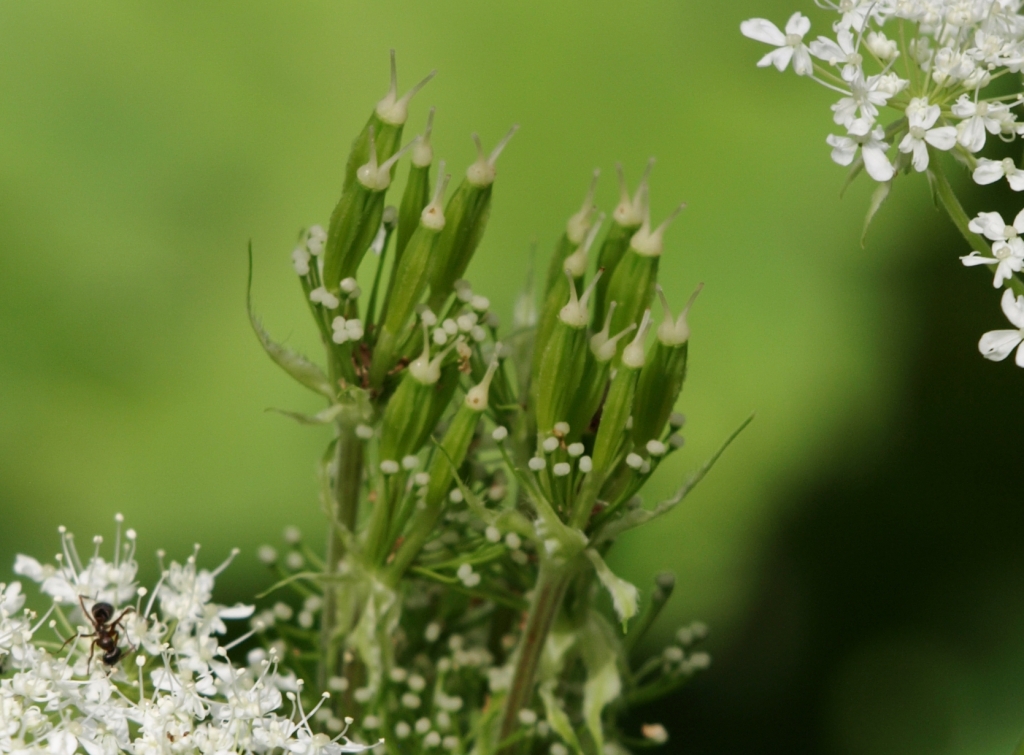
Sweet Cicely seed cluster - Hill Farm, May 2014. Image: HFN

Sweet Cicely seed cluster – Hill Farm, May 2014. Image: HFN

Where happy the plant reaches a substantial size, easily 2 feet or taller, and eventually several feet wide as the foliage expands through spring into early summer. Once blooming is finished, the plant may be shorn back to the ground, where it will re-sprout with renewed vigour and provide a pleasant backdrop for later-blooming flowers.

The texture of the foliage is delicately downy – it feels as soft as it looks. I have occasionally added it to cut flower bouquets for its ferny effect, but it isn’t really happy once cut, so I now mostly enjoy it in the garden.

Sweet Cicely has a long history of use as an herb, being strongly anise (licorice-like) scented in all of its parts, and having a very sweet flavour. It is one of the benign “innocent herbs” – edible in all of its parts, and free of potentially harmful components.

Myrrhis odorata will thrive in the sunny mixed perennial border, as it enjoys fertile soil and summer moisture. It can also be placed in quite deep shade, and, if encouraged to self-sow, will spread to fill in the area under high-pruned shrubs and trees.

I have not found Sweet Cicely to be particularly weedy – seedlings are easy to identify and easily plucked out – but it is a persistent plant once established (that taproot goes a long way down), so consider its siting carefully. Mature plants do not move well, so container grown starts and young seedlings are your best bet for bringing it into your own garden or for spreading it around.

Myrrhis odorata - Sweet Cicely - Hill Farm - June 2014. Image: HFN

Myrrhis odorata – Sweet Cicely – Hill Farm – June 2014. Image: HFN

Maud Grieve’s massive reference book, A Modern Herbal, first published in 1931, has these notes on Myrrhis odorata:

It is a native of Great Britain, a perennial with a thick root and very aromatic foliage, on account of which it was used in former days as a salad herb, or boiled, when the root, leaves, and seed were all used. The leaves are very large, somewhat downy beneath, and have a flavour rather like Anise, with a scent like Lovage. The first shoots consist of an almost triangular, lacey leaf, with a simple wing curving up from each side of its root. The stem grows from 2 to 3 feet high, bearing many leaves, and white flowers in early summer appear in compound umbels. In appearance it is rather like Hemlock, but is of a fresher green colour. The fruit is remarkably large, an inch long, dark brown, and fully flavoured. The leaves taste as if sugar had been sprinkled over them.

It is probable that it is not truly a wild plant, as it is usually found near houses, where it may very probably be cultivated in the garden. Sweet Cicely is very attractive to bees; in the north of England it is said that the seeds are used to polish and scent oak floors and furniture. In Germany they are still very generally used in cookery. The old herbalists describe the plant as ‘so harmless you cannot use it amiss.’ The roots were supposed to be not only excellent in a salad, but when boiled and eaten with oil and vinegar, to be ‘very good for old people that are dull and without courage; it rejoiceth and comforteth the heart and increaseth their lust and strength.’


Share this:

  • Click to share on X (Opens in new window) X
  • Click to share on Facebook (Opens in new window) Facebook
Like Loading...

Related

Posted in Herb, Mid Height, Perennial, Plant Portraits, Shade, Spring, White | Tagged Aromatic Herb, Fern-like Foliage, Foliage Interest, Myrrhis odorata, Shade, Sweet Cicely |

  • Header image:

  • Viola glabella. YELLOW WOOD VIOLET. Stanley, B.C., June 15, 2019.  Image: HFN

  • Contact Info

  • arcadiaborealis@gmail.com
    250-297-6553
  • Hill Farm Nursery / Arcadia Borealis Gardens is located in a rural area north of McLeese Lake, B.C. We are a working farm, and are not set up to accommodate visitors, but we are generally at all of the Williams Lake Farmers' Markets throughout the May till mid-October market season.

  • For 2025, we will be concentrating on expanding our market garden produce and annual vegetable and flower starts, but there will still be a selection of perennials on the table throughout the season.

  • Recent Posts

    • Viola jooi – TRANSYLVANIAN VIOLET
    • Physochlaina orientalis – ORIENTAL PHYSOCHLAINA
    • Claytonia lanceolata – SPRING BEAUTY, MOUNTAIN POTATO
    • Lewisia rediviva – BITTERROOT
    • Cephalaria tchihatchewii – TCHIHATCHEV’S CEPHALARIA
  • Archives

  • Enter your email address to follow this blog and receive notifications of new posts by email.

  • WILLIAMS LAKE SEEDY SATURDAY 2025

  • SATURDAY, MARCH 15th, 2025
    10 AM till 2 PM
    Thompson Rivers University Gymnasium
    1250 Western Avenue
    Williams Lake, B.C.
  • QUESNEL SEEDY SATURDAY 2025

  • SATURDAY, APRIL 26th, 2025
    9 AM till 3 PM
    Quesnel Seniors Activity Centre
    461 Carson Avenue
    Quesnel, B.C.
  • Williams Lake SEEDLING SATURDAY & EARLYBIRD FARMERS' MARKET

  • Kicking off the outdoor Market season!
    Saturday, May 3rd, 2025
    9 AM till 2 PM
    Outdoors at the Farmers' Market Site
    525 Proctor Street
    Next to Kiwanis Park and the Cariboo Memorial Recreation Complex
  • Affiliations

    Alpine Garden Club of British Columbia
    Alpine Garden Society (Great Britain)
    David Douglas Botanical Garden Society
    Growing North Cariboo Society (F.A.R.M.E.D.)
    North American Rock Garden Society (N.A.R.G.S.)

    Perennial Plant Association (P.P.A.)

    Seeds of Diversity Canada

  • Places to Visit:

    SCOUT ISLAND NATURE CENTRE, Williams Lake, B.C. An oasis of peace on the outskirts of a bustling industrial area. Excellent trail network; something to see 365 days of the year – wildflowers, birds, aquatic life and small mammals. Nature centre, resource library, knowledgeable & enthusiastic naturalists on site.

    DAVID DOUGLAS BOTANICAL GARDEN, Prince George, B.C. Located at the University of Northern British Columbia. A small but interesting perennial flower display garden, lilac display, waterfall & bridge, and the Alice Wolczuk Alpine Garden.

    GOODSIR NATURE PARK, Salmon Valley, B.C. 20 miles north of Prince George. 160 acre private nature reserve, 6 miles of trails, open to the public May-Oct. Wildflowers & trees; an active beaver pond; plant museum, guided & self-guided tours; excellent signage; some rare plants. Picnic tables, firepits & camping available. Entry free; donations welcome.

    OSOYOOS DESERT CENTRE, Osoyoos, B.C. 2 km of boardwalk through B.C.’s rarest ecosystem, the “pocket desert.” Wildflowers, birds, reptiles, small mammals. Guided & self-guided; small visitor centre.

    ANCIENT FOREST TRAIL, near Dome Creek, Robson Valley, B.C. (Along Highway 16, halfway between Prince George and McBride. Watch for large signs: “Ancient Forest”.) Hiking trails through ancient cedar forest, including a recently completed 1/2 kilometer wheelchair accessible boardwalk portion. Built by dedicated volunteers; a prodigious amount of planning and sheer hard work went into this trail system, and it shows. Worth a stop to walk the boardwalk; you will be inspired to come back and hike the wilder trails as well. Huge cedar trees, ferns, water features – a prime example of B.C.’s rare and endangered Inland Rain Forest. Interpretive signage at parking lot, outhouses, well-thought-out wheelchair unloading/loading area and beautifully designed boardwalk. Donation box.

  • Image & Content Re-Use Policy

    This website represents many years of experience and many hours of labour. We are pleased to participate in the free and open transfer of information over the World Wide Web, keeping the following in mind.

    Personal non-commercial use of our text and images is warmly encouraged for all, and for our nursery customers in particular. You may copy, print and store our info for your own purposes. If sharing, we ask that you please cite Hill Farm Nursery as the source.

    All images are taken by us and most of those (but not all) have the tag HFN (for Hill Farm Nursery) in the caption.

    All written material and HFN images are copyright Hill Farm Nursery. Fellow gardeners, plant groups, societies and associations, you are welcome to re-publish our material as long as it is cited, credited and/or linked.

    COMMERCIAL RE-USE POLICY: We request that you contact us for permission for COMMERCIAL re-use of any of our written and photographic content: bscharf@uniserve.com.

    High resolution jpegs of most images on this website are available for a fee.

Blog at WordPress.com.

WPThemes.


  • Reblog
  • Subscribe Subscribed
    • Hill Farm Nursery
    • Join 83 other subscribers
    • Already have a WordPress.com account? Log in now.
    • Hill Farm Nursery
    • Subscribe Subscribed
    • Sign up
    • Log in
    • Copy shortlink
    • Report this content
    • View post in Reader
    • Manage subscriptions
    • Collapse this bar
 

Loading Comments...
 

    %d